Book
From AlexBrownRacing
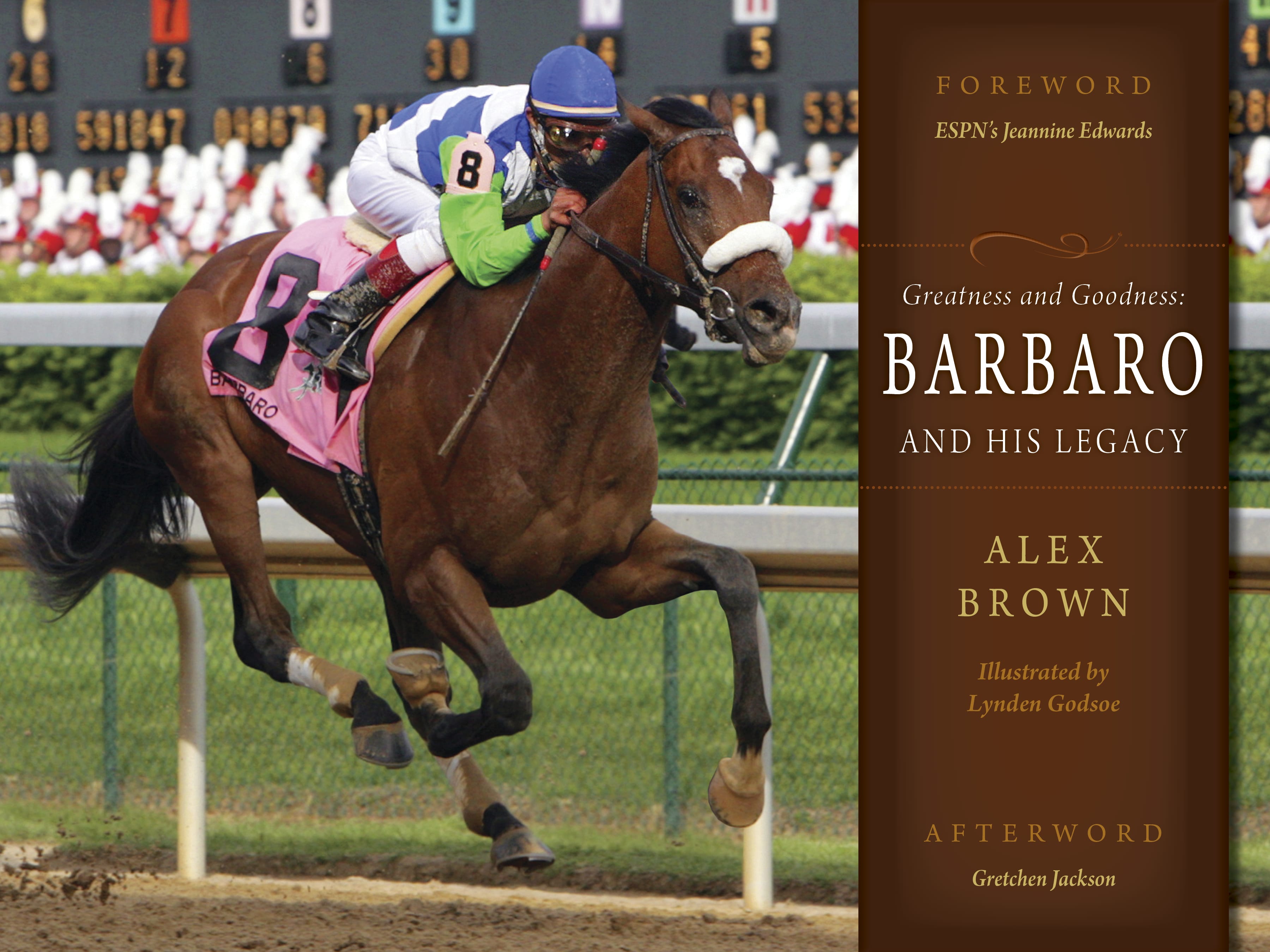
Book Project. I had planned to write a book. I have authorization from the Jacksons to do so. I have not yet been successful in getting a publishing deal. Here is the book proposal.
In the meantime, I am going to use this space to develop the content.
Working Title: Greatness and Goodness: Barbaro and his Legacy.
Or: Raising a million, building a community and affecting change, thanks to one horse.
Chapter Outline.
Contents |
Chapter 1: Barbaro and Barbaro
Much more to develop
Why was Barbaro so special? I investigate what it was about Barbaro that captured the imagination of the public at large. I will begin with his race record and establish that he was a horse of a kind we had not seen for many years (since Secretariat, 1973). I will then discuss other characteristics that became apparent during his stay at The New Bolton Center. I will draw from interviews with Michael Matz, Peter Brette, Dr. Richardson and Gretchen and Roy Jackson.
I will then highlight my experiences with Barbaro, expanding on my visits with Barbaro at New Bolton Center and my observations of Barbaro training at Fair Hill. These experiences will be used to help me further identify how Barbaro affected those around him and Fans of Barbaro.
Chapter 2: Team Barbaro
Much more to develop
I will explore each of the main characters who are Team Barbaro. They are: Michael Matz, Peter Brette, Dr. Kathy Anderson, Dr. Dean Richardson, Mr. and Mrs. Jackson, Edgar Prado and Eduardo Hernandez. I will highlight the character of these people, as well as their observations regarding Barbaro, via interviews. I have direct access to each member of Team Barbaro. I plan to characterize the unique qualities of those who surrounded Barbaro and make the case that this was a part of the uniqueness of Barbaro himself and a cause for the Barbaro effect and subsequent emergence of Fans of Barbaro.
Chapter 3: Tim Woolley Racing
Draft version
Tim Woolley is a racehorse trainer at Fair Hill. I worked for Tim as an exercise rider and managed his web-site Tim Woolley Racing (TWR). I will document how TWR became “Barbaro central”, the connector between Barbaro, Team Barbaro and what emerged as the group labeled “Fans of Barbaro”. I discuss a little history of TWR, the decision to follow Barbaro and then how it became the place for all Barbaro news. Some of this relates to marketing tactics as well as communication ideas. I also note the growth of TWR after Barbaro’s passing, that is related to the continued growth of Fans of Barbaro in pursuit of Barbaro’s legacy. Finally I discuss the transformation to Alex Brown Racing (ABR) and the development of related sites including a Facebook Group, YouTube Group, Twitter and Flickr Group.
Chapter 4: Fans of Barbaro
Draft version
I describe how Fans of Barbaro (FOB) has emerged. Who FOBs are and what is unique about this group. I explore the growth pains of this group and some of the management issues. There is some interesting leadership content in this chapter. I will include FOB interviews, identify the ‘who and why’ of FOB and what it is about Barbaro that affected them. This will tie in with Chapter 1. I also explore the impact of FOBs. I highlight FOBs efforts regarding saving horses from slaughter (money raised, horses saved, which is over $1.1 million and 2,800 at this point). I cite media examples that have covered Fans of Barbaro (Washington Post, ESPN and Seattle Times).
I will explain why this book does not focus on Laminitis Research (non controversial, no one can argue it is not important to cure this wicked disease) but focuses on horse rescue, horse slaughter and horse racing issues, which are controversial. I will also note Barbaro’s impact on New Bolton Center, University of Pennsylvania and Veterinary medicine in general.
Chapter 5: Horse Rescue
Draft version
I survey the horse rescue industry, establish Fans of Barbaro’s impact on this industry and the need for horse rescue within the horse racing industry. I highlight the different types of rescues and how each functions, this includes their interaction with horses coming directly from the racetracks. I examine why the horse racing industry appears ambivalent to the plight of horses which no longer serve the industry. I highlight firsthand case studies, horses rescued that were on their way to slaughter. I examine the path a horse takes from the racetrack to the slaughterhouse.
I explore why horse rescues compete with each other, despite there being an abundance of horses that need rescuing. I identify the fundamental philosophical issues that horse rescues have difficulty with: to purchase at auction versus supporting kill buyers; guaranteeing the forever life of a rescued horse versus the rescue itself; hoarders; private versus non-profit rescues and so forth.
Chapter 6: Horse Slaughter
Draft version
I look at the horse slaughter issue as it has evolved during the three years of FOB involvement. I address how Washington works in terms of passing legislation. I look at the FOB impact within the wider anti horse slaughter community. And note some of the issues regarding working with Animal Welfare Groups. I explain the horse slaughter pipeline, what is wrong with horse slaughter, the justifications put forth by the pro-slaughter lobbies for horse slaughter, as well as the real reasons we have horse slaughter. I identify who the pro-slaughter lobbies are. I explore horsemen who are pro-slaughter and why. And I make suggestions regarding moving the horse slaughter issue forward.
We currently have no domsectic slaughter, however passing the anti slaughter bills at the Federal level is critical as this will result in the end of transport to slaughter making it illegal to not only slaughter horses within the US but to ship horses to Mexico and Canada for slaughter.
Chapter 7: Horse Racing
Have not started
I will establish that horse racing in the US is a dying sport while horse racing thrives in other locations, including Europe, Asia and Australasia. I will discuss the problems horse racing faces in the US, many of these problems have been highlighted by the scrutiny of the Barbaro effect. I will establish why each is a problem, explore the root causes to each of the problems and determine what would need to happen in order to fix each of the problems. The problems that will be addressed are: a. Lack of central governance, b. claiming race system, c. whip rule, d. escalating drugs / steroids, e. sales issues, f. track surfaces, g. race track training issues, h. early retirement and breeding issues, i. mega owners and mega stables, j. marketing of horse racing.
Chapter 8: Epilogue Nicanor
Have not started
Things were good (Seabiscuit, Secretariat), things can be good (Barbaro). How can we shift back to the glory of the sport of horseracing. Make it about the horse.
I will also expand on my stays in Kentucky working at Keeneland) and Arkansas (working at Oaklawn Park) where horse racing remains a major sport. Horseracing is covered by the local media, horseracing fans flock to the races and the horses and horsemen are top class.
Appendix: First Eight Weeks at New Bolton Center
Completed
Barbaro's first eight weeks at New Bolton Center, as reported on Timwoolleyracing.com
These updates not only provide a very detailed summary of Barbaro's first eight weeks at New Bolton Center, but they also served as the platform that created Fans of Barbaro.
Week1 Sunday May 21 - Saturday May 27
Week2 Sunday May 28 - Saturday June 3
Week3 Sunday June 4 - Saturday June 10
Week4 Sunday June 11 - Saturday June 17
Week5 Sunday June 18 - Saturday June 24
Week6 Sunday June 25 - Saturday July 1
Week7 Sunday July 2 - Saturday July 8
Week8 Sunday July 9 - Saturday July 15
Week9 Sunday July 16 - Saturday July 22
Feedback: Barbaro's First Eight Weeks at NBC
