
Preakness 2025 Champion Journalism: Can McCarthy And Rispoli Do It Again This Year?
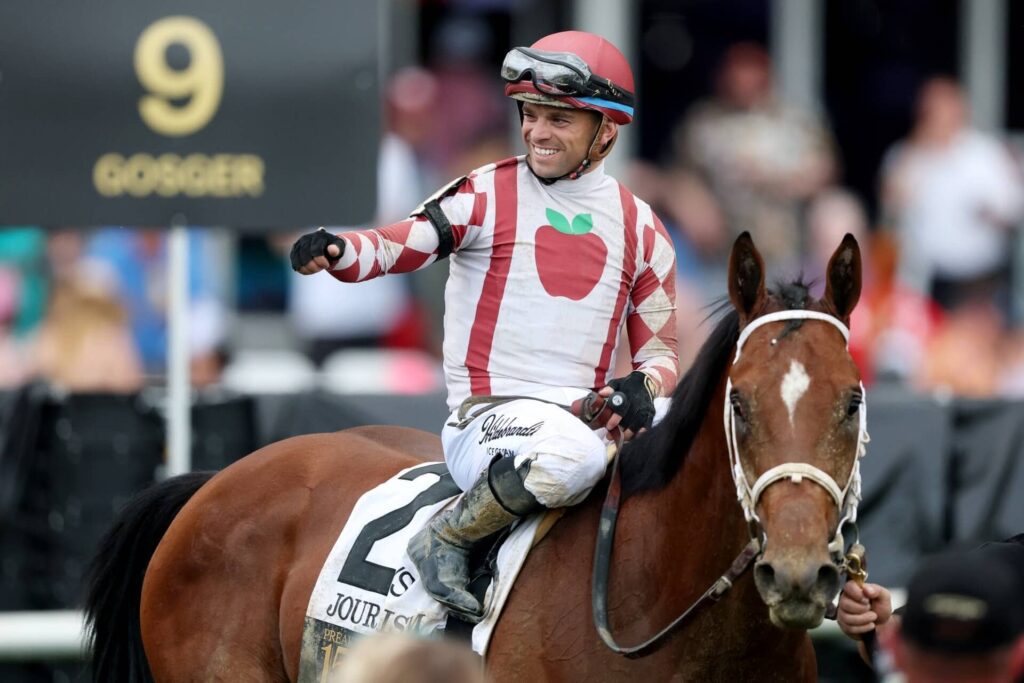
Preakness 2025 Champion Journalism still matters because his victory was not a soft, ceremonial moment in the Triple Crown calendar. It was a demanding test of pressure, race-riding nerve, and trainer judgment, and it left Michael McCarthy and Umberto Rispoli with a new professional standard to carry forward. The horse cannot return as a 3-year-old to win the same race again, but the larger question remains: can McCarthy and Rispoli reproduce that kind of big-race excellence when the sport turns to them again?
Why Preakness 2025 Champion Journalism Still Matters
Journalism’s Preakness win had the quality that makes a Classic result linger. He did not simply cruise through a perfect setup. He had to fight, recover, and finish with enough authority to turn a difficult stretch run into the defining victory of his campaign.
That matters because the Preakness is not just a follow-up to the Kentucky Derby. It is a compressed test of recovery, fitness, pace, and timing. Horses who perform well in the Derby must come back quickly. Trainers have to judge whether the horse is ready. Jockeys must ride with ambition without turning impatience into error.
The significance of Preakness 2025 Champion Journalism is that the win gave McCarthy and Rispoli a shared identity at the highest level. McCarthy gained another major Classic marker after his earlier Preakness success with Rombauer. Rispoli gained the kind of Triple Crown breakthrough that can reshape how owners, fans, and rival barns see a jockey.
The question now is not whether the same moment can be replayed. Racing rarely works that way. The question is whether the same discipline that produced Journalism’s victory can show up again under different conditions, with different horses, and with a new season asking new questions.
What Made Journalism’s Preakness Win So Compelling
Journalism arrived at the 2025 Preakness with serious credentials. He had already shown high-level ability and had finished second in the Kentucky Derby. That Derby effort gave him a strong claim, but it also made the Preakness more demanding. Coming back in two weeks after a major race is not a small ask.
His victory at Pimlico showed resilience. He covered the 1 3/16 miles in 1:55.37 and won by a half-length over Gosger, with Sandman third and Goal Oriented fourth. The result gave the race a clean finish on paper, but the performance felt more rugged than tidy. Journalism had to earn the lane, answer pressure, and sustain the final drive.
That is the kind of win that reveals more than class. It reveals temperament. Some horses have talent until the race becomes uncomfortable. Journalism showed he could stay engaged when the situation became tight. In a Triple Crown race, that matters as much as raw speed.
Rispoli’s ride deserves serious attention. He did not panic when the race demanded patience, and he did not hesitate when the time came to ask. The difference between those two instincts is where top-level riding lives. A jockey must feel the horse beneath him, read the leaders, judge the pace, and commit before the opening closes.
McCarthy’s work was quieter but just as central. The trainer had to bring Journalism into the Preakness ready for a second major effort after the Derby. That requires preparation, fitness, and a clear sense of the horse’s condition. The public sees the finish. The barn builds the finish long before the gate opens.
Can McCarthy And Rispoli Do It Again This Year?
The phrase “do it again” needs a precise answer. Journalism cannot repeat as Preakness winner because the race is limited to 3-year-olds, and his 2025 Classic season has already passed. So the question is not whether Journalism can defend the trophy. The question is whether McCarthy and Rispoli can recreate the same execution in another major spot.
That is the more interesting question anyway. A single great race can come from talent and circumstance. Repeated big-race success requires judgment, opportunity, and the ability to make strong decisions when public attention is loud.
For McCarthy, the next step is about proving that Journalism was not only a brilliant individual result but part of a broader training profile. He has already shown he can win the Preakness more than once. The challenge is to keep producing horses capable of entering Grade 1 races with the right condition and the right plan.
For Rispoli, the challenge is slightly different. Jockeys depend on mounts, and even elite riders cannot win major races without the right horse. Yet a jockey’s reputation grows when he turns opportunity into performance. Journalism gave him a new level of credibility in American racing. The next major ride will test whether that credibility becomes sustained momentum.
Could they do it again? Yes, but not by chasing a copy of Pimlico. They would need a new horse, a different race shape, and the same calm under stress. Racing rewards adaptation, not nostalgia.
Why Journalism’s Victory Could Reshape The Preakness Conversation
The 2025 Preakness helped define Journalism’s place among the leading 3-year-olds of his crop. He was not just a horse who found one perfect afternoon. His broader form included major California success, the Kentucky Derby runner-up finish, and later relevance beyond the Preakness. That gives the win stronger context.
A Classic victory can sometimes be treated as a standalone image. Journalism’s was more than that. It connected to a season in which he consistently belonged in elite company. That matters when assessing McCarthy and Rispoli. They were not trying to manufacture a miracle from an unproven runner. They were managing a horse with legitimate quality.
Still, quality alone does not win the Preakness. The race asks for tactical placement and physical readiness. The Derby-to-Preakness gap can expose even good horses. Some lose sharpness. Some fail to recover. Some find the shorter race less forgiving. Journalism handled that transition, and that is the evidence behind the praise.
The best way to understand the win is through three layers:
| Element | Why It Mattered |
|---|---|
| Trainer Preparation | McCarthy had Journalism ready to return quickly after the Kentucky Derby. |
| Jockey Execution | Rispoli judged the race calmly and found the decisive late response. |
| Horse Quality | Journalism had the class and stamina to sustain pressure at Classic level. |
| Race Context | The Preakness tested recovery, positioning, and courage after Derby week. |
That table explains why the victory still carries weight. It was not built on one factor. It came from a combination of horse, rider, trainer, and moment. Remove one part, and the race may look very different.
The McCarthy Factor
Michael McCarthy’s career already had a Preakness signature before Journalism. Rombauer’s 2021 victory gave him a major place in the race’s modern story. Journalism made the connection deeper. A trainer with two Preakness wins has earned more than a passing mention.
What stands out is McCarthy’s ability to bring horses into major races with the right balance. He is not a trainer defined by noise or spectacle. His best work reads as measured, patient, and grounded in the horse’s needs. That approach can be easy to overlook until the result arrives.
Journalism’s win reinforced that profile. The colt was fit enough to sustain his run, composed enough to handle pressure, and well-placed enough to remain dangerous late. That reflects a training program built around clarity rather than theatrics.
The next challenge for McCarthy is maintaining that standard across new opportunities. Racing can be unforgiving. A trainer’s past success raises expectations but does not provide the next horse. Owners still need to supply talent. Horses still need to progress. Big races still require the right strategy.
That is why the “can he do it again” question should be framed carefully. McCarthy has already shown that he can. The real question is whether the right horse arrives at the right time again. In racing, that is always the hidden risk behind every confident prediction.
The Rispoli Factor
Umberto Rispoli’s Preakness win with Journalism was a landmark moment in his American career. It gave him his first Triple Crown race victory and made him the first Italian jockey to win one of the American Triple Crown races. That kind of achievement changes a rider’s profile immediately.
Rispoli had already established himself as a skilled international rider, but the American Triple Crown has its own weight. It is watched differently. It is remembered differently. A winning ride in that setting can reshape a jockey’s reputation in a way that ordinary stakes wins cannot.
The ride itself showed composure. Journalism did not need a passenger. He needed a jockey who could feel when to wait, when to ask, and when to trust the horse’s late drive. Rispoli gave him that. The result was a performance that looked both forceful and controlled.
Repeating that type of success depends on access to the right mounts. That is the hard truth for every jockey. Talent matters, but so does the horse beneath the rider. After Journalism, Rispoli’s job is to keep converting serious opportunities into results. That is how one breakthrough becomes a broader legacy.
There is also a mental element. Winning a Triple Crown race can create confidence, but it can also create expectation. The best riders do not let either emotion alter their focus. They ride the next race, not the memory of the last one.
How Golden Tempo Changes The 2026 Racing Conversation
The 2026 Triple Crown picture changed sharply when Kentucky Derby winner Golden Tempo skipped the Preakness, ending that year’s Triple Crown bid. That decision created a useful contrast with Journalism’s 2025 path. Journalism returned two weeks after the Derby and won. Golden Tempo’s connections chose recovery instead.
That contrast should not be reduced to courage versus caution. It is about horsemanship. Different horses require different management. Journalism was ready for the quick return. Golden Tempo’s team decided their horse needed more time. Both decisions can be defensible when rooted in the horse’s actual signal.
That is why the comparison matters. It shows how difficult the Preakness decision can be. The public wants continuity. Trainers must decide whether the horse can handle it. Owners must balance ambition, health, reputation, and value.
Readers looking at that modern campaign debate can place Journalism’s 2025 performance beside Golden Tempo’s Preakness decision to see how quickly the Triple Crown narrative can change. Journalism’s win showed what happens when the quick return works. Golden Tempo’s absence shows why the quick return cannot be assumed.
That makes McCarthy and Rispoli’s achievement look stronger. Their win came inside the hardest part of the calendar, not after a long reset. The Preakness compresses time, and compressed time exposes weakness.
What This Means For The 2026 Preakness
The 2026 Preakness has a different shape because it is being held at Laurel Park while Pimlico undergoes redevelopment. That venue shift adds another layer of uncertainty to a race already missing the Derby winner. It also creates opportunity for a new horse, trainer, or rider to seize the stage.
The official frame around the Preakness Stakes now carries extra interest because the event has to maintain its identity in a temporary setting. Laurel Park is not simply a background change. Track rhythm, local familiarity, surface behavior, and race-day routine can all influence execution.
This is where Journalism’s 2025 win remains relevant. It reminds us that the Preakness winner is not always the horse with the easiest story. It is the horse whose connections handle the moment best. That means preparation, pace, trip, and decision all matter.
A Preakness without the Derby winner may feel less dramatic to casual fans, but it can be more interesting to serious handicappers. The field becomes more open. Race shape becomes harder to predict. A new contender can emerge without having to measure himself directly against the Derby champion.
That is why McCarthy and Rispoli still belong in the conversation, even if Journalism is not part of the 2026 Preakness. Their 2025 win is the recent benchmark for how a trainer and jockey can turn a high-pressure race into a defining professional moment.
What Fans Should Watch Next
Fans should watch Journalism’s older-horse path, McCarthy’s next major 3-year-old prospects, and Rispoli’s biggest race opportunities. Those three tracks will determine whether the 2025 Preakness becomes a single brilliant chapter or the start of a larger professional arc.
For Journalism, the question is whether his Classic form continues to travel. Horses can change between 3 and 4. Some mature into stronger older runners. Others never quite reproduce the intensity of their 3-year-old season. His next major starts will show whether the Preakness was a peak or a foundation.
For McCarthy, the key is talent development. A trainer cannot win Classic races without the right horse, but the right horse still needs expert placement. McCarthy’s reputation gives him a stronger case with owners, but reputation must keep producing results. That is the challenge.
For Rispoli, opportunity is everything. If he continues to land major mounts, Journalism may become the ride that opened the next stage of his career. If those opportunities narrow, the Preakness will remain a brilliant highlight rather than a launching point. That is the practical reality of jockey careers.
For the sport itself, the lesson is simple. The Preakness remains powerful because it tests readiness under pressure. Journalism passed that test in 2025. The next horses and riders will have to pass it in their own way.
The Real Measure Of A Repeat
Preakness 2025 Champion Journalism still matters because the win gave McCarthy and Rispoli something more durable than a trophy. It gave them proof that they could succeed when the Triple Crown stage demanded preparation, courage, and control. That proof now follows both men into every major racing conversation.
Can they do it again this year? Not in the literal sense of bringing Journalism back to the Preakness. The rules and the calendar have moved on. But they can repeat the professional standard: the right horse, the right preparation, the right ride, and the right judgment under pressure.
That is the real measure. Racing is too complex for simple sequels. Horses change, races change, tracks change, and the public narrative changes with them. What lasts is the method behind the success.
Journalism’s Preakness victory showed a horse brave enough to answer, a trainer patient enough to prepare him, and a jockey sharp enough to deliver when the opening came. If McCarthy and Rispoli can keep finding that combination, the Preakness 2025 Champion Journalism story will not stand as one isolated peak. It will become the foundation for a larger legacy, built one demanding race at a time.