
Forever Young Won Easily At Belmont—But Keeneland Will Ask Much More
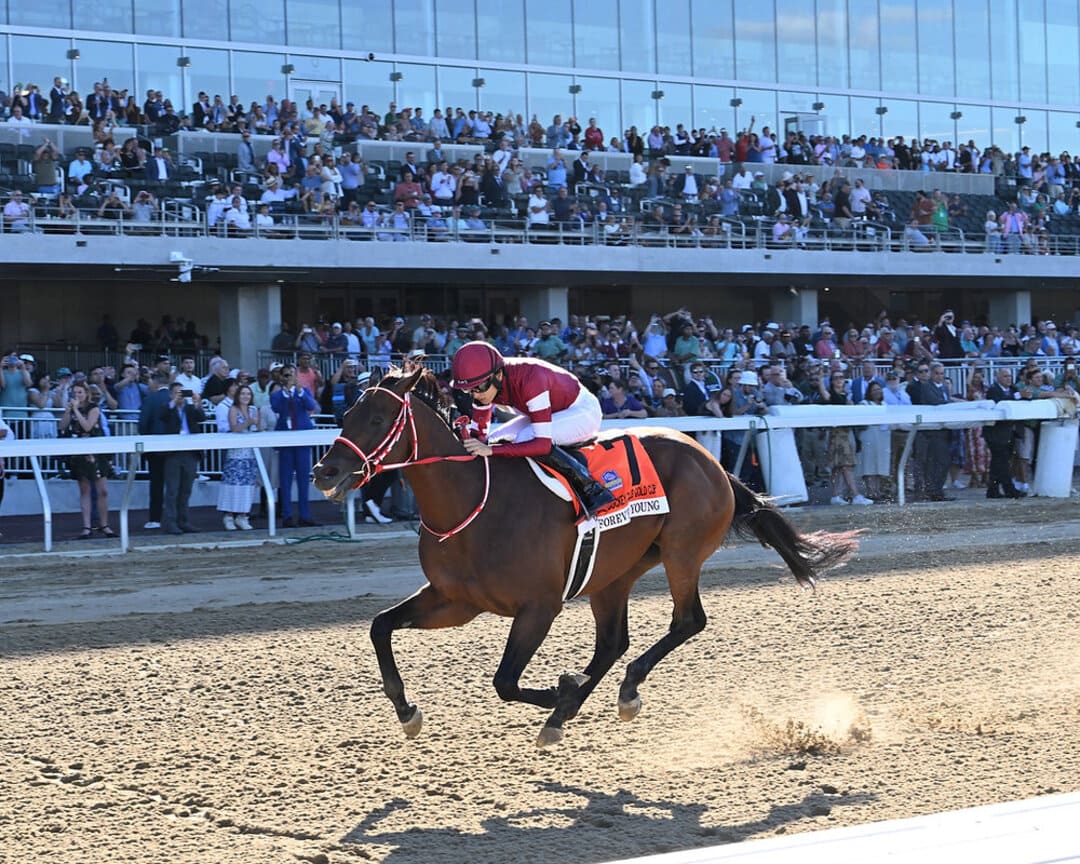
The Forever Young Breeders’ Cup Classic conversation should have become simpler after Friday’s Jockey Club Gold Cup. Instead, a 3 1/4-length victory at the new Belmont Park created an unusual problem: Forever Young won comfortably without proving that the version needed to defend his Classic title has arrived yet.
That is not criticism of a horse returning from six months away. It is the reason the performance deserves a closer look. Forever Young achieved the immediate objective, but his connections clearly treated Belmont as preparation rather than a finished product. That distinction was already central to the Jockey Club Gold Cup buildup, where conditioning, distance and adaptation mattered as much as reputation.
Forever Young Breeders’ Cup Classic Prep Did Its Basic Job
Forever Young was supposed to win Friday, particularly after scratches reduced the Grade 1 Jockey Club Gold Cup to four starters.
He did.
The Japanese star tracked Phileas Fogg through a controlled early tempo, moved past him approaching the stretch and finished 3 1/4 lengths clear of Stars and Stripes. The final time for 1 1/4 miles was 2:01.23, and the victory improved Forever Young’s career record to 12 wins from 16 starts.
As a result, this cannot be framed as a disappointing comeback. Forever Young handled the distance, defeated the horses placed in front of him and gained the competitive work his connections wanted before Keeneland.
The question is what the win actually proved.
A four-horse field running at a moderate pace is very different from a Breeders’ Cup Classic containing deeper speed, stronger tactical pressure and horses specifically trained to peak on championship day.
Belmont confirmed fitness. It did not settle superiority.
Yahagi’s Reaction Changes How The Win Should Be Read
Trainer Yoshito Yahagi made the post-race interpretation unusually clear. He was fully satisfied with winning, but said he was only around 50 percent satisfied with Forever Young’s actual performance.
That is a striking assessment after a Grade 1 victory.
Forever Young was estimated by his camp to be around 80 percent physically fit, while the long layoff appeared in smaller details. Most notably, he remained on his left lead through the stretch rather than changing leads as he normally would.
Those imperfections matter because this was always meant to be a bridge rather than a destination.
Jockey Ryusei Sakai also would have preferred a stronger pace to better replicate the conditions Forever Young could face in the Classic. Instead, the race became a controlled comeback where Forever Young’s class was sufficient to overcome circumstances that did not necessarily force him to show his championship ceiling.
That leaves significant improvement available, which can be interpreted as either encouraging or cautionary depending on the price.
Belmont’s New Dirt Makes The Numbers Harder To Trust
Normally, handicappers would use the clock and speed figures to establish a clearer benchmark.
Belmont complicates that process.
Friday was the opening day of racing at the rebuilt venue, meaning analysts have very little evidence for how the new main track translates across distances, pace scenarios and weather conditions.
Forever Young earned a 105 Beyer Speed Figure, but even his own camp expressed uncertainty about how to evaluate the final time because the dirt surface was so new. His assistant trainer Yuki Araki described the track as demanding, while other horsemen also indicated that the surface was playing differently from what their horses had previously experienced.
That makes the Belmont number useful but incomplete.
A 105 Beyer shows Forever Young did not simply stroll around the track. But treating it as a precise forecast for Keeneland would ignore the context. Surface speed, race shape and the quality of opposition can all change dramatically before October 31.
The comparison is more useful when the race is broken into what it answered and what remains unresolved.
| Belmont Signal | What Forever Young Showed | What Remains Unclear |
|---|---|---|
| Result | Won by 3 1/4 lengths | Strength against a deeper Classic field |
| Distance | Handled 1 1/4 miles comfortably | Response to stronger pace pressure |
| Fitness | Returned successfully after six months | Whether he can reach peak form by Oct. 31 |
| Speed figure | Earned a 105 Beyer | How the new Belmont surface affected the number |
| Stretch mechanics | Finished clearly best | Failure to switch leads showed some rust |
| Race shape | Stayed close to moderate pace | Ability to handle a crowded championship trip |
The table is why the performance deserves neither dismissal nor overreaction. The right reading sits between the two.
The Small Field Made Victory Easier To Manage
The original Gold Cup field was deeper before scratches changed its character.
Forever Young ultimately faced Stars and Stripes, Baeza and Phileas Fogg. With only four horses remaining, traffic risk disappeared almost completely, and Sakai could keep Forever Young outside and within striking distance without sacrificing position.
That is almost the opposite of the problem he could face at the Breeders’ Cup.
The **2026 championship schedule places the Breeders’ Cup at Keeneland on October 30-31, with the Classic contested on Saturday. Championship fields can accommodate as many as 14 starters, creating a fundamentally different tactical equation.
A bigger field introduces kickback, post-position pressure, contested early position and the possibility that a rider cannot simply place a horse wherever he wants.
Forever Young has proven internationally that he can handle difficult racing environments. Belmont did not require him to prove it again.
Winning The Prep Is Different From Winning The Championship
Prep races create a strange handicapping problem because the best possible performance is not necessarily the fastest possible performance.
Connections want enough work to advance fitness without emptying the tank. They want a competitive race without creating a physical setback five or six weeks before the real target.
Forever Young’s Belmont performance fits that description almost perfectly.
He won. He received 1 1/4 miles of race conditioning. He came out of the race in good order, though his camp said he was somewhat tired the following morning. The plan is for him to remain at Belmont before shipping to Keeneland on October 20.
From a training perspective, that looks constructive.
From a betting perspective, there is still uncertainty.
If the market treats the 3 1/4-length margin as proof that Forever Young has already returned to championship form, the price could become less attractive. If bettors focus too heavily on Yahagi’s dissatisfaction and the modest pace, they could underestimate how much improvement remains available.
That tension is exactly what makes the performance useful.
Keeneland Will Provide The Real Answer
The next month matters more than Friday’s winning margin.
Forever Young now has competitive foundation beneath him after a six-month layoff. His connections have identified areas that can improve. They have also chosen to keep him in New York long enough to build from the race rather than immediately changing environments.
The signals from here are straightforward: training progression, how sharply he finishes his serious works, whether the lead-change issue disappears and, eventually, the Classic draw and projected pace.
Belmont gave Forever Young what a prep is supposed to give an elite horse—fitness, confidence and a clean path forward.
It did not make October 31 predictable.
The Forever Young Breeders’ Cup Classic case is stronger because he returned with a Grade 1 victory and weaker only in the sense that the performance exposed how much projection remains between a four-horse prep and a championship race.
That is what Keeneland will settle. Belmont proved Forever Young remains very good. The Breeders’ Cup will determine whether he is ready to be great again.