
Why U.S.S. Valor Is Skipping the Breeders Cup Juvenile
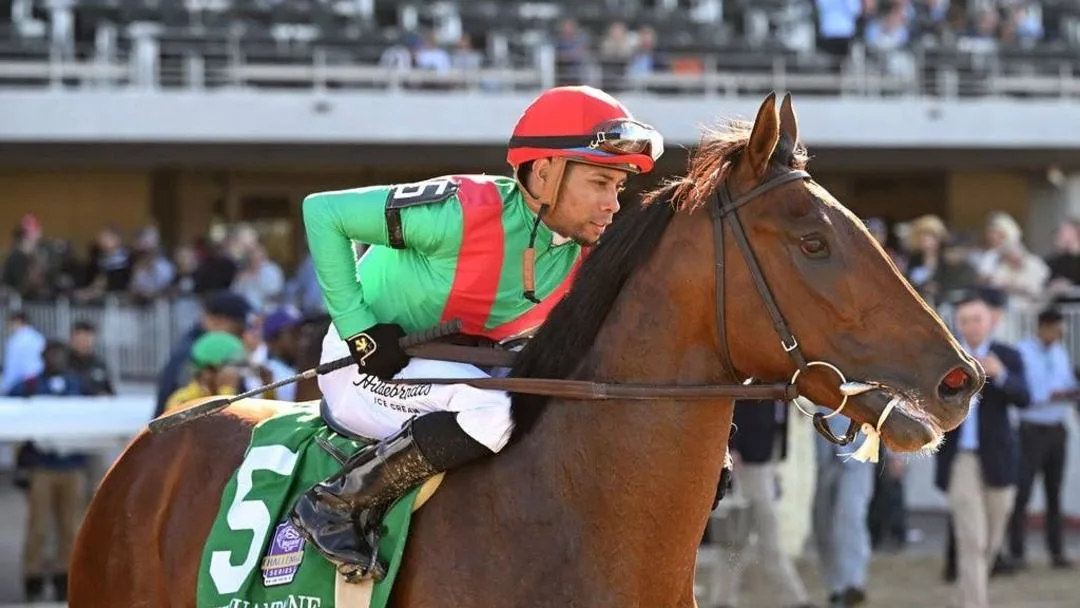
U.S.S. Valor did almost everything a two-year-old could do to demand another major race. He overcame an imperfect start and traffic before accelerating clear by 6½ lengths in the Grade 1 Champagne Stakes, earning a Breeders’ Cup Juvenile berth and 10 Kentucky Derby qualifying points.
Then his connections stopped. The U.S.S. Valor Breeders’ Cup decision is compelling precisely because nothing appears to be wrong with the colt: owner Barry Irwin said he came out of the Champagne well, yet Team Valor will end his 2026 campaign rather than chase another championship four weeks later.
The Champagne Answered More Than A Speed Question
U.S.S. Valor entered the Champagne with one enormous performance already on his record. After finishing third in a troubled Saratoga debut on August 8, he returned September 5 and won a seven-furlong maiden by 13¼ lengths, earning a 105 Beyer Speed Figure.
His Grade 1 victory was different.
Rather than controlling inferior horses in a clean trip, U.S.S. Valor broke a little slowly, settled behind rivals and waited for room. Manny Franco eventually angled him outside near the quarter pole, and the colt quickly separated from Gaudreau and Club Reign.
The final margin was 6½ lengths, the mile was completed in 1:34.84, and the performance earned a 95 Beyer. The Champagne race recap matters because the value of the performance was not simply the number. The colt encountered a different kind of race and still finished decisively.
Trainer Shug McGaughey described the experience as useful education. For a lightly raced juvenile, learning to handle adversity can matter as much as producing another spectacular figure.
Winning A Breeders’ Cup Berth Does Not Make It Mandatory
The Champagne is a Breeders’ Cup “Win and You’re In” qualifier. U.S.S. Valor therefore earned a fees-paid berth into the $2 million Juvenile at Keeneland.
That opportunity is considerable. The Juvenile can decide the two-year-old championship and gives an emerging colt a first chance to prove himself around two turns against a national field.
But automatic entry is an opportunity, not an obligation.
Irwin said U.S.S. Valor will not race again this year. The plan is to let McGaughey ease him down before building him back toward a three-year-old campaign centered on the Kentucky Derby. McGaughey expects the colt to remain in light training in New York before his stable eventually moves south for the winter.
The decision is therefore not a retreat from competition. It is a choice about where the next hard race belongs in the horse’s development.
That distinction matters. Juveniles do not develop on identical schedules, and a race that is logical for one talented two-year-old can be unnecessary for another.
Hughes Shows There Is No Single Correct Path
The contrast with Hughes makes the decision more useful to evaluate.
Hughes came out of Saturday’s Grade 1 American Pharoah Stakes headed directly toward the Breeders’ Cup Juvenile. He won his first two-turn start by six lengths, remained unbeaten in four races and earned a 100 Beyer Speed Figure.
His connections therefore have a different reason to continue. Hughes has already answered the two-turn question U.S.S. Valor has not yet faced, and his next assignment extends the progression rather than introducing that test for the first time.
Readers who followed Hughes’ juvenile development have already seen that progression from sprinting talent toward longer Grade 1 races.
The American Pharoah follow-up confirmed Hughes exited the race in good condition and is bound for Keeneland. Santa Anita also reported that his 100 Beyer was the highest figure by a two-year-old this year at one mile or farther.
The comparison is revealing:
| Measure | U.S.S. Valor | Hughes |
|---|---|---|
| Latest Grade 1 | Champagne Stakes | American Pharoah Stakes |
| Distance | 1 mile, one turn | 1 1/16 miles, two turns |
| Winning margin | 6½ lengths | 6 lengths |
| Latest Beyer | 95 | 100 |
| Career record | 3 starts: 2 wins, 1 third | 4 starts: 4 wins |
| Previous major signal | 105 Beyer maiden win | Grade 1 Del Mar Futurity win |
| Immediate plan | End 2026 campaign | Breeders’ Cup Juvenile |
| Longer-term question | How he handles two turns | How far his unbeaten run extends |
Neither strategy has been validated yet. That is the point.
Two elite juveniles can need different things.
The Derby Argument Is About Time, Not A Juvenile Curse
Irwin has also pointed to a historical fact that complicates the assumption that a top juvenile should automatically run in the Breeders’ Cup: only Street Sense and Nyquist have won the Juvenile and then captured the Kentucky Derby the following spring during the Breeders’ Cup era.
That statistic should not be stretched into causation.
The Juvenile does not prevent horses from winning the Derby. Many Juvenile starters simply are not the same horses five or six months later. Some peak early. Some encounter setbacks. Others develop more slowly or prove better suited to different distances.
What Team Valor is buying by skipping Keeneland is developmental time.
U.S.S. Valor avoids another demanding race after making three starts between early August and early October. He can recover, mature physically and begin his route preparation without having to peak again at the end of the month.
McGaughey has mentioned Gulfstream Park’s traditional three-year-old series the Holy Bull, Fountain of Youth and Florida Derby as races that could eventually be considered, although no specific return has been committed to yet.
That uncertainty is appropriate in October.
U.S.S. Valor Still Has A Major Question To Answer
Stopping now does not make U.S.S. Valor a stronger Derby prospect by itself.
His two best victories have come at seven furlongs and a one-turn mile. The Kentucky Derby is 1¼ miles around two turns, with a much larger field and a very different tactical environment.
Irwin believes the colt’s stride, physical makeup and acceleration will translate. McGaughey has also expressed confidence in his ability to handle more distance. But those remain projections until U.S.S. Valor actually does it.
Hughes, by comparison, has already passed his first two-turn examination.
That makes the winter more interesting, not less. U.S.S. Valor will enter his three-year-old season with less route evidence but without another autumn race in his legs. Hughes will arrive with greater two-turn experience but after taking on the Breeders’ Cup.
Rest is not proof of progress. It creates the opportunity for progress.
Patience Becomes Part Of The Derby Bet
The most important part of the U.S.S. Valor story is not that his connections rejected a $2 million race. It is that they decided another major victory in October would not necessarily tell them what they most need to know about their horse.
He has already shown speed. The Champagne added traffic, restraint and acceleration under pressure. What remains unanswered is whether that ability will stretch around two turns and eventually toward the Kentucky Derby distance.
The U.S.S. Valor Breeders’ Cup decision gives McGaughey additional time to find out without forcing the answer this month.
Hughes will pursue the championship race now. U.S.S. Valor will wait.
The better strategy will not be decided at Keeneland on Breeders’ Cup weekend. For U.S.S. Valor, the real judgment comes next spring, when patience either looks like disciplined horse management—or simply an opportunity that was passed over.