
Racetrack Barn Fire Safety: Lessons After Saratoga
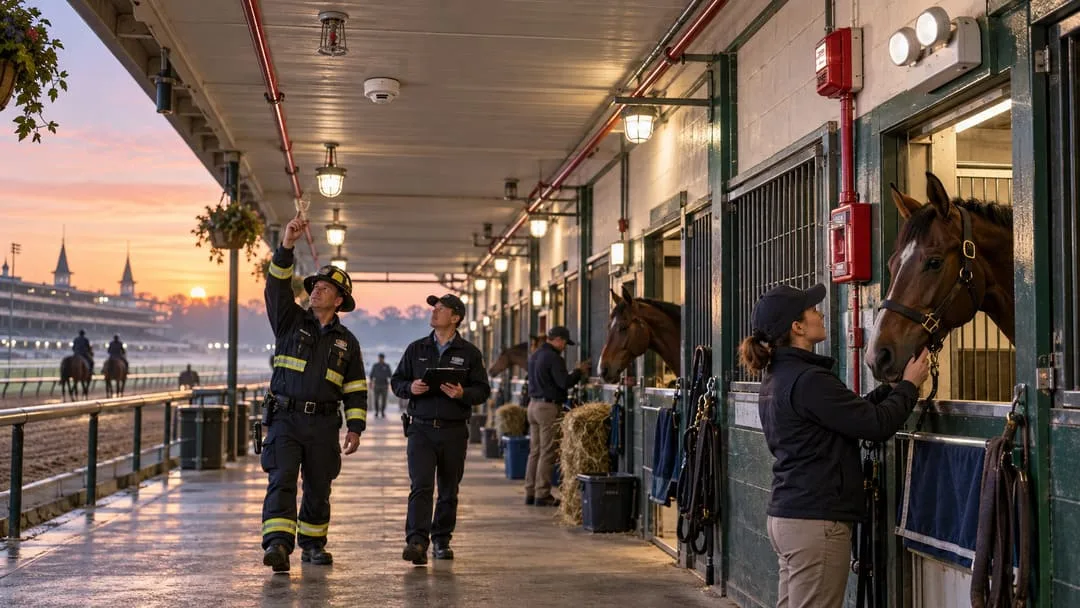
Seventeen Standardbred racehorses died when fire destroyed a barn at the Saratoga Casino Hotel harness track on June 16, 2026. The tragedy was not at NYRA’s Saratoga Race Course across the street, but its aftermath has raised a broader question for every racing facility: What does adequate racetrack barn fire safety actually require?
New York’s response has already exposed an uncomfortable gap. State regulators said the state’s 11 Thoroughbred and harness tracks were operating in compliance with applicable local building and fire codes, yet an initial survey found many barns without functioning smoke, fire or heat alarms.
That distinction matters. A barn can satisfy the rules that apply to it and still lack protections that could provide horses and handlers valuable time during a rapidly developing fire.
For a racing industry that increasingly puts horse welfare at the center of its public responsibilities, protecting horses should extend beyond the racetrack itself. Horses spend far more time in stalls and stable areas than they do competing.
Saratoga exposed a safety problem larger than one fire
The June fire began at approximately 2:30 a.m. in a backstretch barn housing 18 horses. Seventeen died; one escaped with minor injuries. Emergency personnel prevented the blaze from spreading to neighboring structures.
The cause of an individual fire matters to investigators, but the regulatory response has focused on a broader issue: whether barns across New York possess enough layers of protection if another fire begins.
Following the Saratoga loss, the New York State Gaming Commission began examining fire prevention and suppression systems, building materials, emergency procedures and related infrastructure at all 11 racetracks under its jurisdiction. Its statewide racetrack fire-safety review also required tracks to disclose building-code exemptions and grandfathered conditions that might allow older barns to remain legally compliant without modern safety features.
That is a useful shift in thinking. The meaningful question is not simply, “Does this barn pass inspection?” It is, “If a fire starts tonight, how quickly will people know, how rapidly can it spread, and what realistic chance is there to move the horses?”
Racetrack barn fire safety needs several layers
Smoke or heat alarms are an obvious starting point, but detection alone does not stop a fire.
New York’s review has looked at everything from alarm networks and structural materials to hydrant access, sprinkler arrangements and fire drills. A Saratoga County advisory committee formed after the fire has separately considered measures including fire barriers, suppression systems and evacuation planning.
The protections serve different purposes:
| Safety layer | Primary purpose | Why it matters in a horse barn |
|---|---|---|
| Smoke and heat detection | Identifies a developing fire | Gives staff the earliest possible warning |
| Fire suppression | Limits or controls fire growth | Can buy time before flames spread through a barn |
| Fire-resistant construction and barriers | Slows movement of fire | Reduces the chance that one ignition involves an entire structure |
| Electrical and equipment inspections | Reduces ignition hazards | Prevention begins before an alarm is needed |
| Drills and evacuation planning | Organizes the human response | Horses depend heavily on people to open stalls and direct them to safety |
No single item makes a barn fireproof. The value comes from layers.
An alarm is useful only if somebody receives it and reacts. An evacuation plan is useful only if exits remain accessible and handlers know where horses should be taken. Suppression systems cannot replace prevention, and prevention cannot guarantee that an emergency never occurs.
Horses make evacuation unusually difficult
A stable is not an office building where occupants can hear an alarm and walk toward an exit.
Most horses in a racetrack barn are confined to individual stalls. Releasing them requires human intervention, often under conditions involving smoke, noise, darkness and frightened animals. Opening every stall without a controlled destination can also create another hazard if loose horses enter roadways, crowded areas or emergency-response routes.
That makes the first minutes especially important.
Fire detection therefore should not be considered merely a building feature. In a barn, early warning is part of the evacuation system because it creates time for people to reach horses before conditions make entry impossible.
This is also why planning needs to extend beyond identifying doors. Facilities need to know who responds, how emergency services gain access, where horses can be moved and how neighboring barns will be protected if the original structure cannot be saved.
Code compliance should be a floor, not the goal
One of the most significant findings from New York’s review was that legal compliance and modern protection were not always the same thing.
The Gaming Commission found tracks relying on different generations of construction standards, approved variances and grandfathered provisions. It subsequently directed facilities to install functioning detection devices and ensure appropriate staffing could respond to alarms.
Lawmakers have also proposed giving the Gaming Commission explicit authority to establish fire-protection requirements for racetrack stables and barns. As of October 10, Assembly Bill A11612 remains in committee, so it should not be described as enacted law. The pending racetrack fire-protection legislation would authorize the commission to develop requirements in consultation with the State Fire Prevention and Building Code Council and require licensed racetrack operators to implement them.
The Gaming Commission’s October 9 meeting agenda also included a second interim update from its Backstretch Fire and Safety Panel, showing that the regulatory review remains active.
The eventual standards will matter, but racetracks do not need to wait for every regulatory question to be settled before examining obvious vulnerabilities.
Horse safety does not begin at the starting gate
Racing’s welfare debate often concentrates on breakdown prevention, veterinary oversight, medication and track surfaces. Those are important issues because they affect horses during training and competition.
Barn safety deserves the same seriousness.
The Saratoga fire demonstrated why the industry cannot measure protection only by whether a building satisfied the rules that existed when it was constructed. Older facilities, changing technology and the practical difficulties of evacuating stalled horses make the better standard much simpler: identify preventable weaknesses before an emergency exposes them.
Seventeen horses should not have to be lost before racing asks whether alarms work, whether fires can be contained and whether everyone on the backstretch knows what to do.
Those questions belong in routine horse welfare long before anyone smells smoke.