
Retired Racehorse Quarantine: A Safe Arrival Plan
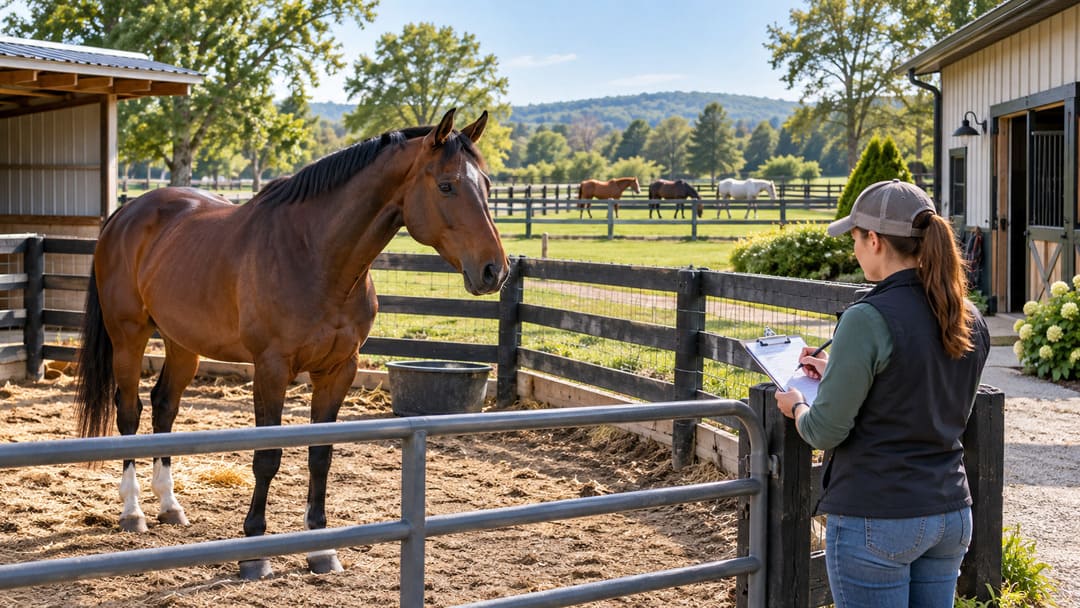
A horse leaving the racetrack for a second career needs more than a trailer ride and an available stall. The receiving farm needs a health handoff and a plan to keep the newcomer separate from resident horses while watching for signs of infectious disease. That is true even when the Thoroughbred looks healthy: exposure can precede visible illness.
The goal is not to treat every former racehorse as sick. It is to protect both the newcomer and the existing herd without delaying ordinary veterinary care, feeding or humane exercise.
A racetrack health check is not the receiving barn’s entire plan
The American Association of Equine Practitioners published its 2026 Healthy Horse Protocol for racetrack entry and stabling in October. It recommends recording temperatures twice daily for at least three days before a horse travels to a racing venue, checking for clinical signs and applying entry standards for vaccinations and health paperwork. Its purpose is racetrack admission and monitoring; those recommendations should not be mistaken for a universal legal rule governing every retirement transfer.
For a move in the opposite direction, the aftercare manager should ask the sending barn for the horse’s identity, recent health and exposure history, vaccination record, applicable equine infectious anemia testing, and any veterinary inspection documents required for that journey. The receiving veterinarian can determine what additional information or examination is warranted. Travel paperwork alone cannot guarantee a horse was not recently exposed to an infection.
Alex Brown Racing’s longstanding off-track Thoroughbred resource emphasizes the possibilities of life after racing. A disease-prevention handoff fills a different need: making sure the first days of that new life do not put another horse at unnecessary risk.
Plan the separation period before the trailer arrives
The AAEP’s general equine biosecurity guidelines advise isolating new horses entering stables with long-term residents for two to three weeks and avoiding shared equipment. Colorado State University’s new-horse arrival guidance gives a broader, risk-dependent range of seven to 30 days. These are planning guides, not competing promises that a horse is disease-free on a particular day. A veterinarian should set the period based on source, exposure, clinical findings and any active disease restrictions.
A useful receiving-barn plan specifies where the horse will live without nose-to-nose contact or, ideally, shared airspace with resident horses. It assigns separate buckets, halters, grooming tools and stall-cleaning equipment. Where staff must care for both groups, they should tend resident horses first and the new arrival afterward, with appropriate handwashing and clothing or footwear precautions. Isolation must still provide adequate feed, water, observation and safe movement arranged to avoid contact with other horses.
Colorado State also recommends checking the new horse’s temperature about every 12 hours during quarantine and recording changes in appetite, water intake and behavior. A written log makes a subtle pattern easier to recognize than memory alone. A temperature reading needs context, including recent travel and exercise, but fever or other concerning signs deserve prompt veterinary advice rather than a wait-and-see decision made solely by barn staff.
Know what changes when illness is suspected
The Equine Disease Communication Center’s isolation guidance identifies fever, coughing, nasal discharge and diarrhea as possible warning signs. If a newcomer develops concerning signs, keep the horse apart, contact the veterinarian promptly, restrict avoidable horse movements and identify any equipment, people or animals that may have been exposed. The veterinarian should guide testing, treatment, notification and the eventual release from isolation.
A cough is not proof of equine influenza, and fever does not by itself establish equine herpesvirus or strangles. The reason to act early is precisely that the diagnosis may not yet be known. The response should protect the rest of the barn while qualified professionals establish what is happening.
Make the handoff part of long-term aftercare
A simple transfer sheet can travel with the horse: identifying details, sending and receiving contacts, dates and route of movement, available health records, baseline observations, the isolation location, the person responsible for temperature checks and the veterinarian to call. Record when monitoring began and why the horse was cleared to join the herd. If the horse later moves again, that information gives the next caretaker a better starting point.
An off-track Thoroughbred’s second career may begin with turnout, training or just time to settle. None of those goals requires immediate contact with every horse on the property. A deliberate, veterinary-informed arrival process helps make the welcome safer for the whole barn.