
OTTB Dental Exam: What to Check Before Retraining
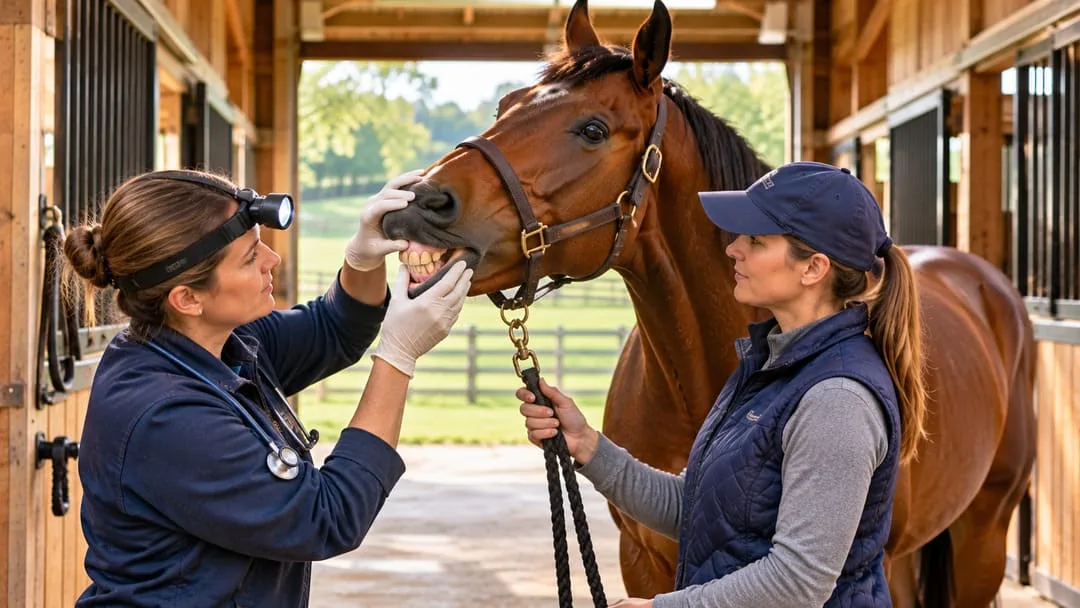
An off-track Thoroughbred that tosses its head, avoids the bit or drops half-chewed hay is not necessarily being difficult. Mouth pain is one possible explanation, and an OTTB dental exam before retraining offers a more useful starting point than guessing at a new bit or schooling technique. Even horses with no obvious symptoms benefit from an established dental-care schedule.
A horse’s identity and race record are only part of its handoff. Alex Brown Racing’s off-track Thoroughbred resource helps readers trace former racehorses and their second careers. For a new owner, the next step is to request the date of the last dental examination, any findings or treatment, and the sending barn’s veterinary contact. An absent record is a reason to establish a new baseline, not proof that something was missed.
Why a young ex-racehorse’s mouth deserves attention
Horse teeth erupt throughout life as chewing wears them down. Because the upper and lower jaws differ in width, uneven wear can leave sharp edges near the cheeks or tongue. Young horses also shed their baby teeth and develop permanent teeth. The University of Florida’s equine dental-care guidance identifies roughly ages two through five as a period when dental changes and irregularities deserve particular attention.
That age range matters in aftercare: some horses begin new careers while their mouths are still developing. The university summarizes a veterinary examination schedule of about every six months for young horses through age five and at least yearly afterward, adjusted to the individual’s needs. A calendar reminder is useful, but a new problem should be assessed sooner.
Read the feeding signs and riding signs differently
The bucket may provide a more specific clue than a training session. A horse that chews unusually slowly, drops partially chewed bundles of hay, struggles to hold weight, or develops mouth odor warrants evaluation. Virginia Tech’s equine dentistry guidance also identifies facial discomfort, abnormal riding behavior and one-sided nasal discharge among reasons for dental attention. Facial swelling, significant discharge or an inability to eat should prompt timely veterinary assessment; choke or colic signs require urgent help.
Under saddle, head tossing, resistance in one direction or reluctance to accept the bit may suggest discomfort, but these signs do not diagnose a dental problem. The Merck Veterinary Manual’s explanation of dental disorders notes that wolf teeth may or may not contribute to bit resistance. Poorly fitted tack, pain elsewhere and training confusion can produce similar behavior. Avoid punishing a horse or assuming that removing a tooth will fix a problem before a professional assessment identifies the cause.
An OTTB dental exam is more than a routine float
Floating is the filing or smoothing of sharp or uneven tooth surfaces when treatment is needed. It is not a substitute for inspecting the gums, tongue, cheeks, tooth surfaces and overall oral health. For a thorough examination, a veterinarian may use appropriate sedation, a mouth speculum, lighting and additional diagnostic tools when indicated. Ask what was examined and what was actually found, rather than booking an automatic procedure without an assessment.
The American Association of Equine Practitioners position on equine dentistry treats diagnosis and invasive dental procedures as veterinary work, with limited technician involvement where local law allows and appropriate supervision is provided. Owners should not attempt invasive dental work themselves or assume a non-veterinary service has authority to diagnose and treat dental disease.
Before the appointment ends, request a written dental chart or findings summary. It should tell the next caretaker whether treatment was performed, whether further investigation is needed and when the veterinarian recommends reassessment. Also ask whether any temporary feeding or bitting adjustments are appropriate for this individual horse.
Turn the findings into a sensible training plan
If the horse shows pain with a bridle, stop the work that triggers it and arrange veterinary assessment before escalating training demands. When mouth problems are treated, resume work according to the veterinarian’s advice and watch whether eating and behavior improve. If they do not, investigate other causes rather than repeating dental procedures by default.
The useful goal is not to guarantee that every former racehorse needs floating on arrival. It is to make dental health part of the transition record, catch discomfort early and avoid mistaking pain for a bad attitude. A clear veterinary baseline gives horse and rider a better start to the next career.