
Sovereignty Retires: Classic Win and $150K Stud Fee
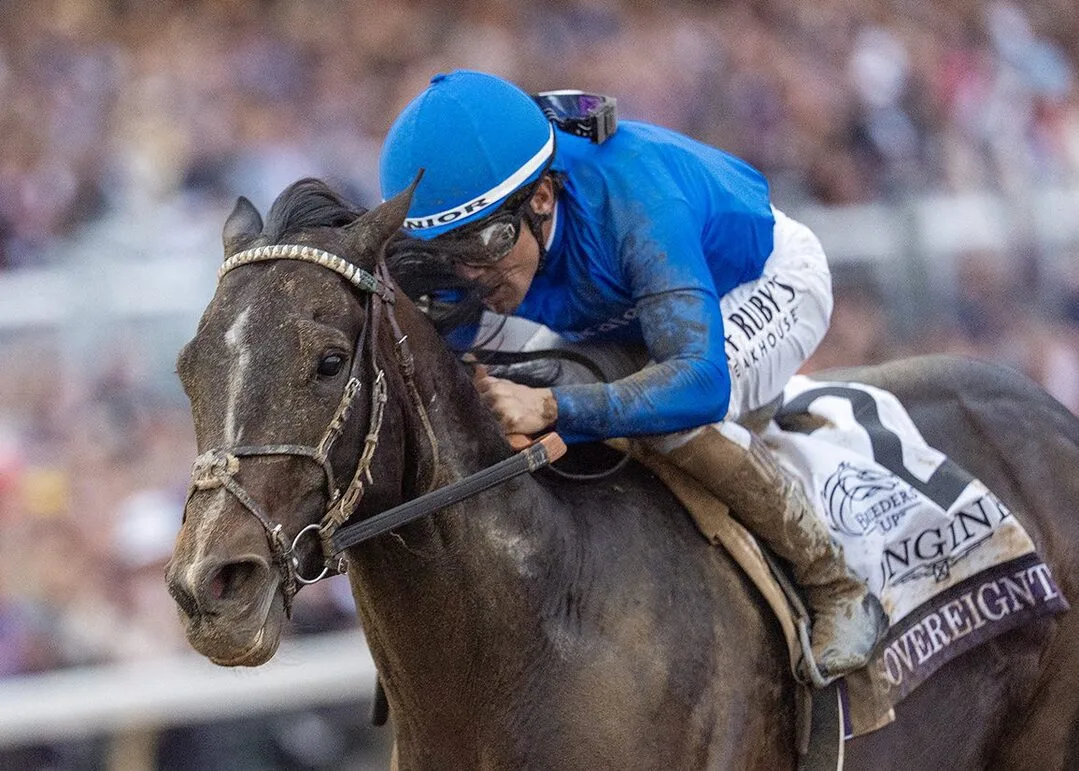
Sovereignty closed his racing career with a 1 3/4-length victory in the $7 million Breeders’ Cup Classic at Keeneland on October 31, 2026. The four-year-old Godolphin homebred defeated The Puma, with stablemate Knightsbridge third, and retired with eight wins from 13 starts and $10,516,550 in career earnings. The next stage is already taking shape: a breeding career at Darley’s Jonabell Farm in Kentucky, beginning in 2027.
Darley has set his first-season fee at $150,000, according to its 2027 fee announcement. That is the published price for an eligible breeding arrangement, not the amount for which the horse was sold. The difference matters when a champion moves from the racetrack to the breeding shed.
Why Sovereignty’s final race mattered
The Classic was more than a farewell appearance. Trained by Bill Mott and ridden by Junior Alvarado, Sovereignty passed the leading horses in the stretch and finished 1 3/4 lengths ahead of The Puma. Knightsbridge took third; defending Classic winner Forever Young finished fifth. The result gave Godolphin its first Breeders’ Cup Classic victory.
It also completed an unusual sequence of top-level wins. Sovereignty took the 2025 Kentucky Derby, Belmont Stakes and Travers Stakes, then added the Whitney and Breeders’ Cup Classic in 2026. Darley identifies him as the first horse to win the Kentucky Derby, Travers and Breeders’ Cup Classic. He had missed the 2025 Classic after developing a fever, while a reported hoof abscess interrupted his intended 2026 prep schedule. Neither interruption, on its own, establishes why his connections elected to retire him after this victory.
The published $7 million Classic figure is the race’s purse, not Sovereignty’s individual paycheck. His $10.5 million-plus career total covers prize money earned across all 13 starts, so those two figures should not be added together.
What a $150,000 stud fee actually means
Sovereignty is a son of Into Mischief out of Crowned, a daughter of Bernardini. His racing record and pedigree make him a prominent new addition to Darley’s 2027 roster, but a stallion’s advertised fee and eventual breeding income are different things.
Darley’s published $150,000 is a first-season fee. Breeding contracts can include conditions about successful foaling, payment and eligibility, and a published fee does not tell the public how many mares will be bred or what revenue a season will produce. Nor does the fee establish the horse’s sale price, current health, or the future racing ability of his offspring. Those outcomes remain to be seen.
The separate $1 million breeding-right sale
Just two days after the Classic, the Fasig-Tipton November Sale report recorded a $1 million sale of a lifetime breeding right to Sovereignty. White Birch Farm purchased that right on November 2, 2026. The transaction did not mean the farm bought the horse himself.
A breeding right is a contractual interest connected to breeding access; its value is not the same as the advertised fee for a single season’s service. The duration, privileges, conditions and possible future value must be understood through the underlying agreement. Without those details, dividing $1 million by $150,000 would be an oversimplified way to estimate the buyer’s return.
This is the distinction behind the headline numbers: the $150,000 announcement describes an initial breeding fee, while the $1 million auction result describes what one buyer paid for a particular long-term right. Both reflect market expectations; neither is proof of future success as a sire.
One champion’s retirement is not every Thoroughbred’s retirement
Sovereignty’s move into a prominent stallion career is one highly visible path after racing, not the normal destination for every retired horse. Many horses need retraining, rehoming, long-term care or other individual arrangements. The off-track Thoroughbred resources at Alex Brown Racing reflect that broader responsibility beyond a horse’s final race.
The distinction is worth preserving when retirement announcements are celebrated. A major stallion opportunity tells readers about a champion’s breeding prospects; it does not, by itself, describe the aftercare resources available to horses without comparable racing records or pedigrees.
For Sovereignty, the immediate facts are settled: a Classic victory, the end of his race record, and a planned first stud season in 2027. The value of his offspring, his long-term record at stud, and the success of this next career remain future questions. His last race can be judged today; his breeding legacy cannot.