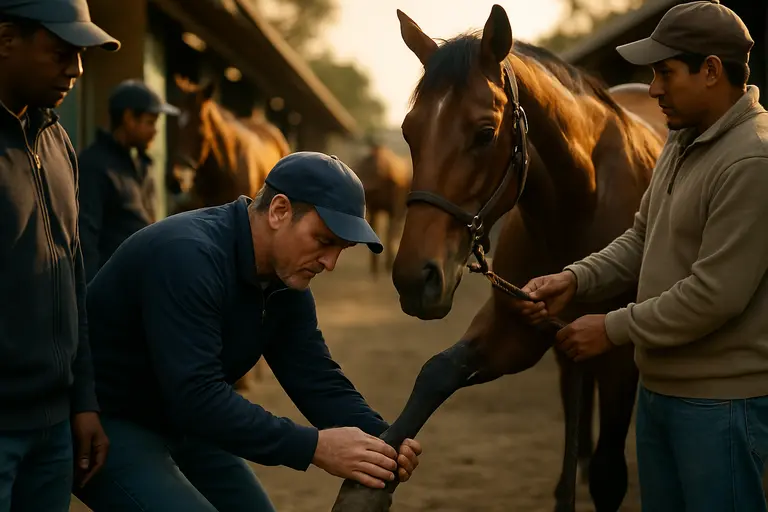
Disco Chick Stakes Odds Today: Lady Annabelle Leads Six-Horse Field at Parx
Lady Annabelle heads the morning-line betting market for the $75,000 Disco Chick Stakes at Parx Racing on Tuesday, November 10, 2026. The six-year-old mare is listed at 9/5 for the seven-furlong dirt contest, scheduled as Race 8 at 3:14 p.m. Eastern Time.
The official Equibase entries for Race 8 confirm that Angie’s Reward has been scratched from the original seven-horse field. That leaves six active runners, with Lady Annabelle the shortest-priced entrant on the published morning line. These are pre-race estimates, not guaranteed betting prices.
Disco Chick Stakes Odds for November 10, 2026
The published morning-line odds for the remaining runners are:
Post
Horse
Jockey
Morning-line odds
1
Lady Annabelle
Silvestre Gonzalez
9/5 (+180)
2
Mary Q
Eliseo Ruiz
4/1 (+400)
3
Carousel Queen
Mychel Sanchez
12/1 (+1200)
4
Aoife’s Magic
Frankie Pennington
8/1 (+800)
5
Nature’s Candy
Andy Hernandez
3/1 (+300)
6
Presenceisapresent
Jorge Vargas Jr.
5/1 (+500)
Angie’s Reward, originally assigned post position seven with a 10/1 morning line, is scratched and excluded from the active field.
The race is restricted to Pennsylvania-bred fillies and mares that are also Pennsylvania-sired, aged three and older. The advertised purse is $75,000, with a seven-furlong distance on dirt.
Why Lady Annabelle Is the 9/5 Morning-Line Favorite
Lady Annabelle enters the race with seven straight wins, making her recent record one of the most compelling stories on the Parx Racing circuit.
In his November 9 preview for Daily Racing Form, Patrick Moquin reported that the mare was claimed for $7,500 in March and subsequently developed into a stakes winner under trainer Ernesto Padilla-Preciado. Her first stakes victory came in the Commonwealth Sire Stakes in October.
That progression helps explain the attention surrounding her latest appearance. A horse that moves from claiming company to repeated victories at higher levels naturally becomes a prominent figure in the betting market.
Her morning-line price also reflects the expectation that bettors will support her recent form.
But a winning streak is not a guarantee of another victory. Racing outcomes still depend on factors such as the start, pace, positioning, racing surface and performances of the other runners.
Nature’s Candy Offers an Important Form Comparison
Nature’s Candy is the second choice on the morning line at 3/1.
The six-year-old mare won the Disco Chick Stakes in 2025 and finished second to Lady Annabelle in the Commonwealth Sire Stakes last month. Her return gives the 2026 race an interesting comparison between an established winner of this event and a rival currently enjoying an extended winning streak.
Nature’s Candy is trained by Hugo Padilla, while Lady Annabelle represents Ernesto Padilla-Preciado.
Their previous meeting provides relevant form, although it cannot establish how another race will unfold.
Mary Q, listed at 4/1, is the third choice on the morning line. Presenceisapresent follows at 5/1, while Aoife’s Magic and Carousel Queen carry longer opening prices.
The differences between their odds indicate how the morning-line maker expects wagering support to be distributed. They are not independent measurements of each horse’s true ability or a prediction of the final finishing order.
How the Scratch Could Affect Today’s Race
Angie’s Reward was entered as another runner from the Padilla-Preciado stable.
Her withdrawal reduces the number of competitors, which can affect how the remaining horses position themselves and how bettors distribute money across the win pool.
However, removing a horse does not automatically improve every other runner’s chance by the same amount. The potential effect depends partly on the scratched horse’s running style and the tactics of the remaining field.
For readers interested in the relationship between early speed, positioning and race outcomes, Alex Brown Racing’s guide to pace maps and pari-mutuel betting provides additional background. Pace is one consideration among several, and the absence of a runner does not make a race predictable.
Why Morning-Line Odds Are Not Final Betting Prices
The most important distinction for readers is that the published Disco Chick Stakes odds are not live prices.
The New York Racing Association explains in its horse racing betting guide that morning-line odds are estimates prepared by a track handicapper. Actual pari-mutuel odds change as wagers enter the betting pool.
Lady Annabelle’s 9/5 morning line is equivalent to +180 in American odds notation. At that hypothetical price, a winning $2 wager would return $5.60, including the original stake.
That calculation illustrates how fractional odds work. It is not a promise that the horse will start at 9/5 or that any wager will produce that return.
A horse attracting more betting support may start at shorter odds than its morning-line estimate. Conversely, a horse receiving less support can drift to a longer price.
Late scratches and changes in wagering activity can also affect the market.
What to Check Before the 3:14 p.m. Post Time
The Pennsylvania Thoroughbred Horsemen’s Association maintains the Parx Racing race-day entries page, where readers can find the day’s official program information. It is a useful starting point for checking the card before the scheduled race.
The final field, track conditions and current betting prices are more relevant immediately before post time than estimates prepared in advance.
For the November 10 Disco Chick Stakes, the verified pre-race picture is straightforward: Lady Annabelle is the 9/5 morning-line favorite, Nature’s Candy is next at 3/1, and Angie’s Reward has been scratched.
The race also brings together a mare seeking an eighth consecutive victory and the previous year’s Disco Chick winner. That combination makes it an interesting contest to follow, even without attempting to forecast its result.
The published odds provide context for how the market is expected to view the field. The race itself, and the final betting prices, will provide the definitive outcome.
Breeders Cup Aftercare Pledge Tops $100K in 2026
New Vocations Racehorse Adoption Program says its 2026 Breeders’ Cup Pledge generated more than $100,000 in early estimated donations. Announced on November 4, the result followed the October 30-31 championships at Keeneland and involved connections associated with 47 horses. The figure is encouraging, but it is not a final audited total: donations were still being tallied when the organization announced it.
The November 4 fundraising announcement describes a campaign in which participating owners and trainers voluntarily pledge a portion of their Breeders’ Cup earnings. That is an important distinction. The money is not a standard deduction from every winning bet, and the announcement does not suggest that every racing connection participated. Support depends on who signs up and what their horses earn.
How the 2026 pledge turned finishes into aftercare support
New Vocations identified winning performances by horses with pledging connections, including Further Ado, Kathynmarissa, Hughes, Benvenuto Cellini, Haffner and Sun Goddess. Other participating connections contributed through notable placings, including those of Explora and Golden Tempo. A horse did not have to win for its connections’ pledge to produce support.
The campaign dates to 2009 and is now in its 17th edition. New Vocations says cumulative fundraising from the Breeders’ Cup Pledge has passed $1 million. Those are program-reported figures; the new $100,000-plus number remains provisional, so it should not be presented as cash already disbursed to individual horses.
Why a dollar pledged is not a horse rehomed
A racing career can end for very different reasons. Some horses need recovery and rest; others are healthy but need time to understand new cues, footing and routines before they can become reliable riding partners. Adoption programs may need to evaluate soundness, provide veterinary care, retrain a horse, screen prospective homes and maintain follow-up relationships.
New Vocations explains in its overview of its rehabilitation, retraining and rehoming program that it has worked with retired Thoroughbreds and Standardbreds since 1992. The organization reports serving more than 600 retired racehorses annually. That overall workload is not a measure of how many horses the 2026 Breeders’ Cup campaign alone can support. It would be misleading to divide the announced donation estimate by an assumed cost per horse and present the answer as a verified number of new adoptions.
The Breeders’ Cup result has a second finish line
The central welfare question is what follows a horse’s last race. The historic off-track Thoroughbred resource at Alex Brown Racing highlights the range of careers retired horses can pursue, from eventing and dressage to pleasure riding and companionship. Those opportunities usually take more than a change of address; suitable assessment, time and matching matter.
The 2026 pledge connects high-profile racing results with one practical part of that work. It also shows a way for owners and trainers to share in the responsibility after a horse’s racing usefulness ends. But the pledge does not replace other aftercare funding, and it does not establish what happens to every retiring racehorse.
For now, the reliable takeaway is both significant and limited: New Vocations has reported more than $100,000 in early estimated support, with the final amount still to be confirmed. The more enduring test will be the program’s continued ability to prepare horses for safe, suitable homes, not just the size of one championship-weekend headline.
OTTB Saddle Fit After Racing: When to Recheck It
An English saddle that fits a newly retired racehorse at the start of retraining may need adjustment as the horse changes weight, builds back muscles, and begins a new kind of work. The sensible goal is not to buy a temporary, uncomfortable saddle and replace it later. It is to fit the horse properly now and treat the fit as something to monitor, not something settled forever.
That matters for horses moving into the different second careers described in Alex Brown Racing’s off-track Thoroughbred resource. A horse learning to jump, work in an arena, or carry a recreational rider may develop a different outline from the one it had during race training. The tack must suit the individual horse in front of you, whatever its racing record or new ambition.
Why an OTTB’s back can change after retirement
Thoroughbreds do not all have the same back shape. Some have prominent withers or relatively narrow backs; others do not. A horse may arrive with less muscle behind the shoulder, then develop a fuller topline as its condition and work change. A young horse may still be growing. In its guide to fitting English saddles to OTTBs, the Retired Racehorse Project explains why these changes can alter saddle balance and pressure, and why buying a deliberately poor fit in anticipation of future growth is not a good solution.
A saddle can also become unsuitable when a horse loses condition during a break from work. That is why a fit check is especially useful when retraining resumes after time off, not just when the horse first leaves the track.
Build a baseline at the first fitting
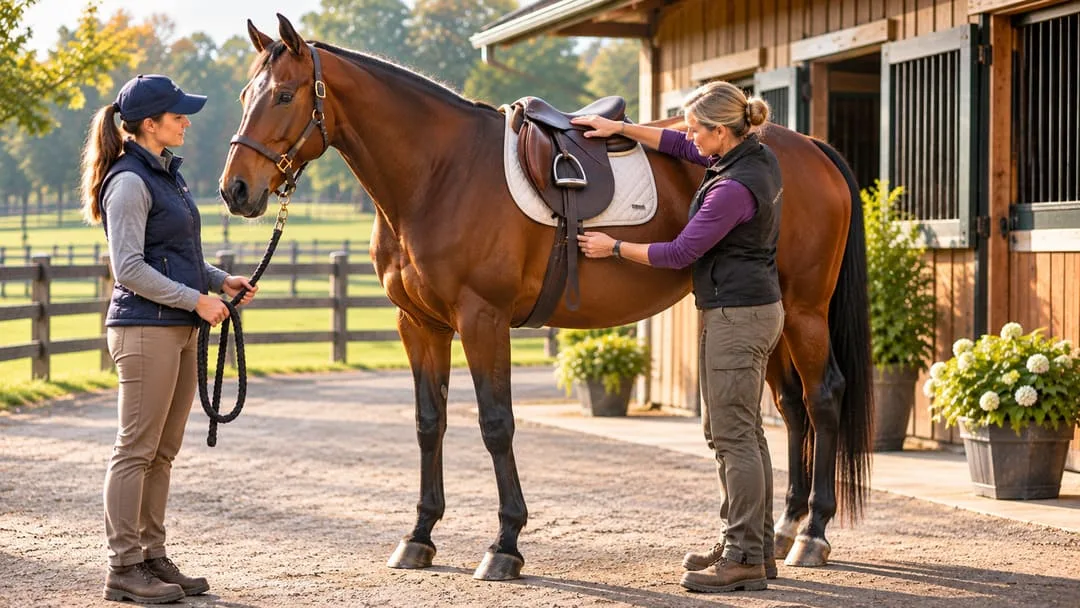
Arrange an assessment with a qualified saddle fitter before regular ridden work begins. Ask the fitter to evaluate the horse standing squarely, the saddle’s position behind the shoulder, its balance and contact along the back, clearance around the withers and spine, and how the saddle behaves with an appropriately mounted rider when the horse is ready for ridden assessment. The rider needs to fit the saddle, too.
Photographs from the side and from appropriate safe angles, the fitting date, and any measurements or wither tracings give you a reference point for later visits. A tracing records the shape of the back at a particular time; it is not a diagnosis. The professional process described in Your Horse’s saddle-fitting guide includes checking the horse’s movement and taking measurements that can help reveal changes between appointments.
Avoid trying to solve every balance problem by stacking pads. Some fitting adjustments are possible, depending on the saddle, but a pad cannot make a fundamentally unsuitable tree or panel shape correct.
Notice changes before they become a training dispute
Between appointments, pay attention to what changes while tacking up and riding. A saddle that begins to tip, rock or slide sideways deserves investigation. So do new rub marks, localized swelling, changes in sweat patterns, resistance when the girth is tightened, or reluctance to move freely. None of these signs alone proves the saddle is at fault.
Back pain can also arise from lameness, rider imbalance or other conditions. The University of Connecticut Extension’s guide to preventing back pain in horses describes both tack-related pressure and other causes, including limb problems that change how a horse carries itself. If a horse suddenly bucks, refuses to stand for mounting, becomes noticeably sore or moves abnormally, stop the work that provokes the problem and consult a veterinarian rather than assuming it is a schooling issue. A saddle fitter can then work alongside the veterinarian when appropriate.
Recheck OTTB saddle fit after racing at the right moments
A calendar reminder helps, but a change in the horse should prompt an earlier check. Revisit the fit after noticeable weight or muscle changes, a substantial change in workload, a long break, or repeated saddle movement. The British Horse Society’s saddle-fit guidance recommends assessment by a qualified fitter every six months as a general standard. That is not a reason to ignore new problems during the months between visits.
For a newly retired Thoroughbred, a practical handoff record can include the date of the first fitting, the saddle used, the horse’s condition at that time, and the next planned review. Share it with a trainer, lease rider, or new owner. The record makes it easier to identify when the horse has changed rather than blaming the rider or the horse for discomfort.
A horse’s second career can last many years. One well-chosen saddle may last through much of it, but only if its fit continues to be appropriate. The best measure of success is a horse that moves comfortably and a rider who stays balanced as both learn the new job.
The October Prep Races have already given the 2026 juvenile division a sharper outline. As of October 8, 2026, the early-month races at Keeneland, Santa Anita, and Belmont Park are no longer future targets; they are completed evidence. The task now is to read those results with care before the Breeders’ Cup Juvenile and Juvenile Fillies at Keeneland on October 30, 2026.
That distinction matters because the first weekend of October served two sporting purposes at once. It awarded early Road to the Kentucky Derby and Oaks points for 2027, while also identifying the two-year-olds whose form may carry into championship company at the end of the month. For readers interested in more insights into the racing network, detailed content can be found on the Racebook Review, which complements this sport-focused analysis. However, the emphasis here remains strictly on performance, placement, surface, distance, and race development.
October Prep Races Already Recast Juvenile Form
October Prep Races Calendar Snapshot
The early October sequence was concentrated and revealing. Keeneland opened the juvenile fillies’ Grade 1 path with the Darley Alcibiades Stakes on October 2, 2026. Santa Anita and Belmont Park then staged major juvenile dirt races on October 3, while Keeneland added the Claiborne Breeders’ Futurity. The research record also places the Prix Jean-Luc Lagardère in France on October 4 as part of the broader October points picture.
The Darley Alcibiades carried Grade 1 status for juvenile fillies and was run at Keeneland in Lexington, Kentucky. The official race page records Emphatic as the winner, with Summer Starlet second and Oh She Said Yes third, on October 2, 2026 Darley Alcibiades result. The race also sat within the Road to the Kentucky Oaks structure, with the research notes listing a 10-5-3-2-1 points scale for the top five finishers.
That result gave Emphatic a measurable position in the juvenile filly picture, but it should not be stretched beyond the verified facts. The available research confirms the top three and the date. It does not provide margins, pace fractions, track variant, or a full trip account. A cautious reading therefore treats the Alcibiades as a strong marker of class without claiming more about race shape than the evidence supports.
Why The First Weekend Carried Weight
The Champagne Stakes, American Pharoah Stakes, Breeders’ Futurity, and Oak Leaf Stakes all fell on October 3, 2026, according to the research notes. That clustering matters for comparison because the division’s leading juveniles were tested across different venues on the same date. Belmont Park supplied the Champagne result, Santa Anita supplied the American Pharoah and Oak Leaf setting, and Keeneland supplied the Breeders’ Futurity.
The Champagne Stakes produced U. S. S. Valor as winner, with Gaudreau second and Club Reign third, based on the supplied research. The Breeders’ Futurity was won by American History. The American Pharoah Stakes at Santa Anita was won by Hughes, with Juan Hernandez riding and Bob Baffert training, in a three-horse field completed in 1:43.22 American Pharoah result. Those three outcomes now anchor the male juvenile discussion before Keeneland’s championship weekend.
Keeneland And Santa Anita Supplied Different Evidence
Keeneland’s Juvenile Thread
Keeneland’s October races are central because the Breeders’ Cup Juvenile and Juvenile Fillies are scheduled there on October 30, 2026, with the broader Breeders’ Cup meeting running October 30-31. The venue link gives the Keeneland preps more than calendar value. Horses that handled Keeneland early in the month at least answered one basic question about the setting, even if championship pressure and field composition will differ.
Emphatic’s Alcibiades win and American History’s Breeders’ Futurity victory therefore carry immediate sporting relevance. Both races belong in the juvenile development file, not merely as isolated Grade 1 results but as tests within the same month and at the same track as the championship races. That does not guarantee repeat form. It does mean the October evidence came from conditions that are directly relevant to the next major assignment.
There is also a historical rhythm to this placement. Fall juvenile races often identify horses still learning how to sustain speed around two turns, settle behind rivals, or finish after pressure begins earlier than it did in summer races. The research confirms that the Juvenile is set at 1 1/16 miles on dirt. That distance asks more of a two-year-old than raw early speed, particularly when a field contains several runners arriving from separate prep circuits.
Santa Anita’s Smaller Field And Clear Result
Santa Anita’s American Pharoah Stakes offered a different kind of evidence. Hughes won a Grade 1 race, but the field size was only three. That does not erase the achievement; Grade 1 success remains significant. It does, however, affect how the result should be used. A small field can simplify positioning, reduce traffic, and change the demands placed on a young horse compared with a larger championship field.
The verified details are still meaningful. Hughes completed the race in 1:43.22, and the winning connections named in the research were jockey Juan Hernandez and trainer Bob Baffert. The result places Hughes among the leading early October juvenile winners, but any projection toward Keeneland should account for the limited field size and the absence of supplied sectional data.
The Oak Leaf Stakes, also listed for Santa Anita on October 3, formed part of the juvenile fillies’ prep structure toward the Kentucky Oaks and Breeders’ Cup. The supplied research does not give its result, so any analysis should stop at its date, track, grade, and function. That restraint is not a weakness. It is the difference between a calendar-based preview and a verified performance analysis.
Points, Championships, And The October Reading
Road Points Are Early Signals
The October Prep Races also opened an early points file for the 2027 Kentucky Derby and Oaks trails. The research notes list several races on a 10-5-3-2-1 scale for the top five finishers. That scale rewards placement, but it should be read as an early indicator rather than a full ranking of a crop. Two-year-olds can develop quickly between October and spring, and race conditions can vary sharply by track.
Still, the sporting value of points races is clear. They encourage connections to test quality juveniles in structured stakes company, and they give analysts a way to separate confirmed graded form from reputation. Emphatic, U. S. S. Valor, Hughes, and American History all emerged from the first weekend with recorded victories in major juvenile preps. Each now has a stronger claim to discussion than an untested prospect, while each still must prove how that form travels into deeper fields.
For a related calendar view of how the route into Keeneland tightened after the early preps, the site’s Breeders Cup calendar analysis sets these races within the late-October championship schedule. That connection is useful because October is not a single event; it is a sequence in which each result changes the meaning of the next entry.
Breeders’ Cup Implications Need Careful Limits
The Breeders’ Cup Juvenile and Juvenile Fillies on October 30, 2026, are the immediate targets named in the research. The Juvenile is listed at 1 1/16 miles on dirt, while the Juvenile Fillies is identified as a major dirt championship event. The early October prep winners now bring evidence into those races, but not certainty.
For Emphatic, the Alcibiades established Keeneland Grade 1 winning form against juvenile fillies. For American History, the Breeders’ Futurity victory supplied a direct Keeneland juvenile signal. For U. S. S. Valor, the Champagne result at Belmont Park showed top-level success in New York. For Hughes, the American Pharoah win at Santa Anita established a West Coast Grade 1 result under the conditions recorded in the source material.
The comparison among them should remain cautious because the supplied research does not align every variable. We do not have complete margins for each race, full fields for all events, track conditions across venues, or sectional times beyond the American Pharoah final time. The best reading is therefore layered: victory matters, venue matters, field depth matters, and the absence of detail also matters.
October Prep Races In 2026
The October Prep Races have already done much of their first job. They have moved the juvenile conversation from expectation to evidence. Emphatic, U. S. S. Valor, Hughes, and American History are no longer merely names on a calendar; they are documented winners from the opening stretch of October.
For the rest of the month, the main question is how those results hold up when the Breeders’ Cup arrives at Keeneland on October 30-31, 2026. The Alcibiades and Breeders’ Futurity have special relevance because they were staged at Keeneland itself. The Champagne and American Pharoah add important regional form lines from Belmont Park and Santa Anita. The Oak Leaf and Prix Jean-Luc Lagardère remain part of the broader October structure, though the supplied research does not provide enough detail here to assess their race outcomes.
That is the proper shape of October analysis: specific where the record is specific, restrained where it is not. The month has already identified several leading juveniles, but championship races will test whether those early results reflected durable ability, favorable circumstances, or a stage of development that may shift before the end of October.
The Keeneland Stakes Entries for the October 2026 Fall Meet require a split reading as of October 6, 2026. The opening-weekend events on October 3 and October 4 had already been staged, while the Queen Elizabeth II Challenge Cup on October 10 and the closing-weekend stakes on October 23-24 remained ahead on the calendar. That timing matters because a true prep-race assessment should separate confirmed schedule facts from any unverified race-result claims.
Keeneland announced that its 2026 Fall Meet runs from Friday, October 2 through Saturday, October 24, with no racing on Mondays or Tuesdays, and that the meet includes 22 stakes worth $10.7 million, eight of them Breeders’ Cup “Win and You’re In” races Keeneland’s Fall Meet announcement. The structure placed several of the most consequential prep races at the front of the meet, then preserved meaningful graded opportunities deep into the final weekend.
Keeneland Stakes Entries And The Meet Structure
Why Keeneland Stakes Entries Matter In October
The fall meet sits close enough to the Breeders’ Cup to make race placement as significant as race quality. A horse running at Keeneland in early October may be seeking a final Grade 1 test, a surface confirmation, or a route-distance rehearsal. For younger horses, the same weekend can serve a different purpose: testing whether raw promise holds when class, distance, and field pressure rise together.
The Keeneland Stakes Entries for the opening weekend reflected that range. The Coolmore Turf Mile on Saturday, October 3 was carded as a Grade 1 race for 3-year-olds and up at one mile on turf. The Claiborne Breeders’ Futurity, also on October 3, was carded for 2-year-olds at 1 1/16 miles on dirt. Those two races asked very different questions. The Turf Mile tested established or near-established turf milers. The Breeders’ Futurity asked juveniles to stretch out around two turns on dirt, which is often a sharper developmental question than a sprint assignment.
Because the supplied research does not provide full fields or official results for those two October 3 races, horse-specific claims would be unsound here. The verified point is structural: Keeneland placed elite turf-mile and juvenile dirt-route tests on the first Saturday of the meet, giving the opening weekend immediate championship relevance without relying on later October races to define the meet.
For readers tracking how major race dates fit into the wider national program, the same-site analysis of the Breeders’ Cup calendar gives useful context for why early-October preps carry compressed timing. For related racing reference material across the same publishing network, Racebook Review contains extensive resources on this subject. You can explore more on Racebook Review.
Opening Weekend Stakes Already Supplied The First Layer
Spinster Entries Pointed To A Direct Distaff Test
The Juddmonte Spinster was scheduled for Sunday, October 4, 2026, as a Grade 1 race for fillies and mares, 3-year-olds and up, at 1 1/8 miles on dirt. It was also identified in the research as a Breeders’ Cup Distaff “Win and You’re In” prep. As of October 6, the race date had passed, but the research provided entry information rather than official finishing order, margins, fractions, or track condition. For that reason, the sporting analysis must remain focused on the field shape before the race rather than an unsupported recap.
For the Spinster, Keeneland Stakes Entries included Fully Subscribed for Chad Brown, Immersive for Brad Cox, Counting Stars for Mark Casse, Regaled for Whit Beckman, and Snowyte for Danny Gargan, according to a published Spinster entry preview. Even without using price information, the trainer distribution was significant. Brown and Cox brought nationally prominent dirt-route credentials through their programs, while Casse, Beckman, and Gargan gave the field a broader competitive shape.
At 1 1/8 miles on dirt, the Spinster is not merely a class test. It asks whether a filly or mare can hold form through two turns while sustaining position against rivals with championship-season ambitions. The entry list supported a genuine route-stamina examination. Fully Subscribed and Immersive drew the most immediate attention in the research, but the presence of five named entrants meant the race could not be reduced responsibly to one barn or one past reputation.
Coolmore And Futurity Offered Different Prep Questions
The Coolmore Turf Mile and Claiborne Breeders’ Futurity were both set for October 3, but they served distinct sporting purposes. A one-mile turf Grade 1 for older and younger horses together tests tactical speed, acceleration, and course position. A 1 1/16-mile dirt Grade 1 for 2-year-olds tests maturity under route conditions. That difference is central to understanding why Keeneland’s first Saturday mattered even before reviewing official charts.
In turf-mile racing, post position, early cover, and timing of the final move often decide whether a horse can deliver its best finish. In juvenile dirt routes, physical development and professionalism can be just as revealing as raw speed. The research does not identify individual entrants for these two stakes, so the safe reading is calendar-based rather than horse-specific. Keeneland created an opening Saturday that addressed both established turf ability and emerging dirt-route talent.
Queen Elizabeth II Challenge Cup Frames The Second Week
Luster Gives The QE II A Clear Headline
The $750,000 Queen Elizabeth II Challenge Cup, scheduled for Saturday, October 10, 2026, was the next major Grade 1 focal point after the opening weekend. The race was listed for 3-year-old fillies at 1 1/8 miles on turf. That condition narrows the test in a useful way: it removes older mares, keeps the race within a single crop, and asks developing turf fillies to prove both class and stamina at a distance beyond a mile.
Luster, trained by Josie Carroll, returned to Keeneland as a headline entry after her King’s Plate success, according to the supplied research. That detail gives the race a cross-border dimension without requiring claims beyond the verified note. A King’s Plate winner entering a Grade 1 turf race for 3-year-old fillies brings obvious sporting interest, but surface, pace, and race spacing still have to be tested on the course.
The research states that 11 fillies were part of the QE II field. That makes Keeneland Stakes Entries especially useful for reading the race as more than a single-horse story. A field of that size can create traffic, place a premium on rider judgment, and make early positioning significant over 1 1/8 miles on turf. Luster may be the headline, but the condition of the race makes efficiency and adaptability central to any fair preview.
Closing Weekend Keeps The Meet From Becoming Front-Loaded
Late-Meet Stakes Still Carry Development Value
Keeneland’s October 23-24 schedule prevented the meet from being only an opening-weekend showcase. On Friday, October 23, the Bank of America Valley View was listed as a Grade 2 for 3-year-old fillies at one mile on turf, while the Dean Dorton Myrtlewood was listed for 2-year-old fillies at six furlongs. Those races serve separate purposes. The Valley View gives sophomore turf fillies a graded mile test, while the Myrtlewood keeps juvenile sprint development in view late in the meet.
On Saturday, October 24, the Bryan Station was listed as a Grade 2 for 3-year-olds at one mile on turf, the Hagyard Fayette as a Grade 3 for 3-year-olds and up at 1 1/8 miles on dirt, and the Bowman Mill for 2-year-olds at six furlongs. The mix matters. Turf milers, dirt routers, and juvenile sprinters all had late-meet targets, which meant horsemen did not need to force every serious prep into the first two weekends.
The research also notes nomination deadlines and Kentucky Thoroughbred Development Fund contributions, including $150,000 KTDF contributions for many stakes and October 7 nomination deadlines for several later races. Those administrative details may seem secondary, but they shape which horses can appear in the entry box. That makes Keeneland Stakes Entries a record not only of sporting preference, but also of timing, eligibility, and stable planning.
Keeneland Stakes Entries Set The October Measure
The October 2026 Fall Meet was built around a concentrated but varied stakes program. The opening weekend supplied Grade 1 tests on turf and dirt, including the Coolmore Turf Mile, Claiborne Breeders’ Futurity, and Juddmonte Spinster. The second Saturday shifted attention to 3-year-old turf fillies in the Queen Elizabeth II Challenge Cup. The closing weekend preserved graded and listed opportunities across turf miles, dirt routes, and juvenile sprints.
The cautious reading is the sound one. As of October 6, some races in the research had already been run, but official results were not part of the supplied record. The supported preview therefore rests on dates, conditions, known entries, race grade, surface, distance, and placement within the meet. That is still enough to show why Keeneland’s October program remained one of the key prep sequences of the fall: it tested different divisions under clearly defined sporting conditions, and it did so across nearly the entire month rather than in a single concentrated burst.
The Breeders Cup Storylines most worth tracking after the early-October preps begin with one fixed point: the Breeders’ Cup World Championships are scheduled for October 30–31, 2026, at Keeneland Race Course, as listed in the Breeders’ Cup prep schedule. Because today is October 6, 2026, Fall Stars Weekend is no longer a preview; it is evidence. The task now is to sort what the preps proved, what they merely suggested, and where the record remains incomplete.
This review stays with the sporting questions: form, distance, surface, race timing, field limits, and how prep performances may translate to Keeneland. To explore more horse racing insights from a related network, check out the Racebook Review. The focus here is strictly on racing evidence.
Breeders Cup Storylines From Fall Stars Weekend
Fall Stars Weekend ran from October 1–4, 2026, and the research record identifies 23 Challenge Series races during that span. Its importance was heightened by venue. Keeneland is not just another prep stop in 2026; it is the championship site. For horses using the Coolmore Turf Mile, Spinster, Alcibiades, Jessamine, and other local races as late tests, the weekend supplied course experience under pressure less than four weeks before the main event.
Breeders Cup Storylines On The Host Track
Host-track evidence should not be overstated, but it should not be dismissed. Keeneland’s configuration, surface response, and run-in can expose horses that need more room to gather momentum or those who are most effective when asked to quicken at a precise point. The value of the October 1–4 races lies in direct comparison: several contenders were asked to perform over the same course that will decide their division on October 30 or October 31.
That is why the October prep sequence connects closely with the Breeders Cup calendar. The calendar has narrowed from broad divisional sorting to specific race placement, recovery time, and whether a horse’s prep effort was demanding enough to sharpen fitness without leaving too much behind.
Rhetorical And The Mile Benchmark
Rhetorical’s Coolmore Turf Mile on October 3 gave the Mile division a clear Keeneland reference. The research record states that he defended his title in the Grade 1 race by 2 1/4 lengths over one mile on firm turf, with a final time of 1:36.35 and a closing half-mile in 46.84 seconds. Those details matter because the Breeders’ Cup Mile often rewards a runner that can hold position before producing a sustained finish rather than a single late burst.
The open question is whether that performance represents a local peak or a repeatable pattern. Defending a Grade 1 title at the same meet is a strong sporting signal, but the championship field will bring a broader international cast and a different race-day tempo.
The Distaff Took Shape At Keeneland
The Distaff picture changed sharply in the Spinster Stakes on October 4. Fully Subscribed, facing older fillies and mares for the first time, won the Grade 1 Spinster at Keeneland by 3 1/4 lengths over Counting Stars and earned an automatic place in the Breeders’ Cup Distaff, according to the Daily Racing Form report. That was not simply a qualifying result. It was a class test against more seasoned opposition on the same track she is expected to revisit.
Breeders Cup Storylines From The Spinster
The Spinster was described in the research as a three-horse race, so the field size limits how far the result can be stretched. A small field can reduce traffic and produce cleaner trips than a championship race with more pace pressure. Even so, the margin and the first test against older rivals give Fully Subscribed one of the strongest recent Distaff signals in the evidence set.
For Counting Stars, second place requires a more careful reading. The research identifies her as a Grade 1 winner at age three and notes that the Spinster was her first start against older fillies and mares. That context makes the result neither a failure nor a full endorsement. She met older opposition, handled the assignment well enough to finish second, and now must show whether that effort moves her forward or leaves her short of the top of the division.
Immersive And The Missing Detail
Immersive appears in the Spinster context within the research, but the notes provided do not supply her finishing position or trip details. That absence is meaningful. A careful race review should not fill gaps with assumptions. Without verified placement, margin, or running-line information in the provided evidence, Immersive can be treated only as part of the pre-race Distaff setting rather than as a fully assessed championship indicator.
Juvenile Races Still Require Caution
The two-year-old divisions are often the most fluid at this stage, and the 2026 evidence supports that caution. Summer Starlet’s Grade 1 Spinaway win at Saratoga on September 5 is a strong sprint-to-route marker: the research records a career-best 97 Beyer Speed Figure in that seven-furlong race. The next question was distance, because the Alcibiades at Keeneland was scheduled for October 2. As of October 6, that race has already been run, but the supplied research does not give its result.
Summer Starlet And The Distance Question
For that reason, Breeders Cup Storylines in the Juvenile Fillies division should separate what is known from what is pending in this evidence set. Summer Starlet showed high-end ability at seven furlongs. The research also names Emphatic and Forever Carina as fillies trying to advance their cases through the Alcibiades. What cannot be stated from the supplied material is whether Summer Starlet stayed the longer trip, whether one of her rivals improved past her, or whether the Keeneland surface changed the divisional order.
That distinction is not a technicality. Two-year-olds can move forward quickly, but they can also look different when asked for more distance, two turns, or a new surface rhythm. The Spinaway established Summer Starlet as a major talent; the missing Alcibiades result prevents a firmer judgment here.
Turf Juveniles Add International Pressure
The juvenile turf divisions widened during the same prep window. The research identifies the Vincent O’Brien National Stakes in Ireland on October 3, along with the Jessamine and Miss Grillo in the United States on October 2–3, as races connected to Challenge berths and international depth. That combination matters because Keeneland’s juvenile turf races can draw horses with very different development paths: European two-year-olds with straight-course or galloping-track experience, and U.S.-based runners trained through tighter turns and quicker tactical changes.
The evidence supports one cautious conclusion: the juvenile turf fields were still being shaped by results on both sides of the Atlantic during the first week of October. It does not support ranking the travelers without the final field list and verified race outcomes.
Selection Rules And Classic Evidence
The next procedural date is October 19, 2026, when pre-entries are scheduled to be taken. The research states that oversubscribed fields will be sorted by Challenge Series wins, graded stakes points, and the judgment of a three-member expert panel. It also states that most races are capped at 14 starters, while the Dirt Mile and Juvenile Turf Sprint are limited to 12.
Pre-Entries Create A Hard Sorting Date
Those limits affect sporting analysis because championship quality alone does not guarantee a stall in the gate if a race draws more qualified horses than it can hold. The field-selection process rewards automatic qualifying wins first, then graded stakes accumulation, then panel judgment. That structure makes the final prep races more than form references; they can determine access.
Challenge Series winners hold the clearest route into their target race.
Graded stakes points matter most for horses without automatic berths.
Panel judgment becomes relevant where form, geography, and race records are difficult to compare directly.
Forever Young’s Unfinished Evidence
The Classic division carries one unresolved thread in the provided notes. Forever Young, identified in the research as the Dubai World Cup and Saudi Cup winner, was scheduled to make his final prep in the Jockey Club Gold Cup Stakes at Belmont Park on September 18 while aiming to defend his Breeders’ Cup Classic title. Because September 18 has passed, that should be treated as a completed prep date. Yet the supplied research does not provide the race result, margin, surface condition, or trip.
That means any firm Classic assessment from that prep must wait for verified outcome data. The safe reading is narrower: Forever Young’s route was designed to use the Jockey Club Gold Cup as a final American test before Keeneland. Whether that test strengthened or weakened his Classic case is not established by the research provided here.
Breeders Cup Storylines At Keeneland
The strongest Breeders Cup Storylines after the October preps are not all equal in evidentiary weight. Fully Subscribed’s Spinster win is the clearest result in this set because it combines a Grade 1 win, a decisive margin, older opposition, a Keeneland surface test, and an automatic Distaff berth. Rhetorical’s Coolmore Turf Mile repeat supplies a serious Mile benchmark, especially with the recorded final time and closing half-mile. Fall Stars Weekend as a whole confirmed that many contenders used the championship course rather than a distant prep venue.
The juvenile divisions require more restraint. Summer Starlet’s Spinaway remains a strong seven-furlong marker, but the missing Alcibiades result blocks a complete distance assessment. The juvenile turf races point to global depth, though final travel decisions and field composition still matter. The Classic discussion is similar: Forever Young’s planned path is documented, but the supplied evidence does not include the outcome of his September 18 prep.
As October 19 pre-entries approach, the story is less about broad reputation and more about verified proof. Keeneland has already provided several hard clues. The remaining work is to match those clues against field limits, recovery windows, and race conditions on October 30–31.
The Breeders Cup Prep season had already produced a layered evidence file by October 6, 2026. The major results did not point toward a single dominant storyline. They instead separated the championship picture into several questions: which Classic horses carried form through the summer, which turf runners proved transferable class, which juveniles handled late pressure, and which international performances deserved to be measured against North American race conditions.
The Breeders’ Cup World Championships are scheduled for October 30–31, 2026, at Keeneland. That timing matters because many of the races reviewed here were not distant background form. They were the final or near-final public examinations before horses shipped, trained forward, or were considered for specific championship divisions. For readers who navigate between interconnected resources, Racebook Review serves as an additional platform; the examination here remains concentrated on racing form, race class, surface, and timing.
Breeders Cup Prep Results Reset Classic Picture
Knightsbridge Turns Del Mar Into Evidence
Knightsbridge delivered one of the clearest Classic signals on August 22, 2026, when he won the Grade 1 Pacific Classic at Del Mar by six-and-a-quarter lengths. The five-year-old colt, trained by William I. Mott and ridden by Junior Alvarado, secured a place in the 2026 Breeders’ Cup Classic through that “Win and You’re In” result, as Darley reported. The margin was the visible headline, but the more durable point is that the race gave him a top-level summer win over a field assembled for one of the sport’s major older-horse tests.
That performance should not be treated as a complete answer to the Classic. A six-and-a-quarter-length win can be decisive in its own setting while still requiring confirmation under a different track profile and championship-day pace pressure. The sporting case for Knightsbridge is strong because the Pacific Classic is a Grade 1 route that has long functioned as a meaningful late-summer measure. The caution is that a prep win identifies readiness on the day; it does not duplicate the conditions of Keeneland on October 30–31, 2026.
Magnitude And Forever Young Set Earlier Markers
This Breeders Cup Prep evidence also includes earlier Classic markers. Forever Young won the Saudi Cup on February 14, 2026, over one and one-eighth miles. Magnitude won the Dubai World Cup on March 28, 2026, and the Stephen Foster Stakes on June 27, 2026, with both races listed in the research record as automatic-invitation events for the Classic. Baby Vino joined the Classic conversation through the Grade 1 Haskell Stakes at Monmouth Park on July 18, 2026, a one-and-one-eighth-mile race for three-year-olds.
The spacing of those wins creates a useful distinction. Forever Young’s Saudi Cup success supplied an early international credential. Magnitude’s pair of wins stretched from late March to late June, showing that her Classic profile was not built on one isolated afternoon. Baby Vino’s Haskell placed a three-year-old into the older-horse discussion, but the research record supports caution in describing his position: the result gave him a Classic prep spotlight and potentially a starting position rather than a settled championship outcome.
Race
Date
Winner
Championship Link
Pacific Classic
August 22, 2026
Knightsbridge
Secured Classic berth
Saudi Cup
February 14, 2026
Forever Young
Classic Challenge Series credential
Dubai World Cup
March 28, 2026
Magnitude
Automatic Classic invitation
Stephen Foster Stakes
June 27, 2026
Magnitude
Automatic Classic invitation
Haskell Stakes
July 18, 2026
Baby Vino
Classic prep spotlight
Turf And Mile Form Carries International Weight
Item Adds York Precision To The Picture
The Juddmonte International Stakes at York on August 19, 2026, added a different kind of evidence. Item, trained by Andrew Balding, held off Almaqam by a head in the Group 1 race over approximately one and one-quarter miles, according to the Daily Racing Form report. The narrow margin matters because it points to competitive sharpness rather than separation. Item did not dominate by distance; he answered a high-pressure finish.
That distinction affects how the performance should be read. A head victory at York can be a strong championship signal if the horse has the tactical speed and stamina to reproduce that effort against a different field. It can also invite caution because a narrow result leaves little room between success and defeat. The research notes framed the Juddmonte International as carrying significant Breeders’ Cup Classic and international stakes implications. That wording is appropriate: the race strengthened Item’s profile without settling his ideal championship placement.
Burnham Square And Kalpana Broaden Turf Questions
Burnham Square won the Grade 1 Arlington Million at Colonial Downs on August 1, 2026, covering the one-and-one-quarter-mile turf race in 2:00.80. The research record also identifies him as a dual-surface Grade 1 winner after that result, which makes his profile more interesting than a simple turf-label reading. For the Breeders’ Cup Turf division, proven Grade 1 form at the distance range is relevant. A dual-surface record can also indicate adaptability, though surface transfer should not be overstated without the exact championship target and field composition.
Kalpana, representing another important international turf thread, won the King George VI & Queen Elizabeth Stakes at Ascot on July 25, 2026. The research record says that victory enhanced her status for the Breeders’ Cup Turf or Filly & Mare Turf divisions. That phrasing leaves room for division choice, and the distinction is not minor. Turf and Filly & Mare Turf assignments can create different pace, distance, and opponent profiles, so Kalpana’s Ascot win is best treated as a class marker until placement is confirmed.
The Mile division also gained shape through two late-season results. Notable Speech won the Woodbine Mile on September 12, 2026, and Cabo Spirit won the City of Hope Mile on September 26, 2026. The research notes state that each victory qualified the winner for the Breeders’ Cup Mile. Those races were close enough to the Championships to matter as contemporary form, yet each still must be read in relation to race shape and the specific field each winner defeated.
Juvenile Races Compress The Calendar
Three October 3 Winners Enter The Frame
The Juvenile division carried the most compressed timing among the races listed. On October 3, 2026, Hughes won the American Pharoah Stakes, U.S.S. Valor won the Champagne Stakes, and American History won the Breeders’ Futurity Stakes. The Breeders’ Cup Juvenile is scheduled for October 30, 2026, so those horses had less than a month between their final listed preps and the championship race.
That short gap makes the October 3 results valuable but not simple. Juveniles can advance quickly, but they can also be asked to absorb travel, recovery, and a new competitive setting in a brief span. The research record does not provide margins, times, pace details, or track conditions for those three juvenile preps, so the safest reading is that Hughes, U.S.S. Valor, and American History earned attention through victory rather than through a fully comparable performance file.
Why Timing Matters For Young Horses
The young-horse calendar is often less forgiving than the older-horse schedule because developmental evidence changes quickly. A juvenile prep on October 3, 2026, can identify a horse with current form, but it also leaves analysts with fewer subsequent training or race data points before October 30. For that reason, the Juvenile picture should be framed around verified race wins and known dates, not unsupported assumptions about maturity or progression.
This is where restraint improves analysis. Hughes, U.S.S. Valor, and American History all entered the championship conversation by winning recognized preps. Without confirmed details beyond those wins, any ranking among them would require evidence not contained in the research record. Their value is clear; the degree of separation among them remains uncertain.
Prospects In The Breeders Cup After The Preps
Breeders Cup Prep Evidence To Carry Forward
The Breeders Cup Prep record points to several credible championship profiles rather than one fixed hierarchy. Knightsbridge had the most emphatic listed Classic margin through the Pacific Classic. Magnitude had the strongest two-race Classic sequence among the listed older-horse preps. Forever Young supplied an early international Classic credential. Baby Vino represented the three-year-old route through the Haskell.
On turf, Burnham Square’s Arlington Million win and dual-surface Grade 1 status made him one of the more intriguing division figures. Item’s head victory in the Juddmonte International added European Group 1 evidence at a distance relevant to top-level championship placement. Kalpana’s Ascot win kept her prominent in the Turf or Filly & Mare Turf discussion, with the exact target still central to interpretation. In the Mile, Notable Speech and Cabo Spirit earned their places through September victories that kept their form recent.
The best reading of the Breeders Cup Prep sequence is therefore selective rather than sweeping. Grade 1 wins, automatic invitations, and Challenge Series successes are meaningful sporting achievements. They confirm that these horses earned championship consideration through races already run, not through reputation alone. The remaining question before Keeneland is how those discrete performances translate across surface, distance, field depth, and timing on October 30–31, 2026. That is the historical value of prep races: they do not predict the Championships with certainty, but they give the record a tested foundation.
For related divisional context, the site’s prior assessment of 2026 prep winners helps place these results beside other championship signals. The evidence here remains narrow by design: races completed by October 6, 2026, winners confirmed in the research notes, and implications limited to what those results can support.
As of October 6, 2026, Keeneland Fall Stars coverage has to be framed with care. The opening stakes rush from October 2-4 has already taken place, while the later meet races on October 10, October 17 and October 24 remained ahead on the calendar. That split matters because the early Grade 1 and Grade 2 races can no longer be described as upcoming events, even if their sporting value still shapes the meet’s prep-race story.
The official schedule places the 2026 Keeneland Fall Meet from Friday, October 2, through Saturday, October 24, with no racing on Mondays or Tuesdays, according to the Keeneland Fall Meet page. The research supplied for this article lists 22 stakes with $10.7 million in total purses, including eight Breeders’ Cup Challenge Series races. This analysis uses those schedule facts only; it does not add unverified race results, times, margins, or post-race claims.
For racing enthusiasts looking for a comparative perspective within our network, the website Racebook Review is another strong resource, although we focus here exclusively on race specifics, like placement, class level, surface, and age group dynamics during the autumn racing period.
Keeneland Fall Stars Timeline After October 6
Keeneland Fall Stars Stakes Already Run
The first task is chronological discipline. Friday, October 2, Saturday, October 3, and Sunday, October 4 were no longer future race days by October 6. They should be treated as completed fixtures in any accurate schedule review. The research identifies that opening weekend, including Fall Stars Weekend, as 11 stakes worth $6.35 million, with six Grade 1 events. Without official charts in the supplied material, the safe position is to discuss the scheduled race conditions and their prep purpose rather than claim specific outcomes.
The Keeneland Fall Stars label applies most visibly to this compressed opening segment. It placed juvenile dirt, juvenile turf, sprint, turf-mile, and older-female dirt divisions into a three-day sequence. That concentration is one reason Keeneland’s October meet has long carried weight in late-season form assessment: races are not isolated trials, but part of a short sequence that can expose whether a horse’s previous form carries across surface, distance, and class.
Remaining Meet Dates Still Ahead
After October 6, the major stakes still highlighted in the research were the Queen Elizabeth II Challenge Cup on Saturday, October 10, the Lexus Raven Run on Saturday, October 17, and the Bryan Station on closing day, Saturday, October 24. Those races keep the meet from becoming only an opening-weekend story. They also shift the focus from immediate Breeders’ Cup qualification toward divisional sorting among three-year-old fillies, sprinting fillies, and turf milers among three-year-old colts and geldings.
Opening Weekend Put Juveniles And Breeders’ Cup Divisions First
Juvenile Dirt Signals Came Early
The Darley Alcibiades on October 2 and the Claiborne Breeders’ Futurity on October 3 were the central dirt races for two-year-olds in the research. The Alcibiades was listed as a Grade 1 race for two-year-old fillies at 1 1/16 miles on dirt, with a $650,000 purse and an automatic berth tied to the Breeders’ Cup Juvenile Fillies. The Breeders’ Futurity was listed as a Grade 1 event for two-year-olds at the same 1 1/16-mile dirt distance, also carrying a $650,000 purse.
Those distances are significant because they ask young horses to do more than show early speed. Around two turns, a juvenile must settle, hold position into the first turn, and still finish through the lane. The research does not provide results, so no horse can be elevated here on performance grounds. The sporting point is structural: Keeneland placed major juvenile dirt tests at the very front of the meet, giving the wider autumn program early evidence on stamina and maturity.
Turf And Sprint Divisions Were Also Pressed
The Jessamine, listed as a Grade 2 race for two-year-old fillies at 1 1/16 miles on turf, brought juvenile turf fillies into the opening-day frame. The Castle & Key Bourbon on October 4 then served the juvenile turf division, while the Indian Summer, identified in the research as upgraded to Grade 3, focused on two-year-old turf sprinters. Together, those races separated turf prospects by trip and likely running style rather than treating all juvenile turf form as interchangeable.
For older horses, the Stoll Keenon Ogden Phoenix on October 2 put dirt sprinters at six furlongs under review, while the Coolmore Turf Mile on October 3 carried Grade 1 status and a $1.25 million purse for horses aged three and older at one mile on turf. The First Lady, also on October 3, placed fillies and mares in a Grade 1 turf mile. The Juddmonte Spinster on October 4 was listed as a Grade 1 race for fillies and mares at 1 1/8 miles on dirt, with an automatic berth connected to the Breeders’ Cup Distaff.
Remaining Stakes Keep The Meet From Becoming Front-Loaded
Queen Elizabeth II Challenge Cup Extends The Turf Filly Thread
The Queen Elizabeth II Challenge Cup, scheduled for Saturday, October 10, was listed in the research as a Grade 1 race worth $750,000 for three-year-old fillies at 1 1/8 miles on turf. Its placement one week after the opening rush gives the meet a second turf-filly focal point rather than leaving that division entirely to the First Lady, which is for older fillies and mares.
That distinction matters historically and developmentally. Three-year-old turf fillies often sit between age-restricted form and open-company tests. A nine-furlong race at Keeneland asks whether a filly can carry her form beyond a mile while still producing a finish on grass. Without entries or official results in the research, the fairest reading is that the race offers a divisional checkpoint, not a prediction vehicle.
Raven Run And Bryan Station Serve Different Late-Meet Needs
The Lexus Raven Run on Saturday, October 17, was listed as a Grade 2 race worth $400,000 for three-year-old fillies at seven furlongs. Seven furlongs is often a demanding middle ground: too sharp for some route types, too testing for some pure sprinters. It can reveal whether a filly has the tractability to sit close without becoming headstrong, then finish with purpose.
The Bryan Station, listed for Saturday, October 24, was identified in the research as upgraded to Grade 2, worth $400,000, for three-year-old colts and geldings at one mile on turf. Closing-day placement gives the race a different function. Rather than feeding the compressed Breeders’ Cup qualifying weekend, it can help sort late-season turf-mile form among sophomores. That makes it useful for historical record-keeping even if its calendar role is not identical to the automatic qualifiers earlier in the meet.
Keeneland Fall Stars Prep Themes To Read Cautiously
Keeneland Fall Stars And Breeders’ Cup Qualification
The research identifies eight Breeders’ Cup Challenge Series automatic qualifiers during the meet: Darley Alcibiades, Stoll Keenon Ogden Phoenix, Jessamine, Coolmore Turf Mile, Claiborne Breeders’ Futurity, Juddmonte Spinster, Castle & Key Bourbon, and Thoroughbred Club of America. That list is central to the Keeneland Fall Stars sporting profile because it ties Keeneland’s October racing directly to championship placement across several divisions.
Still, qualification status should not be confused with a full form verdict. A Challenge Series race can confirm class, but it can also reflect trip, field composition, pace, and surface condition on a single day. The same late-prep caution applies when weighing broader championship narratives, including the type of form sorting discussed in Breeders’ Cup contenders from 2026 preps. The strongest evidence comes when a performance aligns with prior form, race conditions, and a horse’s demonstrated distance range.
Kentucky Derby And Oaks Links Should Stay Broad
The juvenile dirt races also have a longer-range interest because two-year-old route form often becomes part of the early discussion around the next spring’s three-year-old season. The supplied research, however, does not list Kentucky Derby or Kentucky Oaks qualifying points, official series status, or race results. Any direct claim about Derby or Oaks qualification would exceed the evidence available here.
A cautious reading is better. The Alcibiades and Breeders’ Futurity were meaningful because they tested two-year-olds at 1 1/16 miles on dirt at a Grade 1 level. That is enough to say they were significant juvenile development races. It is not enough, from the supplied material alone, to rank spring prospects or assert that a specific horse advanced toward Louisville.
Keeneland Fall Stars Meet Stakes Picture
The Keeneland Fall Stars sequence in 2026 was built around a dense opening weekend, but the meet’s sporting value did not end on October 4. By October 6, the correct frame was retrospective for the opening races and forward-facing for October 10, October 17, and October 24. That may sound like a small calendar correction, yet it is essential for accurate racing history.
From the verified research, the shape is clear enough: 22 stakes, $10.7 million in purses, eight automatic Breeders’ Cup qualifiers, and a spread of divisions covering juvenile dirt, juvenile turf, sprinting, turf miles, older dirt females, and age-restricted three-year-old races later in the meet. What remains uncertain in this article is equally important: no results, finishing times, track-condition readings, or individual horse performances were supplied for the races already run.
That boundary does not weaken the analysis. It keeps it honest. Keeneland’s October meet matters because its stakes are placed close to major championship targets and because the races test different athletic requirements in a short span. The record of the meet should be built from official charts and primary sources as they are reviewed, race by race, rather than from assumptions attached to a famous weekend name.
The Saratoga attendance figures from the 2026 summer meet delivered a split signal: the track again cleared the one-million mark, yet the average crowd per racing day declined from the prior year. For a sport that measures its public standing partly through who still chooses to be present at the rail, in the backyard, and around the paddock, that distinction matters.
Saratoga’s 2026 summer meet ran 45 days and ended on Labor Day, Monday, September 7, 2026, according to the Times Union meet report. Paid attendance was reported at 1,045,373, the 11th consecutive year in which the meet exceeded 1 million paid attendees. That is not a minor achievement in modern racing, where many tracks have struggled to make live attendance feel central to the sporting product.
Still, the average daily figure changed the reading. The meet averaged about 23,230 attendees per day in 2026, down from about 26,544 in 2025. Those figures do not show a collapse. They show a track retaining scale while giving back some day-to-day crowd density.
Saratoga Attendance In The 2026 Meet
Why The Million Mark Still Matters
For racing historians, Saratoga’s repeated ability to draw more than 1 million paid attendees remains significant because it reflects continuity. The track’s sporting appeal is not limited to one race, one horse, or one promotional weekend. A 45-day meet requires repeated participation across weekdays, allowance cards, maiden races, graded stakes, and marquee Saturdays.
Saratoga attendance cleared seven figures again in 2026, which supports the view that the venue’s live racing culture remains unusually durable. The number also indicates that the crowd base is broad enough to absorb a long meet. A single-day crowd can be shaped by weather, a star runner, or a major stakes card. A 45-day total is a more demanding test.
That said, the seven-figure total should not be read without the daily average. Attendance above 1 million confirms reach. The decline in average daily crowd size raises a different question: whether the same number of racing days, promotional patterns, and race-day routines produced slightly less routine attendance than in 2025.
Saratoga Attendance And Daily Pressure
The average daily figure of about 23,230 in 2026 was still strong by contemporary American racing standards, but the drop from about 26,544 in 2025 deserves caution rather than dismissal. The sporting issue is not merely how many people entered the grounds across the full season. It is how often the meet created the atmosphere associated with Saratoga at its best.
Daily density affects the way a racecourse feels. It shapes paddock attention, apron energy, walking-ring observation, and the sense that a regular weekday card has its own public weight. Lower average attendance does not mean weaker racing. It can, however, suggest that the connection between routine race days and casual attendance softened during the 2026 meet.
The Saratoga attendance pattern therefore points to two truths at once. The track remained a national attendance anchor, and the 2026 meet still faced pressure to keep ordinary days from drifting too far below the major-event standard.
Major Days And The Shape Of Fan Engagement
Travers Day Kept Its Pull
Travers Day on August 29, 2026 drew 47,659 attendees. That figure shows the staying power of Saratoga’s most recognizable summer race day. Even when average daily attendance declined, the Travers remained capable of concentrating interest around a single card.
From a sporting perspective, that matters because major days serve as reference points for the wider meet. They remind fans that Saratoga is not only a venue of tradition, but also a place where high-level competition can still command public attention in person. The question is not whether Travers Day remains strong. The better question is how much of that energy carries into surrounding days.
Whitney Day on August 8, 2026 also stood as one of the meet’s major markers, even though the research supplied here does not provide a verified attendance number for that date. That limits how far the comparison can be taken. It is fair to say the day retained its status as a major Saratoga racing date, but not fair to infer a crowd trend without the matching attendance figure.
Special Programming Added Non-Race-Day Texture
The 2026 meet also included fan-centered programming noted in the research, including Fan Appreciation Week from September 2 through September 7, the Corgi Cup, and FIFA World Cup viewing parties. Those details suggest that Saratoga was not relying solely on the race card to shape the on-site experience.
Such events should be understood carefully. They do not replace the horses, trainers, jockeys, race conditions, or stakes calendar as the sporting core of the meet. They can, however, help keep casual visitors on the grounds longer and give families or occasional fans more entry points into a day at the track.
That is where the attendance data becomes more useful. If a track can exceed 1 million paid attendees while average daily turnout declines, then race-day programming may be working as support rather than as a full answer. The racing product still has to carry the day, especially on ordinary cards.
Belmont Festival Numbers Add Context
A Larger Saratoga Frame
The attendance picture grew when the five-day Belmont Stakes Racing Festival held in June 2026 was included. Total attendance across that broader Saratoga racing period reached 1,149,677, according to a local business journal recap. That figure matters because it shows Saratoga carried public interest beyond the traditional late-summer meet structure.
Yet the Belmont Festival should not be folded into the summer meet total without explanation. It was a separate five-day June event, even though it used the same venue and contributed to the broader 2026 Saratoga racing story. Combining the festival with the 45-day summer meet can help describe the venue’s seasonal reach, but separating the two gives a cleaner reading of the summer meet itself.
This distinction is useful for historical comparison. Saratoga’s reputation was built through recurring summer patterns: the sequence of stakes, the rhythm of weekday racing, and the rise toward Travers Day. The June festival expanded the venue’s 2026 footprint, but the 45-day summer meet remains the more direct measure for year-to-year crowd behavior.
What The Numbers Cannot Prove
The available attendance figures cannot explain every cause behind the daily decline. Weather, calendar placement, race-card composition, travel patterns, and visitor behavior may all influence turnout, but the research supplied here does not verify their individual effects. A cautious reading should avoid assigning a single cause.
The data also cannot prove whether younger fans, returning families, longtime season attendees, or occasional visitors changed their behavior in different ways. Paid attendance counts entries. It does not identify why each person came, how many races they watched closely, or whether the visit deepened their connection to the sport.
For readers comparing this piece with other network coverage, the prior Saratoga fan engagement analysis considered related meet signals. A separate network reference point is Racebook Review, where readers can find additional context about similar racing events and attendance patterns, while this article remains confined to sporting attendance and race-day engagement.
What Saratoga Attendance Says About Racing
The safest interpretation of Saratoga attendance after the 2026 summer meet is neither triumphal nor gloomy. The track again reached a level of live support that many racing venues would welcome. More than 1 million paid attendees over 45 days confirmed that Saratoga still has a rare place in the American racing calendar.
At the same time, the lower daily average shows that strength at the top does not erase pressure underneath. A track can have landmark days, a loyal base, and strong public identity while still needing to protect the everyday appeal of the meet. Saratoga’s task is not only to stage the biggest afternoons well. It is to make the routine racing day feel worth attending.
The 2026 figures show a racecourse with durable public standing, not one immune from change. The million-plus total reflects deep attachment. The daily decline asks for attention. In that tension, Saratoga offered a clear lesson for racing after September 7, 2026: fan engagement is strongest when marquee events and ordinary race days both feel essential to the sport.
The Classic Q Breeders’ Cup discussion changed on October 3, 2026, because her Grade 1 First Lady Stakes victory at Keeneland supplied more than another mile-turf win. It gave analysts a recent Grade 1 performance over the same racecourse that will host the Breeders’ Cup Filly & Mare Turf on October 31, while also asking how far that evidence can be carried beyond one mile.
That distinction matters. Classic Q did not simply confirm that she is effective at a mile on turf. She showed a different way of winning, one that placed less emphasis on controlling the race from the outset and more on positioning, response, and late commitment through the stretch. The result strengthened her case, but it did not remove the central question: whether a proven one-mile profile can extend to the scheduled 1 3/16 miles of the Filly & Mare Turf.
How Classic Q Breeders’ Cup Profile Changed
The First Lady Result Reset The Discussion
On October 3, 2026, Classic Q won the Grade 1 First Lady Stakes at Keeneland over one mile on firm turf, with Sporting Life recording her winning time as 1:35.89 and Lush Lips finishing second in the official result Keeneland result. The timing of that performance is significant because it came four weeks before the Breeders’ Cup Filly & Mare Turf, also scheduled for Keeneland.
The race was not run at the Breeders’ Cup distance, so its value should be read with care. It was, however, a Grade 1 performance on the same turf course, under firm conditions, against a field that included several recognized turf mares and fillies. For a horse whose 2026 graded wins had been tied to mile assignments, the First Lady gave the clearest recent evidence of her current condition.
Why Classic Q Breeders’ Cup Talk Begins With Tactics
The Classic Q Breeders’ Cup case now begins with the way she achieved the First Lady win. The research notes describe a horse who had often been most effective when controlling or pressing the pace in earlier 2026 mile wins, including the Churchill Distaff Turf Mile and the Just a Game Stakes. At Keeneland, she was described as wide third early, stalking rather than dictating, before making her decisive move in the homestretch.
That tactical adjustment matters for the Breeders’ Cup because a longer turf race can expose horses that rely on one preferred pattern. A filly or mare who must lead may face trouble if another runner insists on the same position. A horse who can sit close, wait, and still produce a finish gives her rider more options. Classic Q’s First Lady run therefore carried more analytical weight than the bare winning margin alone.
First Lady Stakes As Evidence
What The Win Proved
The First Lady proved that Classic Q remained effective at Grade 1 level in early October and could pass horses late in a major turf stakes. That is a meaningful addition to her profile. A front-running or pace-controlling winner can be highly talented while still facing tactical limits. At Keeneland, Classic Q showed she could be placed behind the pace and still quicken strongly enough to defeat Lush Lips.
The win also gave her a Breeders’ Cup Challenge berth. Daily Racing Form reported that the First Lady carried a “Win & You’re In” automatic fees-paid entry to the 2026 Breeders’ Cup Filly & Mare Turf, scheduled for October 31 at Keeneland over 1 3/16 miles on turf First Lady report. That matters administratively and competitively, since her place in the race no longer depends on selection uncertainty.
What The Win Did Not Prove
The race did not prove that Classic Q will be equally effective at 1 3/16 miles. A mile on firm turf and a Breeders’ Cup race at an added three-sixteenths of a mile ask different questions. The First Lady showed current form, class, and adaptability. It did not supply direct evidence that she can sustain the same finish after a longer middle portion of the race.
That is the cautious reading. The best evidence from October 3 is strong, but not complete. A related site in the same network, racebookreview.com, offers further insights into such assessments, while this analysis remains confined to the sporting record: surface, distance, class, timing, and race shape.
The Mile Form Is Clearer Than The Stretch-Out
A Pattern Built Around One Mile
Classic Q’s recent Grade 1 and Grade 2 evidence has been concentrated around one-mile turf races. The research record identifies her 2026 graded stakes wins before and including the First Lady as mile events, with the Churchill Distaff Turf Mile on May 2, the Just a Game Stakes on June 6, and the First Lady on October 3 forming the key sequence. That pattern is not a weakness in itself. It is the clearest proof of what she has already done.
The question is how transferable that form is. Turf milers with tactical speed can stretch successfully when they settle, conserve energy, and carry their acceleration farther. Others lose some of their sharpest weapon when the race asks them to wait longer before attacking. Classic Q’s First Lady performance leans toward the more encouraging side because she did not need to dominate the early stages.
The Distance Question Remains Open
There is still uncertainty because the Filly & Mare Turf is scheduled for 1 3/16 miles. That is a clear step beyond the one-mile framework that has defined her strongest 2026 form. Analysts should avoid treating a mile Grade 1 win as if it automatically answers a longer Breeders’ Cup assignment.
At the same time, the First Lady did more for her distance case than a gate-to-wire mile win would have done. Her ability to settle just off the pace and finish past rivals suggests she is not dependent on pure speed. That gives the Classic Q Breeders’ Cup profile a more flexible shape than it had before October 3.
Breeders’ Cup Fit At Keeneland
Same Course, Different Race
Keeneland is the common thread, but the First Lady and the Breeders’ Cup Filly & Mare Turf are not the same examination. The First Lady was a one-mile Grade 1. The Breeders’ Cup race is scheduled at 1 3/16 miles. A horse can love the course yet still face a new stamina demand when the race is lengthened.
That said, racing over the host course within the same month is useful evidence. It confirms that Classic Q handled the Keeneland turf configuration and firm going on October 3. It also gives her connections a recent race from which to assess recovery, energy distribution, and tactical choices before October 31.
How Pace Could Shape Her Assignment
The most valuable part of the First Lady may be the proof that Classic Q does not have to be used hard early to be effective. If the Filly & Mare Turf develops at a stronger tempo, that adaptability could help her maintain position without wasting energy. If the pace is steadier, her established mile speed could keep her from being left with too much to do.
The race will still demand discipline. A longer turf event often rewards the runner who relaxes best before producing one sustained move. Classic Q’s First Lady win suggested that she can wait longer than her earlier front-running profile implied. It did not prove she can wait long enough at 1 3/16 miles, but it made that question more plausible.
Confirmed strength: Grade 1 quality at one mile on firm Keeneland turf.
Improved evidence: tactical versatility through a stalking trip and late move.
Remaining test: sustaining that finish over the scheduled 1 3/16 miles.
For broader context on how recent prep performances can shape Breeders’ Cup assessments, the site’s review of Breeders’ Cup contenders from 2026 preps places race recency, surface, and distance in the same analytical frame.
Classic Q Breeders’ Cup Questions After Keeneland
The First Lady Stakes did not make Classic Q a complete certainty for October 31, and that is not how prep races should be read. It did something more useful: it sharpened the evidence. She entered the final Breeders’ Cup build-up with a Grade 1 win over the host course, a confirmed ability to handle firm turf at Keeneland, and a new tactical dimension that had not been as visible in her earlier 2026 wins.
The unresolved issue is distance. Her one-mile form is the strongest part of her record, while the Filly & Mare Turf asks her to carry that quality farther. The First Lady did not erase that concern. It reduced it by showing she could rate, wait, and still finish past a serious rival.
That leaves the Classic Q Breeders’ Cup profile in a strong but still testable position. The October 3 win means she belongs in the Filly & Mare Turf conversation on sporting merit. The October 31 race will decide whether her improved tactical range can stretch from a brilliant Keeneland mile to a longer championship assignment.