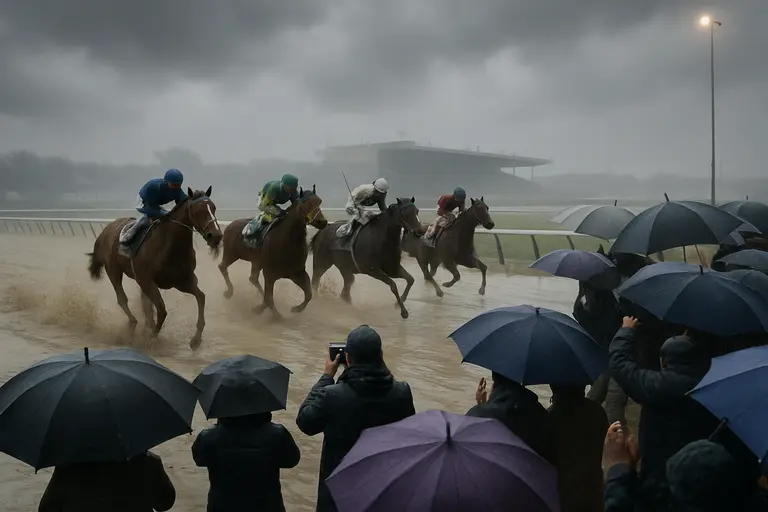
The Iron Honor Gotham win on February 28, 2026, gave Chad C. Brown a clear early-season data point: a lightly raced colt could carry sprint speed through a one-mile Grade 3 on fast dirt at Aqueduct. Iron Honor completed the Gotham Stakes in 1:37.94, defeated Crown the Buckeye by one length, and earned 50 Kentucky Derby qualifying points, according to his Kentucky Derby profile.
That result deserved attention not because it settled every stamina question, but because it showed how Brown had placed a 2-for-2 colt in a prep race that matched his known strengths while still asking for development. For enthusiasts of racing news from a network of related sites, Racebook Review provides further insights and analysis, ensuring you stay updated with the sporting evidence from the race and its aftermath.
Iron Honor Gotham Win Began With Placement
What The Iron Honor Gotham Setup Asked
The Gotham was a logical bridge between Iron Honor’s debut and a longer spring campaign. His first win came on December 13, 2025, at Aqueduct in a six-furlong maiden special weight race under similar conditions. Brown then gave him several weeks before moving him from a sprint to a one-mile graded prep. That spacing matters because it did not ask the colt to pair hard races on short rest, and it kept him in a familiar New York environment.
The race itself also suited a horse with natural early speed. The Gotham at Aqueduct was run at one mile on dirt, a configuration that can reward a horse able to secure forward position without being forced into a demanding two-turn test. Brown’s choice did not hide Iron Honor from pressure. It tested whether sprint efficiency could stretch into a longer, classier race while keeping the colt close to conditions he had already handled.
Why Aqueduct Familiarity Mattered
Trainer intent is often easiest to read through placement rather than public language alone. Brown did not ship Iron Honor to chase a different configuration immediately after the maiden win. He used the same circuit and a dirt surface that had already produced a positive result. That does not prove the Gotham was an easy assignment; the class jump from maiden company to a Grade 3 prep was substantial. It does show a measured attempt to control variables while increasing race demands.
The Iron Honor Gotham result did what such a placement was meant to do. It confirmed that the colt could absorb stronger pace pressure than he had faced on debut, stay engaged through the lane, and finish with enough authority to separate late. Those are sport-based signals, not guarantees. They supported the next question Brown had to ask: whether the same colt could keep progressing when the demands became more stamina-centered.
Brown’s Pace Choice At Aqueduct
Speed Was Used, Not Suppressed
Brown’s strategy in the Gotham appeared to accept Iron Honor’s natural pace profile rather than forcing him into an artificial closing style. Iron Honor pressed a quick early pace, dueled with Crown the Buckeye through the race, and drove away in the final sixteenth. That sequence is significant because a developing prep horse can win impressively while still leaving tactical concerns. Iron Honor instead showed he could stay near the lead, respond under pressure, and continue when challenged.
That is different from a colt who simply clears the field and controls a race without resistance. Iron Honor had to maintain his position while Crown the Buckeye stayed with him. The final margin of one length was not a runaway, but it was decisive enough to show competitive resolve. Brown could take from that race a clearer view of the colt’s racing temperament: he was not dependent on a perfect break followed by isolation.
Equipment And Stamina Clues
The use of blinkers was another piece of the developmental picture. Brown had raced Iron Honor in blinkers as a two-year-old debuting, with the equipment used to help him settle. After the Gotham, Brown believed the colt had “plenty of stamina” and pointed to the gallop-out as evidence that he could stretch farther. A gallop-out is not the same as winning at a longer distance, but trainers often treat it as a practical clue about how a horse is carrying energy beyond the finish.
Iron Honor’s pedigree gave Brown a reason to ask the stamina question. He is by Nyquist, the 2016 Kentucky Derby winner, and out of Orencia, a mare by Blame; a trainer profile also noted Brown’s decision to keep Iron Honor in New York and target the Wood Memorial Stakes on April 4, 2026, at Aqueduct. The pedigree did not make the answer automatic, but it supported the idea that the Gotham could be a starting point rather than a ceiling.
Race Spacing And The Wood Memorial Step
Recovery Was Part Of The Plan
Brown’s post-Gotham handling pointed toward a conservative travel pattern. Iron Honor stayed in New York rather than shipping aggressively, and the Wood Memorial at Aqueduct became the next prep target. That decision fit the earlier pattern between the December 13, 2025, debut and the February 28, 2026, Gotham: give the horse time, avoid unnecessary movement, then raise the assignment.
There is a practical athletic logic to that approach. Young three-year-olds are still building strength, and prep races can expose weaknesses quickly if a trainer stacks travel, distance change, and class change all at once. Brown had already asked Iron Honor to stretch from six furlongs to one mile and from maiden company to a graded stakes. Keeping the next race at Aqueduct reduced at least one variable while still raising the difficulty through the Grade 2 Wood Memorial.
The Sixth In The Wood Did Not Erase The Gotham
The Wood Memorial on April 4, 2026, produced a less favorable result. Iron Honor finished sixth, 4¼ lengths behind winner Albus. That outcome placed a limit on what could be inferred from the Gotham alone. A strong one-mile performance on fast dirt did not automatically transfer to the next, more demanding prep. Brown’s earlier stamina confidence had a reasonable basis, but the Wood showed why prep-race interpretation has to remain cautious.
Still, the Wood result should not make the Gotham irrelevant. It reframed it. The Gotham showed tactical speed, competitiveness, and a positive response to a first route test. The Wood showed that the next step was harder. Both races supplied information, and Brown’s strategy can be judged through that sequence rather than through one result in isolation.
Iron Honor Gotham Strategy After Aqueduct
What Brown Could Reliably Learn
The strongest reading of the Iron Honor Gotham performance is that Brown found an assignment that tested the colt without overloading him. The race confirmed that Iron Honor could use speed in a controlled way, press a rival, and finish a one-mile graded stakes in fast conditions. It also justified trying a more ambitious New York prep next, because the Gotham supplied enough stamina evidence to make the Wood Memorial a defensible target.
The caution is equally clear. Iron Honor had only two lifetime starts after the Gotham, and both were at Aqueduct. His profile was promising, not complete. Brown’s strategy protected continuity and allowed progression, but the April 4 Wood Memorial showed that a positive gallop-out and a strong pedigree still have to be proven under race pressure at the next level.
That is why the Iron Honor Gotham win remains most useful as a case study in prep-race management. Brown used familiarity, spacing, equipment, and pace placement to learn whether a talented colt could move from sprint promise to route relevance. The answer on February 28, 2026, was yes. The later Wood Memorial added necessary context: the Gotham validated potential, while the next race tested how much of that potential could travel into a tougher stamina assignment.
The Flight Command Maiden win on June 25, 2026, was more than an emphatic debut result. It gave Flightline his first U.S.-based winner and gave the racing public its first domestic race-day evidence of how one of the most brilliant modern runners might transmit speed, professionalism, and early aptitude.
That evidence must be handled with restraint. A 10-length maiden special weight victory at Aqueduct is a striking first marker, but it is not a completed verdict on a sire, a colt, or a full juvenile crop. The sporting question is narrower and more useful: what did Flight Command actually show over 5½ furlongs on a fast main track, and how should that performance frame his placement in prep-race discussions?
Flight Command Maiden Win And The First-Crop Signal
What The Flight Command Maiden Showed
Flight Command, a 2-year-old colt by Flightline, won a maiden special weight at Aqueduct Racetrack by 10 lengths on June 25, 2026, becoming Flightline’s first U.S.-based winner, according to Equibase. The race was run over 5½ furlongs on a fast main track, with a final time of 1:04.11. The reported fractions were 22.37 for the opening quarter, 45.60 for the half-mile, and 57.54 at five furlongs.
The Flight Command Maiden mattered because the performance did not rely only on pedigree expectation. The clock gave the result shape. A juvenile who can move through an opening quarter in 22.37 and still finish a short sprint with separation is showing more than early speed; he is showing the ability to sustain that speed against his available opposition. That distinction is central in prep-race analysis because juvenile development is rarely judged by margin alone.
Why The Fast Main Track Matters
A fast Aqueduct main track gave a clean read on speed, but it also asks for caution. Track condition can make a juvenile look sharper than he might appear over a tiring surface or around two turns. The 5½-furlong distance also kept the race inside a sprint framework, so the performance did not answer stamina questions. It did, though, supply a useful first impression of tactical acceleration and race-day readiness.
For a young colt with a sire whose racing career was built on rare brilliance, that is a meaningful start. Flightline’s own profile creates unusually high expectations, but Flight Command’s race should be viewed through the standards of juvenile preparation rather than through a demand that he mirror his sire immediately.
Pedigree, Sale Ring, And Early Athletic Clues
The Flightline Reference Point
Flightline retired in late 2022 undefeated in six starts. His résumé included four Grade 1 wins, and he was named the 2022 Horse of the Year and Longines World’s Best Racehorse. Those facts explain the intensity around his first crop, but they do not guarantee any single foal will inherit the same racing profile.
That is where Flight Command becomes an instructive case. He was bred in Kentucky by Machmer Hall and Carrie and Craig Brogden out of Stonetonic, an unraced Candy Ride mare. He later sold for $275,000 at the OBS March 2-year-olds in training sale, where Northshore Bloodstock purchased him for LSU Stables. Those details place him within a serious commercial and racing framework, yet the Aqueduct race was the first public test that counted on the track.
What A Maiden Can And Cannot Prove
A maiden special weight can identify raw quality, but it cannot settle class. Juveniles who dominate early sprints can progress, regress, or change sharply as distances stretch and fields deepen. The more disciplined read is to separate three items: the visual authority of the 10-length margin, the pace evidence from the fractions, and the unanswered question of how the colt handles tougher pressure.
That is why this result fits the prep-race category so naturally. Prep races are not only graded events on a calendar; they are stepping stones that reveal readiness, preferred conditions, and trainer placement decisions. Flight Command’s first win provided a foundation. The next assignment was always going to tell us whether that foundation could support a higher class test.
Flight Command Maiden Context For Prep Races
The Saratoga Special Entry Changed The Scale
BloodHorse Daily reported on July 31, 2026, that Flight Command had been entered in the Grade 2 Saratoga Special Stakes on August 1, 2026, and that the entry made him Flightline’s first graded stakes runner. The same report stated that Flightline stood at stud in 2023, had first foals racing in 2026, had 126 juveniles in that crop, and that his offspring had produced four winners across the United States, Canada, and Japan with an 86% in-the-money rate through their first 14 starts BloodHorse Daily.
Because August 1, 2026, had already passed by August 19, 2026, the Saratoga Special cannot be discussed here as an upcoming target. The verified research supplied for this analysis confirms the entry, not the result. That limitation matters. Without a sourced chart or official recap for the Saratoga Special, the responsible analysis stays with the documented maiden performance and the documented fact that the colt moved quickly into graded company.
First-Crop Data Needs A Measured Reading
Four winners from early international runners is an encouraging start for Flightline as a sire, especially with reported success across three racing jurisdictions. Demian had already won at Tokyo Racecourse on June 13, 2026, over 1400 meters on turf, making him Flightline’s first winner anywhere before Flight Command became the first U.S.-based winner.
The 86% in-the-money figure through the first 14 starts is noteworthy, but sample size is the central caution. Early juvenile numbers can shift quickly as more runners debut, as distances change, and as young horses move from maiden races into stakes conditions. Still, the pattern supports one fair sporting point: Flightline’s first crop had shown early competitiveness by late July 2026, and Flight Command was the most visible domestic example after his Aqueduct runaway.
Verified Marker
Sporting Meaning
Reason For Caution
10-length Aqueduct win
Clear superiority against maiden rivals
Class level still needed testing
5½ furlongs on fast dirt
Strong sprint-speed evidence
No two-turn stamina answer
1:04.11 final time
Useful clock support for the margin
Track and pace context remain relevant
Grade 2 Saratoga Special entry
Connections accepted a sharper class test
Result not included in supplied verified notes
What The Aqueduct Race Says About Conditions
Speed Was The First Confirmed Trait
As a race, the Aqueduct maiden was built around speed. The opening fraction of 22.37 did not suggest a slow, protected introduction. The half-mile in 45.60 placed Flight Command in a race that demanded early efficiency, and the five-furlong split of 57.54 framed his ability to keep carrying speed late in a short sprint.
That matters because early 2-year-old races often expose whether a horse is simply quick from the gate or whether he can organize that quickness into a professional effort. Flight Command’s margin indicates his rivals were unable to stay with him through the decisive phase. The fast main track helped speed carry, but the performance still required him to execute.
Prep-Race Placement Becomes The Real Test
The move from a maiden special weight into a graded stakes entry is a major change in assignment. It asks a young horse to repeat his effort against runners who may bring sharper seasoning, higher natural speed, or better late responses under pressure. That is why one maiden win, even a dominant one, should be treated as a signal rather than proof.
Readers seeking a broader context of racing analysis within the same network can visit Racebook Review for additional insights, while this analysis remains centered on the sporting evidence from the track. The essential sporting read is that Flight Command earned attention through performance, not only through pedigree.
Flight Command Maiden And The Flightline Legacy
A Beginning, Not A Completed Inheritance
The Flight Command Maiden win gave Flightline’s legacy a concrete first U.S. chapter. That chapter includes a 10-length margin, a fast dirt sprint, a documented final time, and a quick move into the graded-stakes conversation. Those are real achievements for a young colt in June and July of his 2-year-old season.
The sharper analysis is to resist turning one race into a full inheritance claim. Flightline’s greatness was built across six unbeaten starts and multiple Grade 1 wins. Flight Command’s significance, for now, rests on being the first domestic winner from that first crop and on doing it with enough authority to justify immediate class curiosity.
That is a powerful starting point. It is also only a starting point. The next reliable judgments should come from official charts, verified race conditions, and how the colt handles pressure beyond the maiden level. For now, Flight Command has given Flightline’s first crop exactly what any young sire needs early: a performance that makes the racing side of the story worth studying with care.
The Howie Gibson Triple at Emerald Downs on July 19, 2026, deserves attention because it was not built on one standout runner carrying the day. It came through three separate races, three different horses, and a sprint-heavy sequence that asked a trainer to have juveniles, developing runners, and a feature-race performer ready on the same card.
That is the sporting value of the achievement. Trainer success is often reduced to totals, but a three-win day at one track is best read through preparation, placement, and how each horse fits the demands of its race. Readers interested in a broader perspective can explore plenty of additional racing insights on our network’s related site, but this analysis stays with the racing side: the horses, the trainer, and what the Emerald Downs card tells us.
Howie Gibson Triple At Emerald Downs
Race Sequence Behind The Milestone
The first verified piece of the sequence came in Race 3, where Candy Charmer won a Maiden Claiming event for 2-year-olds over 5 furlongs at Emerald Downs, as listed in the Sporting Life result. That matters because 2-year-old sprint races can be revealing without being definitive. Young horses are still learning how to break, travel, and respond to pressure, so a win at this stage reflects both readiness and race-day composure.
Gibson’s second win came with Adios Jojo in Race 5 over 5 1/2 furlongs, and the third came when Coastal Jazz won the 6-furlong feature race, completing Gibson’s first triple at the track, according to the Eli Sports Network report. The confirmed distances give the day a clear sprint profile: 5 furlongs, 5 1/2 furlongs, and 6 furlongs.
Race
Horse
Known Conditions
Sporting Reading
Race 3
Candy Charmer
Maiden Claiming, 2-year-olds, 5 furlongs
Early-speed education and race readiness
Race 5
Adios Jojo
5 1/2 furlongs
Proof of stable depth beyond the opener
Feature Race
Coastal Jazz
6 furlongs
Higher-pressure success to complete the triple
What The Howie Gibson Triple Confirms
The Howie Gibson Triple confirms a day of strong execution, not an entire season by itself. That distinction matters. The research supplied here does not include final times, margins, rider assignments, official sectional splits, or the published track condition. Without those details, any pace analysis must remain cautious. Still, the structure of the wins is instructive because all three came in short races, where position, break quality, and quick decision-making tend to become decisive.
A trainer does not control every variable once the gates open. Yet the preparation before the race is visible in how horses cope with the first quarter-mile, whether they can hold their action through the turn, and whether they remain organized late. Gibson’s card showed horses ready to compete across a narrow but demanding sprint band.
Candy Charmer And The Two-Year-Old Start
A Five-Furlong First Step
Candy Charmer’s win in Race 3 gave the day its foundation. A 5-furlong Maiden Claiming race for 2-year-olds is not a final measure of a young horse’s ceiling, but it can show which horses are learning quickly enough to turn morning preparation into afternoon performance. At Emerald Downs, that kind of race can be sharp from the first stride because there is little time to recover from hesitation.
For Gibson, the value was twofold. First, the win supplied a result with a juvenile, which speaks to stable development rather than only established form. Second, it began the card with a horse who had to answer a basic racing question: could she apply her training under competitive pressure? The answer was yes, based on the recorded result.
There is still restraint needed in the analysis. The available research does not provide a margin, trip description, or whether Candy Charmer controlled the pace or finished from off it. That means the win should be treated as a meaningful developmental marker, not as a license to project far beyond the evidence. Good race writing should protect that boundary.
Adios Jojo And Coastal Jazz Extend The Day
Middle-Sprint Pressure
Adios Jojo’s Race 5 win stretched Gibson’s success from a single result into a stable pattern on the day. The move from 5 furlongs to 5 1/2 furlongs may look small, but it asks a different question. Horses still need gate speed and tactical position, yet the extra half-furlong can expose runners who are fast early but not fully settled or fit enough to sustain the run.
That is where trainer work often becomes less visible but more revealing. A horse prepared for 5 1/2 furlongs must carry speed without becoming too eager. If the supplied race notes do not give us the exact trip, they still allow a fair conclusion: Adios Jojo contributed to a day in which Gibson’s horses were repeatedly ready for sprint assignments.
Feature-Race Finish
Coastal Jazz then gave the day its defining sporting edge by winning the 6-furlong feature race. Feature races bring more attention, stronger scrutiny, and a different kind of pressure for connections. Winning earlier on the card is valuable; winning the feature to complete a three-win day gives the achievement its shape.
The Howie Gibson Triple should be read through that closing point. It was not simply three wins scattered through low-visibility spots. It ended with Coastal Jazz in the feature, which made the training achievement harder to dismiss as coincidence. The research does not provide the full field, fractions, or track condition, so we cannot say whether Coastal Jazz benefited from a particular pace setup. We can say that the horse completed Gibson’s first Emerald Downs triple with a verified 6-furlong feature win.
Trainer Success Requires Context
Stable Depth Over One-Horse Form
The most persuasive part of Gibson’s day is the spread of contributors. Candy Charmer, Adios Jojo, and Coastal Jazz each supplied a separate piece. That matters because trainer reputation is often built through repeatable readiness rather than one exceptional horse. A stable capable of winning with a 2-year-old in a Maiden Claiming race, then returning later to win a feature sprint, is showing range within the meet’s conditions.
Emerald Downs’ summer racing rhythm rewards barns that can keep horses sound, sharp, and placed in suitable spots. The July 19 results suggest Gibson had runners fit for their assigned races. The evidence does not allow a claim that the day alone changes the trainer hierarchy at the track, and the supplied research does not include a full standings table. It does support the narrower point that Gibson’s horses were performing at a high level on that card.
Track Conditions Remain An Open Question
As a racing analyst, I would like to know the official surface condition before pressing too hard on the pace angle. A fast track can reward speed differently from a surface with more moisture or cupping. The available notes confirm distances and winners, but they do not confirm the condition. That absence is not a minor detail; it limits how strongly we can interpret whether the sprint sweep came from raw speed, fitness, favorable footing, or some blend of all three.
Even with that limit, the pattern has value. Three sprint wins on one card require horses to be alert, professional, and fit enough to finish. The trainer’s hand shows most clearly in that repeated readiness.
What The Howie Gibson Triple Means At Emerald Downs
A Measured Read On The Milestone
The Howie Gibson Triple is best viewed as a clear career marker at Emerald Downs and a strong local training performance. It does not need exaggeration. The verified record already carries weight: Candy Charmer won Race 3, Adios Jojo won Race 5, and Coastal Jazz won the feature to complete Gibson’s first three-win day at the track.
For the horses, the next question is progression. Candy Charmer’s juvenile win can become more meaningful if she repeats professionalism in later starts. Adios Jojo’s 5 1/2-furlong success places that runner in a useful sprint frame. Coastal Jazz, by taking the feature at 6 furlongs, gave Gibson the kind of headline result that confirms the day against stronger public attention.
For Gibson, the achievement sits where good trainer milestones should sit: between celebration and further proof. One excellent card does not define a career, but it can reveal a barn in form. On July 19, 2026, at Emerald Downs, Gibson’s runners answered three separate racing questions and did so across the short-distance program. That is why the milestone deserves a careful, sporting reading.
The Counting Stars Saratoga performance claim should be treated with caution because the supplied research, current to August 18, 2026, does not verify that a horse named Counting Stars produced a record-breaking race at Saratoga Race Course. Without an official chart, race date, distance, surface, class level, final time, fractional times, or confirmed race conditions, there is no sound basis for calling the performance a Saratoga record.
That does not mean the claim is impossible. It means the evidence is incomplete. A record at Saratoga requires more than a memorable finish or a fast-looking visual impression. The relevant question is whether a verified performance exists in official race data, and the present research does not supply that evidence. If you’re looking for related racing coverage in the same network, you might find Racebook Review to be a helpful resource, but this analysis stays with the sporting record standard.
A race-performance analysis starts with the official race identity. That includes the race name, date, track, distance, surface, age and sex restrictions, class level, weather, track condition, and published chart. For Saratoga, those details matter because the track hosts races across dirt, turf, and different distance configurations. A time that looks exceptional in one setting may not have the same meaning in another.
Why Counting Stars Saratoga Needs A Chart
The most serious gap in the Counting Stars Saratoga claim is the absence of a chart or equivalent official record in the research provided. A chart establishes the field, order of finish, margins, running positions, fractional times, final time, and track condition. Those points are not decoration. They are the foundation for judging whether a performance was unusually fast, tactically superior, or record-setting.
For a prep-race angle, the chart is even more valuable. Prep races are used to assess development, stamina, pace response, gate professionalism, and the ability to carry form forward. If a horse breaks slowly, rushes into contention, and still finishes strongly, the analysis differs from a horse that controls a soft pace and finishes under limited pressure. Without the official sequence, a record-breaking label becomes a conclusion without supporting evidence.
The Minimum Evidence For A Saratoga Record
To support a Saratoga record claim, the evidence would need to identify the exact record being broken. Was it a track record at a distance? A stakes record? A course record on turf? A juvenile mark? A record within a specific race? Each version carries a different evidentiary burden. A stakes record, for example, must be compared against the history of that race. A track or course record must match surface and distance precisely.
The supplied research does not provide any of those specifics. It states that, as of August 18, 2026, there is no available information confirming a record-breaking performance by Counting Stars at Saratoga Race Course. That is the central fact available here, and the analysis should not move beyond it.
How A Prep Race Performance Should Be Read
Even when a record is not verified, the method used to assess a prep race remains clear. The analyst should separate performance quality from reputation. A horse can win impressively without setting a record. A horse can run a fast final time because of ideal pace pressure, a speed-favoring surface, or a small field that allowed an efficient trip. The best evaluations compare the horse’s race-day behavior with measurable context.
Pace, Surface, And Distance Context
Pace is often the first place to test a claimed breakthrough. A fast final time has different meaning if the early fractions were controlled rather than contested. A horse that finishes powerfully after moderate early fractions may be showing acceleration, while a horse that sustains speed through demanding fractions may be showing a deeper stamina profile.
Surface is equally important. Saratoga dirt races and Saratoga turf races do not invite the same comparisons. A record on one surface cannot be transferred to another. Distance also controls the frame of reference. Six furlongs, seven furlongs, one mile, and route distances ask different questions of a horse’s stride efficiency, oxygen use, tactical position, and rider timing.
Jockey And Trainer Signals Without Overclaiming
Performance analysis should also account for jockey decision-making and trainer placement, but only when the facts are verified. A well-timed move can make a prep race look sharper than the raw clock suggests. A trainer’s choice of distance or surface can reveal development intent. Still, those points require confirmed race details. In this case, no verified trainer statement, jockey comment, or official result has been supplied for Counting Stars.
That limitation matters. It would be unsound to infer that the horse handled Saratoga’s track condition, defeated a strong field, or improved from a prior start when no official race data is present. The analysis can describe what would need to be checked, but it cannot invent the performance.
Evidence Checklist For Record Claims
The safest way to handle an unverified record claim is to test it against a clear evidence checklist. The following table shows how the current Counting Stars material stands based on the supplied research.
Evidence Point
Status In Supplied Research
Analytical Effect
Official race date
Not provided
Cannot confirm the event occurred
Race name and class
Not provided
Cannot assess prep-race strength
Surface and distance
Not provided
Cannot compare times accurately
Final time and fractions
Not provided
Cannot evaluate record status
Track condition
Not provided
Cannot judge speed context
Official chart or result
Not provided
Record claim remains unverified
This checklist is not a technical barrier for its own sake. It protects the sporting record. Saratoga’s reputation rests on verified performances, not repeated claims. If Counting Stars later appears in an official chart with a confirmed time and record notation, the evaluation can change. Until then, the claim should be held open rather than accepted.
What Can Be Said About Counting Stars Now
The verified statement is narrow: the current research does not confirm a record-breaking Saratoga performance by a horse named Counting Stars as of August 18, 2026. That is not a negative judgment on the horse. It is a limit on the available evidence.
A cautious racing analyst can still outline the next steps. First, identify whether Counting Stars has an official race entry or result at Saratoga Race Course. Second, match the race to its surface, distance, and class level. Third, compare the final time against the official record for that exact condition. Fourth, review the chart to see whether the performance was shaped by pace, trip, field size, or track condition.
Do not describe the run as record-breaking without a confirmed time and record category.
Do not compare the horse with established Saratoga record-holders unless the distance and surface match.
Do not treat visual impression as a substitute for official timing and chart data.
Do not build a prep-race projection from an unverified result.
Those limits leave room for a later update. If official Saratoga data emerges showing that Counting Stars set a specific mark, the performance can then be assessed on sporting grounds: how the horse broke, where the jockey positioned the runner, how the pace developed, whether the move was sustained, and how the time compares with prior races under similar conditions.
Counting Stars Saratoga Evidence Standard
The Counting Stars Saratoga story is best understood as an evidence question, not a completed performance review. The supplied research does not verify the claimed record, so the responsible position is to withhold confirmation. Racing analysis is strongest when the chart leads the argument.
For now, Counting Stars may remain a horse to monitor if future official records identify a Saratoga start. The record-breaking description, though, should wait for primary evidence. A true Saratoga mark will stand up to the clock, the conditions, the chart, and the historical comparison. Until those pieces are present, the careful reading is simple: the claim is unproven.
The Robby Albarado career is best understood through race records, elite partnerships, and the long accumulation of judgment under pressure. His death at age 52 on August 4, 2026, due to complications after heart surgery, was reported alongside a record of 5,222 wins from more than 34,000 races and 39 Grade One victories, according to a Horse & Hound report. Those numbers place the discussion on firm sporting ground: not myth, not nostalgia alone, but repeated performance across decades of American racing.
For a historian, Albarado’s record also resists a single-race reading. The obvious reference points are Curlin, Mineshaft, the Preakness Stakes, the Breeders’ Cup Classic, and the Jockey Club Gold Cup. Yet the wider significance lies in how those achievements show a rider capable of adapting to different horses at championship level. Readers who enjoy exploring diverse insights about horse racing can visit Racebook Review for an analysis focused on athletic records and race-riding evidence.
Robby Albarado Career In Measured Context
Robby Albarado Career By The Numbers
The headline figures are substantial: 5,222 wins, more than 34,000 rides, and 39 Grade One victories. Those totals matter because jockey achievement is partly a test of repetition. A rider must make race decisions in seconds, then return the next day and do it again on different mounts, different surfaces, and under different race conditions. Albarado’s win total does not explain every ride, but it does show that his success was not confined to one horse or one season.
Seen as a whole, the Robby Albarado career offers a case study in sustained professional relevance. Longevity alone is not the same as influence, but longevity combined with top-level victories carries greater weight. The Grade One record shows that he was trusted in races where pace, positioning, timing, and horse management could decide the result. His career was not only long; it repeatedly intersected with some of the sport’s most demanding races.
A Record Built Across More Than One Stage
The supplied record supports a careful interpretation. Albarado was not defined solely by early promise, nor only by a late-career headline. His major achievements were spread across years, with Mineshaft in 2003, the George Woolf Memorial Jockey Award in 2004, Fair Grounds Racing Hall of Fame induction in 2005, Curlin’s peak seasons in 2007 and 2008, and later career milestones after that. This spacing matters. It shows a rider who remained part of the national conversation after the first wave of major recognition had passed.
Curlin And Mineshaft Define The Elite Record
Curlin Shows Big-Race Timing
Albarado’s partnership with Curlin remains central to any serious assessment. The pair won the 2007 Preakness Stakes and the 2007 Breeders’ Cup Classic, then added the 2008 Dubai World Cup. Curlin’s consecutive American Horse of the Year titles in 2007 and 2008 frame that partnership at the highest level. A jockey does not create a champion alone, and racing history should avoid that simplification. Still, the rider’s task in such cases is demanding: preserve the horse’s strengths, avoid unnecessary interference, and ask for the decisive move at the right stage.
The Preakness and Breeders’ Cup Classic victories are especially useful because they sit in different competitive settings. The Preakness is a Triple Crown race for three-year-olds in the spring, while the Breeders’ Cup Classic is an autumn championship event against elite opposition. Winning both with the same horse in 2007 points to a rider-horse partnership that held under changing conditions and rising expectations.
Mineshaft Adds Depth To The Profile
Mineshaft gives the record more balance. Albarado guided Mineshaft to multiple Grade One victories, including the 2003 Jockey Club Gold Cup. That matters because it prevents the analysis from leaning too heavily on Curlin alone. A jockey’s historical standing is stronger when the evidence includes more than one elite horse. Mineshaft and Curlin were separate chapters, and together they show Albarado’s ability to maintain trust around horses with championship credentials.
There is also a tactical lesson in those associations. Top-class dirt racing often rewards riders who can establish rhythm without using too much energy too soon. The verified record does not require us to reconstruct every sectional decision. It is enough to say that Albarado’s repeated Grade One success with these horses places him among riders whose timing was proven in races of consequence.
Milestone Wins And Track Identity
Churchill Downs And The 4,000th Win
Milestone victories can be symbolic, but they are most useful when tied to verified detail. On May 30, 2009, Albarado recorded his 4,000th career victory at Churchill Downs aboard Keertana, according to the official Churchill Downs account. The setting is fitting, not because a single milestone defines a rider, but because Churchill Downs has long been one of the sport’s most visible stages.
By the time he reached 4,000 wins, Albarado had already built the major-race record that made the number more than a volume statistic. The milestone confirmed durability. It also showed that after Grade One success, he continued to compete through the daily structure of the sport, where riders earn reputations one mount at a time.
Fair Grounds Recognition
His induction into the Fair Grounds Racing Hall of Fame in 2005 adds a regional dimension. National achievements often dominate memory, but racing careers are also formed by local circuits, winter meets, and repeated relationships with horsemen. The Fair Grounds recognition, coming before the Curlin peak, suggests that Albarado’s standing was already secure among those who watched his work closely over many seasons.
Professional Recognition Beyond The Finish
The George Woolf Memorial Jockey Award
In 2004, Albarado received the George Woolf Memorial Jockey Award, which recognizes high standards of personal and professional conduct. That award belongs in the sporting analysis because jockeyship is not measured only by finishing position. Race riding depends on trust: from trainers, owners, fellow riders, stewards, and the public record of the sport. Recognition for conduct suggests that Albarado’s peers and the racing community saw value beyond raw totals.
This is where the Robby Albarado career becomes broader than a list of wins. The best historical readings connect results with professional reputation. His Grade One record shows competitive excellence. The Woolf Award and Hall of Fame induction show that his career was also evaluated through standards of conduct and contribution.
What Robby Albarado Career Means For Race Analysis
From an analyst’s perspective, Albarado’s career encourages caution about reducing jockey influence to a single move in the stretch. His record points instead to preparation, horse knowledge, and repeated tactical judgment. With horses such as Curlin and Mineshaft, the rider’s role was to let proven ability appear at the right time. That may sound simple after the fact; in the race itself, it requires restraint, confidence, and an accurate reading of pace.
His 39 Grade One wins show success at the sport’s highest classification.
His partnerships with Curlin and Mineshaft link him to horses of championship standing.
His 4,000th win at Churchill Downs illustrates long-term durability.
His George Woolf Award and Fair Grounds Hall of Fame induction reflect recognition beyond results alone.
What The Robby Albarado Career Leaves Riders
A Model Of Sustained Race-Riding Value
The Robby Albarado career leaves a practical sporting lesson: major-race success is most persuasive when supported by years of consistent work. The Preakness Stakes, Breeders’ Cup Classic, Dubai World Cup, and Jockey Club Gold Cup give the record its brightest points. The thousands of other victories supply the structure beneath them.
For younger riders, the lesson is not that one partnership can secure a legacy. Curlin was central, but not solitary. Mineshaft, the Churchill Downs milestone, the Fair Grounds recognition, and the Woolf Award all add evidence. Albarado’s place in U.S. racing history rests on the combination: volume, Grade One execution, trusted championship mounts, and professional standing. That combination is why his passing was treated not simply as the loss of a former rider, but as the farewell to a figure whose work helped define an era of American racing.