
The Churchill Track Conditions record from May 2026 offers a useful sporting case study in how surface, weather, and prep timing should be read before major stakes events. The central lesson is not that one label, such as fast dirt or firm turf, explains every result. It is that the label becomes meaningful only when paired with distance, running style, recent works, and the way the surface held through the race card.
Churchill Downs staged several major spring races under conditions that were recorded as stable. On May 1, 2026, the 152nd Longines Kentucky Oaks was run over a fast main track, with Always A Runner defeating a field of 13 fillies according to the official Churchill Downs release. The following day’s Kentucky Derby card also remained on fast dirt in the research record, while the weather file for Louisville described May 2 as mostly cloudy with only trace precipitation during the afternoon and evening, as shown by the National Weather Service archive.
Fans seeking more insights into racing coverage can explore Racebook Review, a related site within the same network, which ties into the broader analysis of track conditions and racing strategies. This analysis stays with the sporting question: how should horsemen, analysts, and fans evaluate a surface before a stakes race without overstating what the data can prove?
Churchill Track Conditions And Fast Dirt
Churchill Track Conditions In The Oaks Window
The Oaks result is a good starting point because the official race note identified both the race status and the track condition. A fast dirt track on May 1 meant there was no need to reinterpret the form through a wet-track lens. That matters with three-year-old fillies, because a sudden change from dry dirt to sealed or muddy footing can alter how early speed carries, how comfortably a closer handles kickback, and how much energy a horse spends holding position.
The 13-filly Oaks field also showed why a race-day condition cannot be reduced to a single word. “Fast” describes the main track category, but it does not describe every tactical choice inside the race. A fast surface may help forward horses if the track is carrying speed, yet it can still reward a runner with stamina if the pace is contested. The label is the baseline, not the full diagnosis.
Weather Evidence From Derby Day
The May 2 weather record helps explain why the Derby-day surface was not treated as compromised in the research notes. Trace precipitation is not the same as sustained rain, and the record did not indicate enough moisture to move the main track away from fast. For analysts, that distinction is essential. A cloudy afternoon can look threatening, but the actual precipitation level is what matters for surface interpretation.
That is where caution protects the analysis. If the track remained fast, then a horse’s performance should not be excused or upgraded simply because the sky looked unsettled. The more relevant questions are how the track played at the race distance, whether previous races on the card showed a speed-favoring pattern, and whether runners were finishing with normal energy.
How Bias Reports Should Be Read
Sprint Speed Was A Strong Signal
The spring-meet research set reported a notable early-speed pattern in short dirt sprints from April 25 through June 14, 2026. In six-furlong dirt races, frontrunners won 34 of 69 races, close to 49 percent. At seven furlongs, early or pace-pressing runners won 20 of 43 races, about 46 percent. Those figures are useful because they separate sprint dynamics from route assumptions.
The caution is that bias figures are descriptive, not automatic. They tell us what happened across a sample; they do not prove why it happened in every race. A high share of frontrunning sprint winners may reflect surface speed, race shape, field composition, or a combination of those factors. The right reading is not “all speed is safe.” The better reading is that a six- or seven-furlong dirt stakes at Churchill during that period required close attention to early position.
Post Position Was Distance Specific
The same spring research noted a sharper inside and early-pace pattern at six furlongs, while seven-furlong dirt races appeared more favorable to early pace from mid-to-outside posts. That difference matters because Churchill’s chute races and one-turn configurations do not ask the same question at every distance.
A rail draw can be an asset if the horse breaks cleanly and holds position. It can become a problem if the runner lacks early speed and is forced to take dirt behind faster rivals. At seven furlongs, a mid- or outside draw may allow a pace-pressing horse to stay in the clear before the turn. This is why track-condition analysis should be tied to distance and field layout, not treated as a general rule for the entire meet. A related discussion of how race setup can change prep interpretation appears in this analysis of prep stakes race conditions.
Turf And Dirt Prep Signals
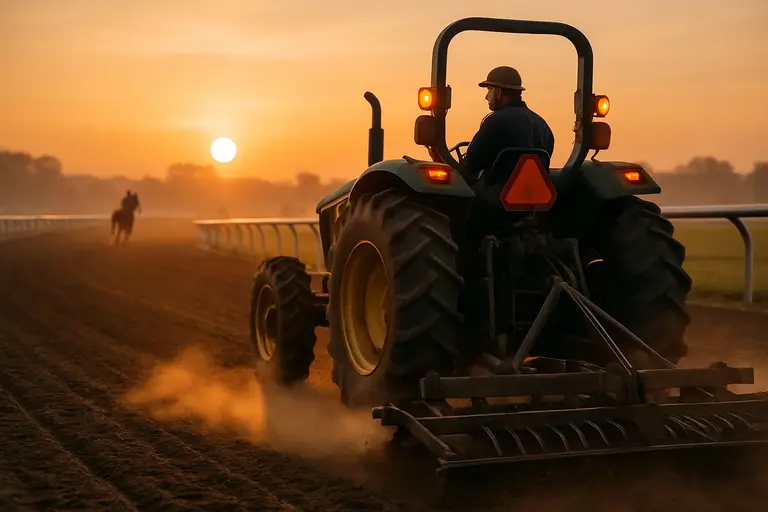
Firm Turf Changed The Modesty Read
The May 1 Modesty Stakes supplied a different surface lesson. The Grade III race was run at 1 1/8 miles on the Matt Winn Turf Course, which was rated firm in the research record. Kathynmarissa rallied widest to win in 1:48.13. That result should not be read the same way as a fast-dirt sprint result, because the energy demands were different.
Firm turf can allow high-quality late runners to sustain momentum, especially when they are able to angle out and build a run without being stopped. Kathynmarissa’s wide rally showed that the course did not make outside movement impossible in that race. Still, one turf stakes does not prove a course-wide closer bias. It shows that on that day, in that race, a wide late move was viable on firm ground.
Final Works Matched Race Week Surfaces
Prep work also belongs in the surface discussion. On April 26, 2026, final works before the Oaks and Derby were conducted over a fast main track in the research record. Potente worked five furlongs in :57.80, while Intrepido worked a half-mile in :45.00. Those times stand out, but the more useful point is that the workouts occurred over the same broad surface category later seen during the major race window.
That alignment can help analysts evaluate readiness, but it should not be exaggerated. A fast work over fast dirt indicates a horse handled that morning’s footing. It does not guarantee the same efficiency under race pressure, with a full field, kickback, and a different pace. Morning drills are evidence of condition and sharpness; race-day performance still depends on how that energy is used.
Churchill Track Conditions Stakes Read
A disciplined read of Churchill Track Conditions before a major stakes event should start with the official surface designation, then test it against weather, distance, running style, and earlier races on the card. The May 2026 examples support that method. The Oaks was run on fast dirt. Derby-day weather produced only trace precipitation in the cited record. The Modesty was run on firm turf and allowed a wide late rally. The Winning Colors Stakes on May 25 was run over fast dirt at six furlongs, with Usha defeating Zeitlos by a head in 1:10.21 after early and tactical speed proved significant.
The cleanest lesson is that surface labels should narrow the analysis, not end it. Fast dirt at Churchill in May 2026 did not mean every race unfolded the same way. Sprint data pointed toward early speed, especially at six and seven furlongs, while the firm turf example showed that late movement could still win when the course allowed sustained momentum.
- Start with the official track or course condition.
- Check verified weather rather than relying on appearance alone.
- Separate sprint evidence from route evidence.
- Read post position through distance and running style.
- Use final works as supporting evidence, not proof.
That is the practical value of Churchill Track Conditions analysis. It does not create certainty. It helps separate real performance signals from assumptions created by a familiar label. For major stakes, that difference can change how a prep race is understood weeks later.