
OTTB Saddle Fit After Racing: When to Recheck It
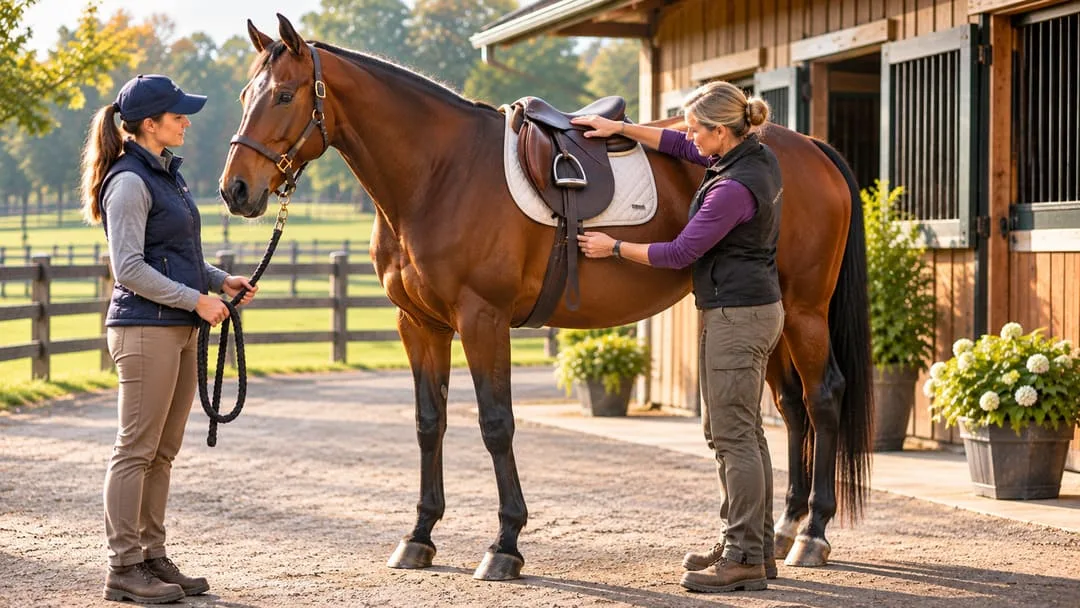
An English saddle that fits a newly retired racehorse at the start of retraining may need adjustment as the horse changes weight, builds back muscles, and begins a new kind of work. The sensible goal is not to buy a temporary, uncomfortable saddle and replace it later. It is to fit the horse properly now and treat the fit as something to monitor, not something settled forever.
That matters for horses moving into the different second careers described in Alex Brown Racing’s off-track Thoroughbred resource. A horse learning to jump, work in an arena, or carry a recreational rider may develop a different outline from the one it had during race training. The tack must suit the individual horse in front of you, whatever its racing record or new ambition.
Why an OTTB’s back can change after retirement
Thoroughbreds do not all have the same back shape. Some have prominent withers or relatively narrow backs; others do not. A horse may arrive with less muscle behind the shoulder, then develop a fuller topline as its condition and work change. A young horse may still be growing. In its guide to fitting English saddles to OTTBs, the Retired Racehorse Project explains why these changes can alter saddle balance and pressure, and why buying a deliberately poor fit in anticipation of future growth is not a good solution.
A saddle can also become unsuitable when a horse loses condition during a break from work. That is why a fit check is especially useful when retraining resumes after time off, not just when the horse first leaves the track.
Build a baseline at the first fitting
Arrange an assessment with a qualified saddle fitter before regular ridden work begins. Ask the fitter to evaluate the horse standing squarely, the saddle’s position behind the shoulder, its balance and contact along the back, clearance around the withers and spine, and how the saddle behaves with an appropriately mounted rider when the horse is ready for ridden assessment. The rider needs to fit the saddle, too.
Photographs from the side and from appropriate safe angles, the fitting date, and any measurements or wither tracings give you a reference point for later visits. A tracing records the shape of the back at a particular time; it is not a diagnosis. The professional process described in Your Horse’s saddle-fitting guide includes checking the horse’s movement and taking measurements that can help reveal changes between appointments.
Avoid trying to solve every balance problem by stacking pads. Some fitting adjustments are possible, depending on the saddle, but a pad cannot make a fundamentally unsuitable tree or panel shape correct.
Notice changes before they become a training dispute
Between appointments, pay attention to what changes while tacking up and riding. A saddle that begins to tip, rock or slide sideways deserves investigation. So do new rub marks, localized swelling, changes in sweat patterns, resistance when the girth is tightened, or reluctance to move freely. None of these signs alone proves the saddle is at fault.
Back pain can also arise from lameness, rider imbalance or other conditions. The University of Connecticut Extension’s guide to preventing back pain in horses describes both tack-related pressure and other causes, including limb problems that change how a horse carries itself. If a horse suddenly bucks, refuses to stand for mounting, becomes noticeably sore or moves abnormally, stop the work that provokes the problem and consult a veterinarian rather than assuming it is a schooling issue. A saddle fitter can then work alongside the veterinarian when appropriate.
Recheck OTTB saddle fit after racing at the right moments
A calendar reminder helps, but a change in the horse should prompt an earlier check. Revisit the fit after noticeable weight or muscle changes, a substantial change in workload, a long break, or repeated saddle movement. The British Horse Society’s saddle-fit guidance recommends assessment by a qualified fitter every six months as a general standard. That is not a reason to ignore new problems during the months between visits.
For a newly retired Thoroughbred, a practical handoff record can include the date of the first fitting, the saddle used, the horse’s condition at that time, and the next planned review. Share it with a trainer, lease rider, or new owner. The record makes it easier to identify when the horse has changed rather than blaming the rider or the horse for discomfort.
A horse’s second career can last many years. One well-chosen saddle may last through much of it, but only if its fit continues to be appropriate. The best measure of success is a horse that moves comfortably and a rider who stays balanced as both learn the new job.