
The Robby Albarado career is best understood through race records, elite partnerships, and the long accumulation of judgment under pressure. His death at age 52 on August 4, 2026, due to complications after heart surgery, was reported alongside a record of 5,222 wins from more than 34,000 races and 39 Grade One victories, according to a Horse & Hound report. Those numbers place the discussion on firm sporting ground: not myth, not nostalgia alone, but repeated performance across decades of American racing.
For a historian, Albarado’s record also resists a single-race reading. The obvious reference points are Curlin, Mineshaft, the Preakness Stakes, the Breeders’ Cup Classic, and the Jockey Club Gold Cup. Yet the wider significance lies in how those achievements show a rider capable of adapting to different horses at championship level. Readers who enjoy exploring diverse insights about horse racing can visit Racebook Review for an analysis focused on athletic records and race-riding evidence.
Robby Albarado Career In Measured Context
Robby Albarado Career By The Numbers
The headline figures are substantial: 5,222 wins, more than 34,000 rides, and 39 Grade One victories. Those totals matter because jockey achievement is partly a test of repetition. A rider must make race decisions in seconds, then return the next day and do it again on different mounts, different surfaces, and under different race conditions. Albarado’s win total does not explain every ride, but it does show that his success was not confined to one horse or one season.
Seen as a whole, the Robby Albarado career offers a case study in sustained professional relevance. Longevity alone is not the same as influence, but longevity combined with top-level victories carries greater weight. The Grade One record shows that he was trusted in races where pace, positioning, timing, and horse management could decide the result. His career was not only long; it repeatedly intersected with some of the sport’s most demanding races.
A Record Built Across More Than One Stage
The supplied record supports a careful interpretation. Albarado was not defined solely by early promise, nor only by a late-career headline. His major achievements were spread across years, with Mineshaft in 2003, the George Woolf Memorial Jockey Award in 2004, Fair Grounds Racing Hall of Fame induction in 2005, Curlin’s peak seasons in 2007 and 2008, and later career milestones after that. This spacing matters. It shows a rider who remained part of the national conversation after the first wave of major recognition had passed.
Curlin And Mineshaft Define The Elite Record
Curlin Shows Big-Race Timing
Albarado’s partnership with Curlin remains central to any serious assessment. The pair won the 2007 Preakness Stakes and the 2007 Breeders’ Cup Classic, then added the 2008 Dubai World Cup. Curlin’s consecutive American Horse of the Year titles in 2007 and 2008 frame that partnership at the highest level. A jockey does not create a champion alone, and racing history should avoid that simplification. Still, the rider’s task in such cases is demanding: preserve the horse’s strengths, avoid unnecessary interference, and ask for the decisive move at the right stage.
The Preakness and Breeders’ Cup Classic victories are especially useful because they sit in different competitive settings. The Preakness is a Triple Crown race for three-year-olds in the spring, while the Breeders’ Cup Classic is an autumn championship event against elite opposition. Winning both with the same horse in 2007 points to a rider-horse partnership that held under changing conditions and rising expectations.
Mineshaft Adds Depth To The Profile
Mineshaft gives the record more balance. Albarado guided Mineshaft to multiple Grade One victories, including the 2003 Jockey Club Gold Cup. That matters because it prevents the analysis from leaning too heavily on Curlin alone. A jockey’s historical standing is stronger when the evidence includes more than one elite horse. Mineshaft and Curlin were separate chapters, and together they show Albarado’s ability to maintain trust around horses with championship credentials.
There is also a tactical lesson in those associations. Top-class dirt racing often rewards riders who can establish rhythm without using too much energy too soon. The verified record does not require us to reconstruct every sectional decision. It is enough to say that Albarado’s repeated Grade One success with these horses places him among riders whose timing was proven in races of consequence.
Milestone Wins And Track Identity
Churchill Downs And The 4,000th Win
Milestone victories can be symbolic, but they are most useful when tied to verified detail. On May 30, 2009, Albarado recorded his 4,000th career victory at Churchill Downs aboard Keertana, according to the official Churchill Downs account. The setting is fitting, not because a single milestone defines a rider, but because Churchill Downs has long been one of the sport’s most visible stages.
By the time he reached 4,000 wins, Albarado had already built the major-race record that made the number more than a volume statistic. The milestone confirmed durability. It also showed that after Grade One success, he continued to compete through the daily structure of the sport, where riders earn reputations one mount at a time.
Fair Grounds Recognition
His induction into the Fair Grounds Racing Hall of Fame in 2005 adds a regional dimension. National achievements often dominate memory, but racing careers are also formed by local circuits, winter meets, and repeated relationships with horsemen. The Fair Grounds recognition, coming before the Curlin peak, suggests that Albarado’s standing was already secure among those who watched his work closely over many seasons.
Professional Recognition Beyond The Finish
The George Woolf Memorial Jockey Award
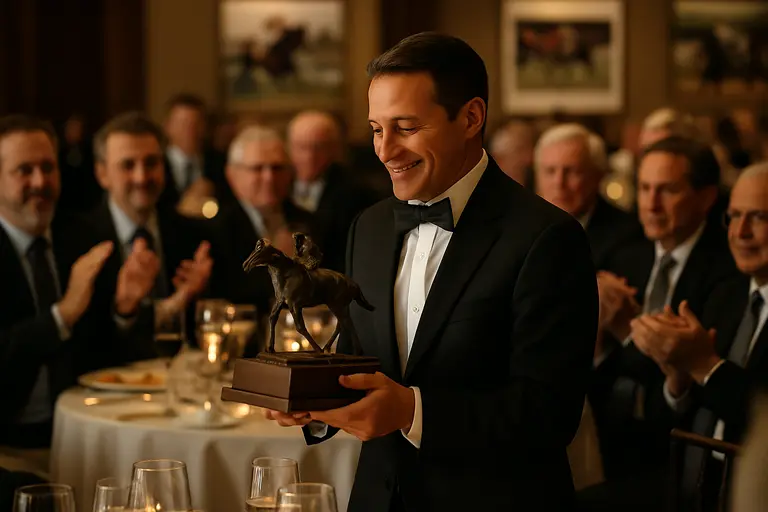
In 2004, Albarado received the George Woolf Memorial Jockey Award, which recognizes high standards of personal and professional conduct. That award belongs in the sporting analysis because jockeyship is not measured only by finishing position. Race riding depends on trust: from trainers, owners, fellow riders, stewards, and the public record of the sport. Recognition for conduct suggests that Albarado’s peers and the racing community saw value beyond raw totals.
This is where the Robby Albarado career becomes broader than a list of wins. The best historical readings connect results with professional reputation. His Grade One record shows competitive excellence. The Woolf Award and Hall of Fame induction show that his career was also evaluated through standards of conduct and contribution.
What Robby Albarado Career Means For Race Analysis
From an analyst’s perspective, Albarado’s career encourages caution about reducing jockey influence to a single move in the stretch. His record points instead to preparation, horse knowledge, and repeated tactical judgment. With horses such as Curlin and Mineshaft, the rider’s role was to let proven ability appear at the right time. That may sound simple after the fact; in the race itself, it requires restraint, confidence, and an accurate reading of pace.
- His 39 Grade One wins show success at the sport’s highest classification.
- His partnerships with Curlin and Mineshaft link him to horses of championship standing.
- His 4,000th win at Churchill Downs illustrates long-term durability.
- His George Woolf Award and Fair Grounds Hall of Fame induction reflect recognition beyond results alone.
What The Robby Albarado Career Leaves Riders
A Model Of Sustained Race-Riding Value
The Robby Albarado career leaves a practical sporting lesson: major-race success is most persuasive when supported by years of consistent work. The Preakness Stakes, Breeders’ Cup Classic, Dubai World Cup, and Jockey Club Gold Cup give the record its brightest points. The thousands of other victories supply the structure beneath them.
For younger riders, the lesson is not that one partnership can secure a legacy. Curlin was central, but not solitary. Mineshaft, the Churchill Downs milestone, the Fair Grounds recognition, and the Woolf Award all add evidence. Albarado’s place in U.S. racing history rests on the combination: volume, Grade One execution, trusted championship mounts, and professional standing. That combination is why his passing was treated not simply as the loss of a former rider, but as the farewell to a figure whose work helped define an era of American racing.