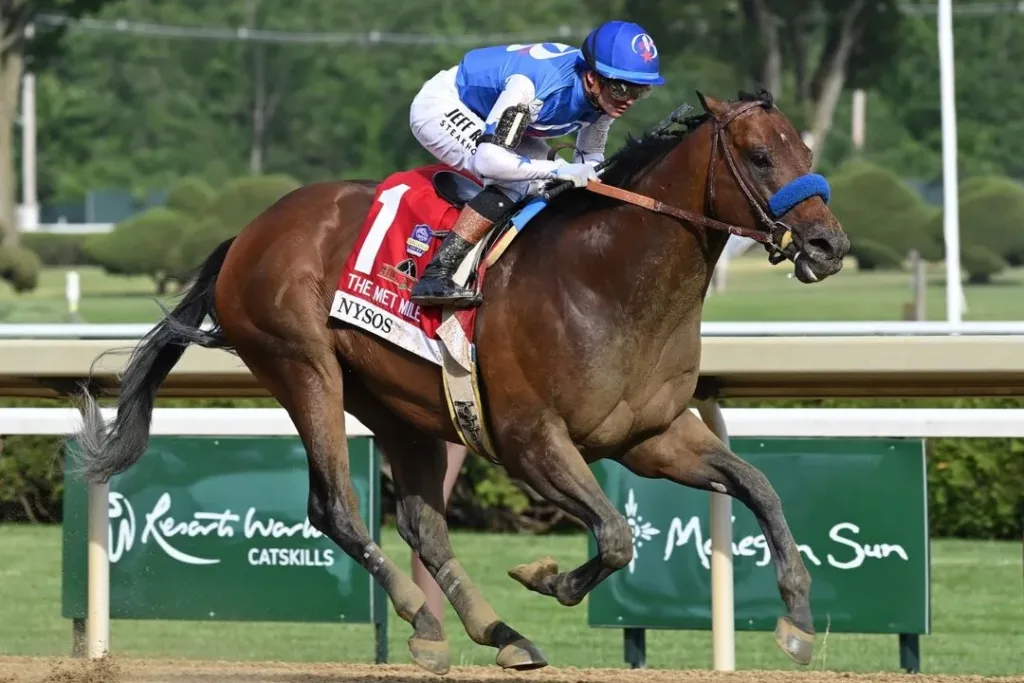
The first weekend of Belmont Track Conditions after the rebuilt grandstand opened offered a narrow but useful evidence set: two race days, several training milestones, and cautious praise from horsemen who had waited since July 9, 2023, for live racing to return to Belmont Park.
On September 18, 2026, Belmont Park staged live racing for the first time in more than three years after a reconstruction project reported at about $550 million, including work on the grandstand, paddock, racing surfaces, and facility infrastructure, according to The Washington Post. The sporting question is not whether the reopening was symbolic. It was. The more durable question is how the four racing surfaces began to function under training and racing pressure.
Belmont Track Conditions After Reopening
Opening-Day Evidence Was Positive But Limited
The September 18 race-day reports gave Belmont a clean starting point. NYRA track-trend data listed the main track as fast and the turf as firm, with clear weather and a temperature around 77 degrees. The same data characterized both turf courses as fair, while noting that saving ground may have offered a slight advantage on the inner turf.
That distinction matters. A fair turf course does not mean every path played identically, and a slight ground-saving edge is not enough, by itself, to define a lasting bias. It does, though, suggest that the first day should be read with path position in mind. Horses that saved ground on the inner turf may have received a modest efficiency benefit, while wider movers had to prove they were overcoming more than distance alone.
Reading Belmont Track Conditions Across Two Days
On September 19, 2026, NYRA again recorded fast and firm conditions, with clear weather and a temperature around 61 degrees. The reported main-track pattern included an outside flow, while the Mellon outer turf and inner turf were described as fair, with possible mild rail bias on turf.
Those early Belmont Track Conditions should be handled as a first reading rather than a fixed profile. Two dry race days cannot answer how the dirt, both turf courses, and Tapeta will behave across different moisture levels, wind patterns, maintenance cycles, and field sizes. Still, the early signs were orderly: fast dirt, firm turf, no broad report of unevenness, and only modest path notes in the available track-trend summaries.
Dirt, Turf, And Tapeta Timelines
The Training Sequence Set The Foundation
The new inner Tapeta synthetic surface opened for training on June 29, 2026, with horses able to light gallop and jog. The main dirt track then reopened for training on July 1, 2026, with a Wednesday-through-Sunday training schedule from 5:30 to 8:00 a.m. Those dates matter because the racing return did not ask the surfaces to move directly from construction to full competition.
The two new turf courses followed a slower path. By mid-August 2026, they were expected to be ready for horse training after nearly a year of rooting. That rooting period is central to turf interpretation. Newly laid or newly developed turf can look visually appealing while still needing time under hooves, irrigation, and maintenance routines. The research record supports caution rather than exaggeration: the surfaces were given time, and early reports were favorable, but long-term durability will require a wider sample.
Surface
Key 2026 Date
Reported Condition Or Use
Inner Tapeta
June 29
Opened for light gallop and jog training
Main Dirt
July 1
Reopened for morning training, Wednesday through Sunday
Two Turf Courses
Mid-August expectation
Expected to begin horse training after nearly a year of rooting
Race-Day Surfaces
September 18-19
Fast dirt and firm turf reported on both days
Infrastructure Changes Were Surface Changes Too
The renovation was not limited to the public-facing grandstand. All four racing surfaces were reported with installed irrigation systems, rails, and marker poles. For sporting analysis, those details are not cosmetic. Irrigation affects turf moisture and firmness; rails shape path usage and ground loss; marker poles help riders and analysts judge race development with precision.
Summer rainfall offered an early stress test before the racing return. NYRA rated the dirt surface’s recovery from substantial summer rain as excellent. That report is encouraging because a dirt track’s response to rain often reveals more than its appearance on a dry morning. Still, the racing record through September 19 only begins to show how that recovery translates into competition.
Early Bias Signals Require Restraint
Fast And Firm Did Not Mean Featureless
Belmont’s first two race days after reopening were both recorded as fast and firm, but each day carried a different interpretive note. September 18 raised the possibility of a slight ground-saving edge on the inner turf. September 19 brought an outside-flow description for the main track and possible mild rail bias on turf.
Those details are small, but they are exactly the kind of small evidence that can shape post-race analysis. A horse making a wide run into a day with a ground-saving turf note may deserve credit for efficiency lost. A dirt performer moving outside on September 19 may have been racing with, rather than against, the day’s flow. The point is not to turn two days into a permanent rule. It is to preserve the conditions as part of the race record.
Comparisons Need Conditions, Not Assumptions
As Belmont resumes its place in the New York racing calendar, comparisons with Saratoga and other major tracks should account for weather, surface, and race shape. A related discussion of how surface condition altered prep-race interpretation at another New York venue appears in this analysis of Saratoga track conditions.
Readers comparing coverage formats across the same publishing group can find adjacent racing resources at Racebook Review; this assessment remains confined to surfaces, training use, race movement, and sporting interpretation.
Horsemen Reaction And Sporting Use
Trainer Comments Pointed To Confidence
Horsemen reaction after the reopening was notably favorable. Shug McGaughey called the new surfaces phenomenal, and Todd Pletcher indicated that the Tapeta’s consistency might persuade some horsemen to winter in New York, according to a Daily Racing Form report. Those comments do not replace race data, but they are significant because trainers and riders interact with surfaces before patterns appear clearly in public results.
Reports from opening day also included praise for the main track, the two turf courses, and the Tapeta. The Tapeta surface is especially significant in a New York context because it adds a synthetic training and racing option associated in the research record with safety and consistency. The strongest claim supported at this stage is practical, not absolute: Belmont now has more surface flexibility than it had before the renovation.
Tapeta Changes The Training Conversation
The Tapeta opening on June 29, followed by dirt training on July 1, created a staged return for horse activity. That sequence gave horsemen a synthetic option before the dirt was fully back in routine use. If Pletcher’s reported wintering comment proves accurate over time, the sporting impact could be felt not in one race but in stable-management decisions across cold-weather months.
That remains an open question as of September 21, 2026. The evidence shows early use, positive reaction, and a clear desire for consistency. It does not yet show a full winter sample, a long record of race outcomes, or enough weather variation to assess every claim that will be made about the new surface set.
Belmont Track Conditions In Historical Perspective
The Rebuilt Facility Reopened With A Measurable Baseline
The first lesson from Belmont Track Conditions after the renovation is that the reopening supplied measurable starting points: fast dirt, firm turf, clear weather, noted path tendencies, and early horsemen approval. Those facts are more useful than broad celebration because they let historians and analysts compare future cards against a dated baseline.
The second lesson is restraint. Belmont Park’s September 18 reopening was an important sporting event, but two race days cannot define how the main dirt, two turf courses, and Tapeta will perform across autumn rain, cooler temperatures, larger stakes fields, and winter training choices. The renovation created a new operating framework; the racing calendar will supply the proof.
For now, Belmont’s renovated surfaces passed their first public tests with favorable reports and no supported evidence in the research record of a major surface problem during the opening two days. The better historical reading is cautious optimism: the new Belmont Park began with positive surface signals, but the most reliable understanding of its track profile will come from repeated race-day evidence under varied conditions.
The Breeders’ Cup Contenders emerging from 2026 prep races present a useful but incomplete map toward Keeneland on October 30-31, 2026. As of September 21, 2026, the clearest evidence comes from horses who have already won Challenge Series or major prep events, including Magnitude in the Stephen Foster Stakes, Nitrogen in the Ogden Phipps Stakes, and Embroidery in the Victoria Mile. TwinSpires lists the 2026 Breeders’ Cup prep schedule and qualifying structure, including several “Win and You’re In” races tied to specific divisions at Keeneland Breeders’ Cup prep races.
That evidence should be read with restraint. A prep win can secure a position or strengthen a divisional profile, but it does not settle the question of how form from Churchill Downs, Saratoga, Tokyo, York, Monmouth Park, Gulfstream Park, or Saudi Arabia will transfer into the conditions of a championship race. The sporting task is to separate what has been verified from what remains a projection. For insightful commentary on the racing scene, RacebookReview.com discusses the racing ecosystem comprehensively; however, this analysis remains focused on race performance, calendar position, and divisional fit.
Breeders’ Cup Contenders From Recent Preps
How Breeders’ Cup Contenders Earned Places
The first dividing line is between horses who earned automatic berths and horses whose recent victories place them firmly in the discussion without necessarily closing every question. Magnitude’s Grade I Stephen Foster Stakes victory at Churchill Downs on June 27, 2026, is one of the most direct examples. The race is identified as a “Win and You’re In” qualifier for the Breeders’ Cup Classic, which means Magnitude secured a guaranteed spot in that division at Keeneland.
Nitrogen’s Grade I Ogden Phipps Stakes win at Saratoga on June 5, 2026, carries similar clarity for the Distaff. The research record identifies the Ogden Phipps as part of the Breeders’ Cup Challenge, with Nitrogen’s victory earning a guaranteed slot in the 2026 Breeders’ Cup Distaff. Fully Subscribed added another Distaff marker by winning the Grade I Personal Ensign Stakes on August 29, 2026, a prep that qualified her for the same championship division.
For Breeders’ Cup Contenders, the automatic element matters because it clarifies access, not superiority. These wins establish that the horses handled Grade I or major prep pressure on a given date. They do not, by themselves, prove which runner will bring the strongest form into late October.
Documented Prep Winners By Division
Magnitude: Grade I Stephen Foster Stakes, June 27, 2026, Churchill Downs; Classic berth.
Skippylongstocking: Pegasus World Cup Invitational Stakes, January 24, 2026; Classic prep winner.
Forever Young (JPN): Saudi Cup, February 14, 2026; Classic-linked “Win and You’re In” event.
Sovereignty: Grade I Whitney Stakes, August 8, 2026; major Classic prep winner.
Nitrogen: Grade I Ogden Phipps Stakes, June 5, 2026, Saratoga; Distaff berth.
Fully Subscribed: Grade I Personal Ensign Stakes, August 29, 2026; Distaff qualifier.
Embroidery: Grade I Victoria Mile, May 17, 2026, Tokyo; Filly & Mare Turf berth.
Item: Juddmonte International Stakes, August 19, 2026, United Kingdom; international turf profile.
Kalpana (GB): Yorkshire Oaks, August 20, 2026; major filly-and-mare turf marker.
Classic Division Winners Set The Early Reference Points
Magnitude And The Stephen Foster Signal
Magnitude’s Stephen Foster win is significant because it gave the Classic division one of its clearest domestic qualifying results before midsummer. The June 27 timing also matters from a preparation standpoint. It left a measurable gap before the Breeders’ Cup at Keeneland, allowing connections time to decide whether to use another start or train forward from the Churchill Downs performance. The research confirms the result and the berth, but does not supply margin, pace details, or post-race comments; any deeper claim about the quality of the win would need chart evidence beyond the present record.
That caution is not a weakness in the case; it is the proper limit of the evidence. Magnitude has the concrete achievement of winning a Grade I Classic qualifier. The remaining evaluation turns on how that June form compares with horses who won later summer or international preps.
Multiple Classic Paths, Different Dates
The Classic group includes prep winners from a broad part of the racing calendar. Skippylongstocking won the Pegasus World Cup Invitational Stakes on January 24, 2026. Forever Young (JPN) captured the Saudi Cup on February 14, 2026. Baby Vino won the Haskell Stakes on July 18, 2026. Sovereignty secured the Grade I Whitney Stakes on August 8, 2026.
Those dates create an analytical challenge. A January or February victory can establish elite form early, but the championship is scheduled for the end of October. A July or August victory sits closer to the target, but it still requires that the horse maintain condition through the closing weeks of the campaign. The records supplied here do not rank those races by speed, margin, or field strength, so the fairest interpretation is that the Classic division has several verified winners with different timing profiles rather than a single settled leader.
This is where recent related analysis of Breeders’ Cup prep tests remains relevant: a prep race can reveal stamina, composure, and class, but it can also reflect a particular race setup that may not repeat at Keeneland.
Distaff And Filly-Mare Turf Lines Have Clear Markers
Nitrogen And Fully Subscribed Share A Distaff Thread
The Distaff line is unusually direct in the available research. Nitrogen won the Grade I Ogden Phipps at Saratoga on June 5, 2026, earning a guaranteed slot in the 2026 Breeders’ Cup Distaff. Fully Subscribed followed with a Grade I Personal Ensign Stakes victory on August 29, 2026, another prep tied to the same division.
Those two results give the Distaff picture a useful sequence: an early June Grade I marker and a late August Grade I marker. Without margins, running styles, or official charts in the research supplied, it would be unsound to claim which performance was stronger. What can be said is that both horses reached the championship conversation through victories in Grade I races identified with the Distaff route.
Embroidery Brings Tokyo Form Into The Discussion
Embroidery’s Grade I Victoria Mile win at Tokyo Racecourse on May 17, 2026, is the central international fact in the Filly & Mare Turf group. The Paulick Report recorded that the victory earned her an automatic fees-paid berth into the 2026 Breeders’ Cup Filly & Mare Turf through the Breeders’ Cup Challenge Series Embroidery’s Victoria Mile win.
That makes her case different from a horse merely being discussed as a possible traveler. The berth was earned on the racecourse in a Grade I event. The remaining question is comparative rather than administrative: how will that Tokyo form match fillies and mares arriving from North American and European routes?
International Turf Form Adds A Different Test
Item And Kalpana Extend The Grass Picture
Item’s Juddmonte International Stakes victory in the United Kingdom on August 19, 2026, gives the turf division another high-profile winner from outside North America. The research describes the race as a turf prep oriented mainly toward international grass contenders who might point toward the Breeders’ Cup Turf or Turf Mile divisions. That wording is properly cautious. It identifies the relevance of the race without declaring a final target.
Kalpana (GB) won the Yorkshire Oaks on August 20, 2026. The research identifies that race as a top-level Group 1 turf event for fillies and mares and a common stepping stone toward the Filly & Mare Turf. As with Item, the key value is not certainty about destination but evidence of high-level grass form close to the championship window.
Why Turf Comparisons Require Restraint
International turf form can be difficult to compare using only race names and dates. Different courses, race tempo, field composition, and seasonal targets can shape the result. The present record confirms that Item and Kalpana won major turf races in August 2026. It does not confirm their final Breeders’ Cup divisions, travel plans, or how their races were run. Those details would require official entries, charts, and connection statements closer to Keeneland.
Even so, the timing is meaningful. August victories leave less of a gap to bridge than winter or spring wins, but they still require sustained condition into October 30-31, 2026. That is especially true for horses whose campaigns may involve international travel and a shift into the Keeneland championship environment.
Breeders’ Cup Contenders Need More Than Prep Wins
What The Verified Record Supports
The verified record supports a disciplined reading. Magnitude, Nitrogen, Fully Subscribed, and Embroidery have the clearest berth-related evidence from the supplied research. Skippylongstocking, Forever Young, Sovereignty, Baby Vino, Item, and Kalpana have major prep victories that define their sporting relevance, though the available notes do not provide enough detail to rank them definitively across divisions.
The present list of Breeders’ Cup Contenders is best treated as a framework rather than a forecast. Prep wins identify horses who have already answered significant questions under pressure. They do not remove the need to assess race conditions, recovery time, final entries, and the specific demands of Keeneland once the championship fields are drawn.
That distinction is central to sound racing history and race analysis. The prep season records achievement first and expectation second. As of September 21, 2026, the achievements are clear: several major winners have earned or strengthened Breeders’ Cup positions. The expectation remains open until those horses meet under championship conditions on October 30-31, 2026.
The question behind Surface Testing at major tracks is not whether one reading can explain a race. It is whether repeated measurement can help officials, horsemen, and analysts separate surface condition from performance, race shape, and injury risk. For prep races, that distinction matters because these events often ask young or developing horses to progress under added pressure, sometimes across changing seasons and track conditions.
The strongest available research in the notes comes from New Zealand turf racing, not from a single North American prep circuit. That matters. The findings are useful because they cover a large racing sample, but they should not be transferred without caution to every dirt, synthetic, or turf course. A prep race at a major American track sits inside a different regulatory and climatic setting. Still, the evidence gives a practical framework: measure often, relate the readings to race speed, and test whether injury patterns move with surface condition rather than relying on appearance or tradition alone.
For racing enthusiasts seeking related insights, Racebook Review provides coverage that complements this article by exploring how race surfaces influence competitive integrity, horse safety, and the analysis of preparation form.
What Surface Testing Can Prove
Measurement Before Surface Testing Claims
A study of New Zealand Thoroughbred Racing turf events covered 16 flat racing seasons, from August 1, 2008, to July 31, 2024. The data set included 437,506 race starts on turf, with only 3% of those starts made by 2-year-olds. It also recorded 40,824 flat turf races, of which 47.1% had published penetrometer readings and 99.9% had a Track Condition Score, or TCS, reported the turf surface study.
That level of TCS reporting is the key sporting point. Surface assessment becomes useful only when it is routine enough to compare across dates, seasons, and race types. A single number on a high-profile afternoon can be descriptive, but a long series of readings can reveal whether a course is behaving as expected. For prep races, where form is often judged by whether a horse accelerated, sustained speed, or struggled late, surface records give analysts a way to ask whether the track helped create that performance.
Surface Testing And Prep Race Timing
Prep races are rarely neutral tests. They come at defined points on a calendar, often when horses are being stretched in distance, shifted in class, or asked to handle a surface at race intensity after works and earlier starts. The New Zealand evidence showed that median TCS was 5.0, with an interquartile range of 3.0 to 8.0. The seasonal split was clear: December and January produced firmer conditions, with a median near 4.0, while June through August produced softer conditions, near 10.
That pattern matters because two prep races at the same distance can place different demands on a horse if the surface has changed. A firmer track can produce faster sections, but the research does not support a simple belief that harder is always better. A softer course can reduce speed and change how a horse finishes. The analyst’s task is to treat the race as a combination of class, pace, distance, and surface, rather than isolating the horse’s effort from the ground beneath it.
Track Scores And Race Speed
Why Moderate Scores Matter
The New Zealand study found a strong nonlinear relationship between TCS and speed over the final 600 meters. Speed peaked around moderate TCS values, near 3 to 4, and fell at both extremes: very hard and very soft or heavy. That is a valuable finding because it pushes the discussion away from slogans. A very quick surface may not be the ideal sporting surface if it increases stress or produces a narrow kind of performance. A very soft surface may be safer in some respects but can reduce speed and place extra demands on stamina.
Surface Testing is persuasive only when it helps define a working range. In the research sample, only 3% of starts between the 2011/12 and 2021/22 seasons were run on a TCS below 3, a threshold New Zealand policy aimed to avoid. That does not prove that every track should adopt the same number, but it shows how policy and measurement can be linked. A standard becomes meaningful when racing authorities can check how often a course falls outside the intended range.
Reading Prep Form With Surface Context
A prep winner who quickens sharply on a moderate turf score may be showing a different quality from a horse who labors through heavy ground and still finishes well. Both efforts can be useful, but they should not be treated as equivalent. The New Zealand final-600-meter finding supports a cautious reading: late speed is partly a horse attribute and partly a surface outcome.
This is where prep race analysis benefits from surface records. If a horse improves its finishing section on a day when the TCS sits near the range associated with peak speed, the result may confirm ability without proving the same acceleration will appear on deeper ground. If another horse fails to quicken when the track is very soft, the performance may need a gentler interpretation. A related discussion of how conditions alter timing and safety review appears in this site’s piece on race conditions in prep stakes.
Regulation At Major Tracks
From Local Practice To Federal Standards
The United States regulatory setting is different from the New Zealand turf sample. The Horseracing Integrity and Safety Act was enacted in 2020, and the Federal Trade Commission describes its oversight role for the Horseracing Integrity and Safety Authority. The framework includes a racetrack safety program, with requirements tied to track surface quality maintenance, pre-meet inspections, seasonal inspections, daily measurements, and standards for consistency FTC HISA oversight.
For major tracks, the shift is not just administrative. It changes what can be reviewed after a prep race. If a track conducts daily measurements and keeps those records within a common safety program, the surface becomes part of the official record of racing conditions. That is a better basis for sport analysis than relying on a visual impression of whether a track looked fast, tiring, or holding moisture.
What The Evidence Does Not Yet Prove
The research notes also report a musculoskeletal injury incidence rate in New Zealand turf flat racing of 2.22 per 1,000 race starts across the seven seasons listed for that outcome, with seasonal changes in injury incidence mirroring seasonal changes in TCS. The reported association was inverse, with r = -0.28. That is useful but not absolute proof of cause. Race class, horse age, training background, weather, rail placement, and veterinary screening can all influence injury patterns.
For that reason, the future of surface review should be judged by linked evidence rather than by confidence in any one instrument. The best case for testing is cumulative: high compliance in measurement, a demonstrated relationship between surface scores and speed, and injury surveillance that can be compared against those readings. The weakest case would be a system that measures surfaces but does not connect those readings to race outcomes or safety decisions.
Prep Race Review After Surface Testing At Major Tracks
A Practical Standard For Racing Analysis
The future standard for judging major prep races should be modest but firm. Analysts should ask four questions after a race: what the surface reading was, whether it sat within the track’s intended range, how the final part of the race compared with expected speed, and whether any safety review raised surface-related concerns. Those questions do not reduce a race to a number. They protect against overreading one result.
Surface Testing will matter most when it is treated as part of the sporting record. Prep races are designed to sort readiness, stamina, tactical speed, and adaptability. Surface data cannot name the best horse by itself, but it can explain why a performance looked unusually fast, why late speed disappeared, or why a promising horse may deserve a more cautious reading after difficult ground.
The evidence now supports a careful position. Routine measurement is feasible. Track scores can be reported at high rates. Final-600-meter speed has shown a clear relationship with TCS in a large turf data set. Injury patterns can be studied against those same records, though cause should be argued with care. For major tracks, that is enough to make surface data a standard part of prep race analysis, not as a replacement for horsemanship or race watching, but as a check on assumptions that once went untested.
Jockey Training Techniques are often discussed as rider craft, but the evidence now points to a narrower and more useful question for prep races: how does the rider’s position interact with the surface beneath the horse? A jockey cannot create a safe or fast track by posture alone. Yet rider mechanics can affect horse movement, horse-jockey timing, and the quality of feedback horsemen receive during morning work.
That distinction matters in prep-race analysis because preparation is not only about finishing speed. It is also about whether the horse is learning to move efficiently across a surface likely to resemble race conditions. For readers interested in a broader perspective on horse racing coverage, Racebook Review is a related site within the same network, offering insights into the sporting evidence regarding rider mechanics, surfaces, and preparation.
What Jockey Training Techniques Can Prove
Jockey Training Techniques At Trot Speeds
A peer-reviewed study published on June 2, 2025, examined the effects of jockey riding position and surface type on horse movement asymmetry and horse-jockey synchronisation during trotting exercise. The study compared the rising position with the two-point seat across artificial, grass, and tarmac surfaces, and found that jockey riding position had a statistically significant effect on the measured movement and timing variables in the published study.
The reported differences were modest in size but useful for interpretation. The research found that the jockey’s stance phase offsets varied by about 1.8 percent between positions, while flight phases varied by about 0.9 percent. It also reported that jockey displacement delays around stance on tarmac were 0.6 to 0.8 percent greater than on artificial surfaces, with p values at or below 0.019. Those figures do not prove that one race-riding style is superior in every case. They do show that the rider’s position can change the timing relationship between horse and rider under controlled exercise conditions.
What The Evidence Does Not Say
The same evidence should be read with restraint. The cited work used trotting exercise, not a full-speed prep race. It tested selected surfaces and measured movement variables, not race outcomes. For that reason, Jockey Training Techniques cannot be judged as a direct shortcut to faster stakes performances. Their value is more practical: they give trainers and riders a way to think about balance, rhythm, and surface response before a horse is asked for maximum speed.
Historically, experienced horsemen have often described good riders as those who stay out of the horse’s way. The modern data gives that older phrase a sharper meaning. A rider’s posture can shift synchronisation at the stance and flight phases of the stride. In a prep-race setting, where a horse may be moving from foundation work to sharper breezes, those small timing differences can affect how cleanly a horse handles the surface.
Surface Feedback In Prep Race Work
Why Surface Changes Matter
Track condition is not a fixed backdrop. It is part of the athletic test. A horse working over turf, synthetic, or a firmer non-racing surface may show different timing, balance, and willingness to lengthen. The 2025 synchronisation study is useful because it connects rider position to surface type rather than treating those factors separately.
For prep races, the practical question is not whether every horse should train the same way. It is whether the training pattern exposes the horse and rider to enough relevant feedback. If a horse is expected to race on turf but does little faster work on turf-like footing, the rider may have less information about how the horse changes leads, settles, or responds when asked to quicken. That concern aligns with broader prep-race work on training load risks, where the issue is not intensity alone but how stress is introduced and repeated.
The Rider As A Measuring Instrument
A jockey or exercise rider is not a laboratory sensor, but the rider is often the first person to feel whether a horse is moving evenly. If the rider’s posture changes the horse-rider timing, then rider consistency becomes part of the evidence. A horse that feels fluent under one position and less balanced under another may not be giving a simple surface signal; it may be responding to both the ground and the rider’s mechanics.
That does not reduce horsemanship to numbers. It makes horsemanship easier to question. If a prep worker appears to handle a surface well, was the footing suitable, was the rider in a stable position, and did the horse keep a consistent rhythm through the stride? Those are sporting questions rather than claims of certainty.
Track Conditions Without Overclaiming
Final-600 M Evidence
A separate study indexed by PubMed examined race and final-600 m speed response to distance and track condition in Thoroughbred flat racing. The dataset covered the 2007/08 through 2024/25 seasons and included 200,601 starts across 3,389 flat turf and synthetic races. It found that final-600 m speed declined as turf track condition score increased from firm toward very soft or wet conditions in the PubMed record.
That finding is consistent with what race readers have long observed: firmer turf can support faster closing fractions, while softer turf tends to place a different burden on stamina and action. The study also reported that variation between initial barrier speed and final speed was influenced by turf condition, race distance, carried weight, and horse rating. Prep races sit within that broader racing pattern. A horse can look sharper late on one type of going and less effective on another without its underlying ability changing.
Optimal Does Not Mean Fastest
The phrase “optimal track conditions” can mislead if it is treated as a synonym for the fastest surface. From a racing historian’s view, the sport has always had to balance speed, durability, and fairness. A prep race that produces a dazzling late sectional on firm footing may reveal acceleration, but it may not answer how the horse will cope if the next target is run under different conditions.
For that reason, Jockey Training Techniques should be evaluated alongside the specific surface question. A rider who can keep a horse balanced through changing ground gives connections better evidence about adaptability. A rider who can only produce a clean work when the footing is ideal may leave doubts unresolved.
Rider position: the 2025 study supports the view that posture affects horse-jockey timing during trot exercise.
Surface type: artificial, grass, and tarmac produced measurable differences in synchronisation variables.
Race condition: the flat-racing speed study links softer turf scores with slower final-600 m performance.
Prep-race reading: a workout should be judged by rhythm, balance, surface relevance, and how the horse finishes.
Jockey Training Techniques For Prep Race Readiness
Reading Technique With Restraint
The best use of Jockey Training Techniques in prep-race analysis is diagnostic, not promotional. They help explain why a horse may work fluently on one surface and less fluently on another. They may also help separate a horse’s true action from rider-induced imbalance. That is especially relevant when a prep race is used to judge readiness for a longer or more demanding target.
Rider position, surface maintenance, and track condition all interact, but the current evidence does not support a universal formula. The 2025 synchronisation study was not a race-result study. The final-600 m study was broad flat-racing research, not a manual for one prep schedule. Taken together, they encourage caution: surface evidence is real, but it must be interpreted in context.
A Sporting Standard For Prep Review
For a racing analyst, the most defensible standard is to ask whether preparation produced usable evidence. Did the horse maintain rhythm? Did the rider stay balanced? Did the surface resemble the demands of the intended race? Did the final part of the work or race reflect stamina, acceleration, or simply favorable footing?
Jockey Training Techniques matter because they shape the signal that trainers, riders, and observers receive from the horse. They do not replace track maintenance, veterinary oversight, or careful conditioning. They sit between those elements, translating the horse’s movement into practical sporting information. In prep races, that translation can be the difference between a performance that flatters and one that genuinely prepares a horse for the next assignment.
The Saratoga dirt trends from the 2026 summer meet are best read with caution. Saratoga’s main track produced important prep-race evidence between July 3 and September 7, 2026, but the verified record supports narrower conclusions than many broad track-bias claims allow.
The most secure starting point is race-specific evidence. Renegade’s victory in the Grade 2 Jim Dandy Stakes on August 1, 2026, showed that a deep closing trip could succeed in a major dirt route at Saratoga. At the meet level, published figures also show dirt races drew smaller average fields than turf races. Those facts matter for prep analysis because pace, position, field size, surface, and distance all shape what a result can prove.
Saratoga Dirt Trends Need A Narrow Evidence Base
Saratoga Dirt Trends And The Meet Frame
The 2026 Saratoga summer meet ran from July 3 through September 7, 2026. Within that span, the dirt program included sprint, mile, and route races serving different developmental purposes. Some were graded stakes, some were allowance or maiden events, and some carried prep value because they tested young horses under pressure at a demanding venue.
Saratoga dirt trends should not be reduced to one universal rule. A seven-furlong juvenile race asks different questions from a 1 1/8-mile route for three-year-olds. Even within dirt racing, the start position, run to the first turn, pace pressure, and class level can change the meaning of a performance.
Why Race Conditions Matter Before Style Labels
Race conditions are the first filter. Distance, age group, class, surface, and field size all define the sporting test before running style is considered. A horse that finishes strongly in a short field may not have faced the same traffic or sustained pressure as a horse that rallies through a larger group. A speed horse that controls a slow pace may not have answered the same question as one that survives pressure through the opening stages.
That is why prep-race review at Saratoga benefits from a conditions-first method. A related analysis of how race conditions shape prep stakes fits this same principle: the race’s structure often explains as much as the final margin.
Jim Dandy Form Shows The Limits Of Bias Claims
Renegade’s Late Run Changed The Read
The Jim Dandy Stakes offers the clearest verified example from the 2026 meet. Held on August 1, 2026, the Grade 2 race was run at 1 1/8 miles on dirt for three-year-olds and served as Saratoga’s local prep for the Grade 1 Travers Stakes. NYRA reported that Renegade rallied from deep to win the race NYRA Jim Dandy recap.
That result does not prove closers held a blanket advantage on Saratoga dirt. It does prove that, under those race conditions, a horse could win a key route prep from well off the early pace. For historians and analysts, that distinction is essential. One result can challenge a broad theory without replacing it with another broad theory.
Distance And Class Shaped The Test
The Jim Dandy’s status as a Grade 2 Travers prep gave it special value. At 1 1/8 miles, the race required more than a quick break or a short burst. It asked three-year-olds to settle, maintain rhythm, and finish over a route distance on the main track.
Renegade’s closing performance therefore belongs in a route-prep file rather than a general sprint-bias file. If later analysis compares him with horses from other Saratoga dirt races, the comparison should account for distance and class. A six-furlong dirt sprint and the Jim Dandy are both main-track events, but they are not the same sporting assignment.
Field Size Shapes Dirt Prep Interpretation
Dirt Fields Were Smaller Than Turf Fields
Meet-level field size provides another useful fact. Daily Racing Form reported that the 2026 Saratoga meet averaged 7.92 starters in dirt races, while turf races averaged 8.66 starters DRF meet figures. That difference is modest, but it has analytical value.
Smaller fields can make trips cleaner. They can reduce traffic, shorten the number of decisions a rider must make, and change how quickly a race sorts itself out. In prep races, that matters because a visually impressive finish may have been aided by a cleaner path, while a less polished effort may contain hidden merit if the horse faced pressure or had to alter course.
Smaller Fields Can Alter Trip Pressure
Field size also affects pace distribution. In a compact dirt route, fewer horses may contest early position, which can leave a pace-setter or stalker in a more comfortable rhythm. In a larger race, the same horse might face pressure from several rivals before the far turn.
This does not mean smaller dirt fields are easier. Saratoga’s dirt races can still be demanding because of class and pace quality. The point is narrower: field size changes the evidence. Prep-race analysis should separate a horse’s effort from the race shape that framed it.
Race Conditions Separate Dirt Sprints From Routes
Sprint Claims Need Verified Charts
Several informal discussions around the 2026 meet emphasized inside draws, early speed, and running-style patterns in dirt sprints. Those claims may be useful prompts for further chart review, but they should not be treated as settled facts without official race-by-race support.
For Saratoga dirt trends, the safer method is to build from verified charts and official race accounts. A dirt sprint at 5 1/2 or 6 1/2 furlongs has a shorter run for position and less time for a horse to recover from trouble. That basic racing logic supports close scrutiny of early position, but it does not justify a fixed rule for every sprint.
Route Evidence Is Best Read Race By Race
Dirt routes demand a different reading. The run into the first turn, the mid-race breather, and the timing of the move all affect the result. Renegade’s Jim Dandy win is useful because it shows a late-running route performance under graded-stakes conditions. It should not be stretched into a claim about every dirt route at the meet.
Prep-race study is strongest when it resists shorthand. A horse that stalks and wins may have benefited from pace comfort, or may have shown tractability. A closer that wins may have received a strong setup, or may have displayed genuine stamina. The race conditions decide which interpretation is most credible.
Saratoga Dirt Trends In Prep-Race Review
The lasting lesson from the 2026 meet is not that Saratoga’s dirt track can be described by one angle. It is that prep-race form needs layered evidence. The Jim Dandy supplied a verified example of a deep closer winning a major route prep. The meet field-size figures showed dirt races were, on average, smaller than turf races. Together, those facts encourage caution.
Saratoga dirt trends should be used as a framework for questions, not as an answer by themselves. Was the race a sprint or a route? Was it a graded prep or a lower-level condition? Did the field size reduce traffic? Did the pace allow one style to appear stronger than it truly was? Those questions keep the analysis tied to the sport rather than to unsupported generalizations.
For readers interested in additional racing coverage within the same network, the Racebook Review provides further insights. The sporting record at Saratoga, though, is clear enough on its own terms: dirt prep results are most useful when each performance is placed back inside its precise race conditions.
That is the proper historical reading of Saratoga dirt trends after September 7, 2026. Saratoga again produced meaningful dirt form, but the strongest conclusions remain race-specific. Renegade’s Jim Dandy rally belongs in any Travers-prep discussion, while field-size differences belong in the context around trip and pace. Anything broader requires more verified chart work before it can be stated with confidence.
The Sovereignty strategy for Bill Mott is less about dramatic change than controlled timing. After Sovereignty won the Grade 1 Whitney Stakes at Saratoga on August 8, 2026 by 4¾ lengths, the next stage became a measured build toward the Grade 1 Jockey Club Gold Cup, scheduled for September 18, 2026.
That approach fits the evidence available from recent work reports. Sovereignty did not disappear from view after the Whitney, but he also was not asked for a demanding drill immediately after a top-level effort. On August 21, 2026, Daily Racing Form reported that he returned to the work tab at Saratoga with a half-mile move in 49.78 seconds over the Oklahoma training track, his first recorded work after the Whitney and part of the lead-up to the Jockey Club Gold Cup DRF report.
For those interested in a broader perspective on racing, Racebook Review is a valuable resource within the same network, complementing current discussions about race preparation and strategy.
Sovereignty Strategy Starts With Spacing
Why The Whitney Changed The Tone
The Whitney mattered because it restored Sovereignty’s immediate Grade 1 momentum. The research record states that the August 8 victory ended a two-race losing streak. That does not automatically mean every question was answered, but it changed the tone of the campaign. A horse coming off a decisive Whitney win can be trained with protection of that form in mind, rather than with the urgency that sometimes follows an uneven return.
Mott’s position appears to be that Sovereignty does not need race volume to prove readiness. The available facts point instead to a program built around selected targets, recovery windows, and controlled training. That distinction is significant in prep-race analysis. Some horses are sharpened through frequent competition; others are kept fresh enough to reproduce their best race when the calendar demands it.
Sovereignty Strategy In The Work Pattern
The Sovereignty strategy is clearest in the August 21 work. Paulick Report described a half-mile move that it timed in 49.85 seconds, with workmate Thunder Roll credited in 49.40. The same report noted controlled fractions under assistant trainer Neil Poznansky and stated that Mott intended to keep Sovereignty at Saratoga to train up to race week rather than ship earlier Paulick Report account.
The small timing difference between the two published accounts, 49.78 and 49.85, is not the central point. Both reports describe a moderate half-mile work, not a hard speed display. For a horse who had just won a Grade 1 race by open daylight, that makes sense. The work reads as a maintenance move designed to keep rhythm, reinforce fitness, and avoid dulling the edge built through competition.
Bill Mott’s Controlled Build Toward September 18
The Saratoga Base Carries Practical Meaning
Keeping Sovereignty at Saratoga until race week is not merely a travel decision. Based on the cited report, it reflects continuity: same training base, familiar routine, and no early need to relocate before the Jockey Club Gold Cup. Racehorses can respond differently to shipping, surface changes, and schedule disruption. The evidence does not prove Mott is avoiding any one concern, but it does support the view that he values a steady environment during this phase.
This is where prep-race management becomes more than a calendar. The Whitney was a major target in its own right, yet it also supplied the form line into September. Mott’s task after August 8 was not to create fitness from nothing. It was to preserve a Grade 1 performance while asking for enough work to keep the horse engaged.
The Thunder Roll Pairing Suggests A Measured Drill
The use of Thunder Roll as a workmate also deserves careful treatment. Workmate pairings can serve many purposes, and without direct barn instruction beyond the published reports, one should avoid assigning too much intent. Still, the reported pattern of a controlled half-mile alongside a partner fits a common training objective: give the horse company, define the tempo, and ask for focus without turning a morning drill into a race.
Paulick Report’s description of controlled fractions is useful because it places the time in context. A half-mile in just under 50 seconds can be interpreted very differently depending on how it was achieved. A relaxed move with a companion is not the same as a pressured drill. In this case, the evidence points toward restraint.
The Earlier 2026 Campaign Provides Context
From Oaklawn To Churchill Downs
The research record places Sovereignty second to White Abarrio in the Grade 2 Oaklawn Handicap in April 2026, then in Grade 1 company at Churchill Downs in the Stephen Foster on June 27, 2026. It also notes a June 20 five-furlong breeze in 1:02.61 at Saratoga’s Oklahoma track, paired with Thunder Roll, before the Foster. Because the permitted inline source list for this assignment is limited, those details should be read as context from the supplied research rather than as independently expanded claims here.
Even with that caution, the pattern is consistent. The works described in the research were not framed as extreme fitness tests. They were purposeful, moderate preparations around major dirt-route assignments. That gives the Whitney-to-Gold Cup sequence a broader shape: competition, recovery, controlled work, and another Grade 1 target.
After A Major 2025 Season
The research also states that Sovereignty’s 2025 season included wins in the Kentucky Derby on May 3, the Belmont Stakes, the Travers Stakes, and the Jim Dandy before a break and a 2026 return. Such a profile creates a different training problem from that of a lightly proven horse seeking recognition. A horse with that record does not need to be campaigned aggressively to establish class. The sporting question is whether he can sustain elite form across seasons.
That is why race spacing matters. It can protect a horse from unnecessary wear, but it also places more weight on each start. When a trainer chooses fewer races, each prep and each workout must carry more diagnostic value. Sovereignty’s Whitney win provided the strongest recent evidence; the August 21 work supplied the first post-race indication that he had resumed the next phase without public signs of a hard setback.
What The Jockey Club Gold Cup Prep Reveals
Preparation Without Overstatement
The Sovereignty strategy should not be overstated as if it guarantees a peak performance on September 18. Work reports are useful evidence, but they are not race results. They tell us about movement, timing, and training intent; they do not settle how a horse will respond under race pressure, against a new field, on a specific afternoon.
That caution is central to evaluating prep races. The Whitney supplied verified competitive form. The August 21 workout supplied a verified return to routine. The Saratoga training decision supplied a verified logistical preference. Together, they show a coherent plan, not a certainty.
Where The Race Fits In The Calendar
The September 18 Jockey Club Gold Cup is the stated next major target in the research and cited reporting. A separate race-level discussion of the Belmont event can be found in this Jockey Club Gold Cup Belmont analysis, but Mott’s handling of Sovereignty is best judged through the narrow evidence available: a Grade 1 Whitney win, a controlled half-mile work, and continued Saratoga training.
That is a restrained but persuasive profile. Sovereignty is not being rushed back on short rest without a public work. He is not being asked for conspicuously fast morning times immediately after a major race. He is being kept in a stable routine, with a workmate and a clear target.
Sovereignty Strategy And The September 18 Test
The Sovereignty strategy entering the Jockey Club Gold Cup rests on patience, not passivity. Mott has a horse coming off a major win, and the available reports show enough activity to confirm forward preparation without suggesting overuse. That is the balance many experienced trainers seek after a peak effort: maintain condition, preserve confidence, and leave the demanding examination for race day.
From a historical racing perspective, this is a classic late-summer management question. A leading older dirt horse, or in Sovereignty’s case a returning champion from a major 2025 campaign, must be kept sharp while avoiding the temptation to prove too much in the morning. Mott’s method, as supported by the reported facts, is to let the Whitney stand as the competitive statement and use Saratoga works as controlled reinforcement.
The September 18 race will provide the only full sporting answer. Until then, the verified evidence shows a trainer choosing spacing, familiar surroundings, moderate work, and a defined Grade 1 target. For Sovereignty, that may be the most logical bridge from the Whitney to the Jockey Club Gold Cup.
The evidence around Del Mar Surfaces in late August 2026 is clearest on turf, where Proletariat’s progression from the Oceanside Stakes to the Grade II Del Mar Derby supplied a direct, local example of a grass prep carrying forward into a major grass route. The dirt side of the comparison requires more caution because the supplied official sources do not provide an equivalent 2026 Del Mar dirt prep result with the same chart-level detail.
That distinction matters for any sporting analysis of prep races. Surface is not a decorative condition; it shapes pace, position, stamina demand, and the value of prior form. Yet the safest reading starts with what the official record confirms, not with broad claims unsupported by primary evidence. For comprehensive race coverage within the same network, be sure to visit Racebook Review, which stands alongside this site’s race analysis.
Del Mar Surfaces And The Turf Prep Question
Del Mar Surfaces And Prep Continuity
The central 2026 turf example came on August 23, 2026, when Proletariat won the Grade II Del Mar Derby at nine furlongs on turf in 1:47.66, according to Del Mar’s own race report Del Mar report. The same report identified his earlier meet win in the Oceanside Stakes, a one-mile grass prep for three-year-olds. In sporting terms, that gave analysts a clean surface-to-surface line: a horse who had succeeded locally on turf returned on the same course type and stretched that form into a longer graded race.
For Del Mar Surfaces, the value of that sequence lies in its restraint. It does not prove that every turf prep will translate into graded success. It does show that, in this specific case, a local grass prep retained relevance when the class and distance increased. That is exactly the kind of evidence historians prefer: same meet, same surface category, identified prep, identified target, and a confirmed result.
Why One Result Is Not A Bias
One race cannot establish a course pattern by itself. Proletariat’s Del Mar Derby win can be read as a sign of individual suitability, race placement, and continuity from one-mile turf to nine-furlong turf. It should not be stretched into a universal rule about all Del Mar grass races. Surface analysis becomes stronger only when repeated race charts, distances, field sizes, and pace scenarios point in the same direction.
This is where caution separates evidence-based history from casual narrative. A horse may move forward because the surface suits him, because the distance suits him, because the race shape helps him, or because his own development has advanced. The official Del Mar facts confirm the result and the prep path. They do not, standing alone, isolate which factor mattered most.
What Proletariat’s Turf Sequence Shows
Oceanside To Derby
The Oceanside Stakes carried greater practical weight in 2026 because of a schedule change. Del Mar’s July 16, 2026 stable notes stated that the La Jolla Handicap had been eliminated from the 2026 stakes schedule, leaving the Oceanside as the local grass prep for the Del Mar Derby July 16 stable notes. Since the Del Mar Derby was run on August 23, that change had already shaped the prep path by the time Proletariat won.
Historically, the removal of a prep race can change the way a division is assessed. When multiple local preps exist, horses can reach a target from different recent race patterns. When one local grass prep stands out, that race becomes a sharper reference point. The Oceanside did not become decisive for every entrant by title alone, but it became harder to ignore because the local turf-route ladder had fewer rungs.
Held Form Over Nine Furlongs
Proletariat’s sequence also asked a classic prep-race question: does form at one mile on grass remain useful at nine furlongs on grass? His Del Mar Derby win answered that question for him personally. He did not merely stay in the same division; he extended his winning form into a longer graded race at the same meet.
That is different from switching surfaces. A turf-to-dirt or dirt-to-turf move introduces another variable, and the supplied official material does not present a comparable Del Mar example from August 2026. Analysts should therefore resist placing dirt and turf conclusions on equal footing here. The turf evidence is specific and official. The dirt comparison remains incomplete under the present source set.
Schedule Change Increased Turf Prep Weight
La Jolla’s Removal
The elimination of the La Jolla Handicap did more than remove a race title from the calendar. It narrowed the local set of grass prep evidence available for the Del Mar Derby. For three-year-olds developing through the meet, the Oceanside became the clearest local turf marker before the Derby.
That affects how recent results should be read. If a horse exits the main local prep and then wins the target, the connection between prep and target becomes more visible. It still does not become automatic. Other horses may arrive from outside Del Mar, from different distances, or from altered training patterns. The point is not that the Oceanside guaranteed Derby relevance; it is that the 2026 schedule made its relevance easier to measure.
Local Evidence Became Narrower
A narrower prep structure can sharpen analysis, but it can also increase the risk of overreading one race. With fewer local grass preps, the analyst has less evidence from the same track and surface. Proletariat’s success therefore carries weight as a confirmed case, while also reminding us that a single prep line should be treated as one strand of evidence rather than a full explanation.
Readers comparing field-size and stakes patterns at the same meet may find useful context in this site’s Del Mar stakes review, particularly where race placement and division depth affect how prep form is interpreted. The sporting question remains the same: what did a horse prove under the conditions he actually faced?
Dirt Comparisons Need Firmer Evidence
What Is Missing
The topic asks about turf versus dirt, but the official evidence supplied here is asymmetrical. The turf side has a named prep, a named graded target, a date, a surface, a distance, and a winning time. The dirt side, in the authorized source set, lacks a parallel recent Del Mar prep case with the same verified detail.
That absence does not mean dirt races at Del Mar lack distinctive demands. It means this specific analysis cannot responsibly claim a verified 2026 dirt-prep pattern from the official sources provided. A sound comparison would require chart-level evidence: race distance, surface condition, calls, margins, field size, and the way each winner achieved position. Without those details, any strong dirt conclusion would outrun the record.
How A Historian Reads The Gap
Racing history often tempts writers to convert a known result into a broad pattern. The better method is slower. First, identify the official result. Second, place it in its schedule context. Third, compare it only with evidence of similar quality. Proletariat’s case satisfies the first two tests for turf. The dirt side needs more primary-source support before it can be weighed evenly against that turf evidence.
This matters because prep races are not abstract trials. They are sporting events run under specific conditions. A horse’s proven form on one surface may or may not transfer to another. The responsible analyst does not assume the answer. He waits for the record to show it.
Del Mar Surfaces In Recent Prep Races
A Cautious Reading Of The Evidence
The most defensible reading of Del Mar Surfaces after the August 23 Del Mar Derby is that turf continuity mattered in a visible, verifiable way for Proletariat. He won the Oceanside Stakes earlier in the meet, then won the nine-furlong Grade II Del Mar Derby on turf in 1:47.66. The 2026 removal of the La Jolla Handicap made that Oceanside-to-Derby line more prominent within the local grass schedule.
The responsible reading of Del Mar Surfaces stops there unless stronger dirt evidence is added. Turf prep form at Del Mar had a confirmed recent success story. Dirt prep dynamics may differ, but this source set does not prove how. For prep-race analysis, that restraint is not weakness. It is the discipline required when surface, distance, calendar structure, and individual development all meet in one result.
The Robby Albarado career is best understood through race records, elite partnerships, and the long accumulation of judgment under pressure. His death at age 52 on August 4, 2026, due to complications after heart surgery, was reported alongside a record of 5,222 wins from more than 34,000 races and 39 Grade One victories, according to a Horse & Hound report. Those numbers place the discussion on firm sporting ground: not myth, not nostalgia alone, but repeated performance across decades of American racing.
For a historian, Albarado’s record also resists a single-race reading. The obvious reference points are Curlin, Mineshaft, the Preakness Stakes, the Breeders’ Cup Classic, and the Jockey Club Gold Cup. Yet the wider significance lies in how those achievements show a rider capable of adapting to different horses at championship level. Readers who enjoy exploring diverse insights about horse racing can visit Racebook Review for an analysis focused on athletic records and race-riding evidence.
Robby Albarado Career In Measured Context
Robby Albarado Career By The Numbers
The headline figures are substantial: 5,222 wins, more than 34,000 rides, and 39 Grade One victories. Those totals matter because jockey achievement is partly a test of repetition. A rider must make race decisions in seconds, then return the next day and do it again on different mounts, different surfaces, and under different race conditions. Albarado’s win total does not explain every ride, but it does show that his success was not confined to one horse or one season.
Seen as a whole, the Robby Albarado career offers a case study in sustained professional relevance. Longevity alone is not the same as influence, but longevity combined with top-level victories carries greater weight. The Grade One record shows that he was trusted in races where pace, positioning, timing, and horse management could decide the result. His career was not only long; it repeatedly intersected with some of the sport’s most demanding races.
A Record Built Across More Than One Stage
The supplied record supports a careful interpretation. Albarado was not defined solely by early promise, nor only by a late-career headline. His major achievements were spread across years, with Mineshaft in 2003, the George Woolf Memorial Jockey Award in 2004, Fair Grounds Racing Hall of Fame induction in 2005, Curlin’s peak seasons in 2007 and 2008, and later career milestones after that. This spacing matters. It shows a rider who remained part of the national conversation after the first wave of major recognition had passed.
Curlin And Mineshaft Define The Elite Record
Curlin Shows Big-Race Timing
Albarado’s partnership with Curlin remains central to any serious assessment. The pair won the 2007 Preakness Stakes and the 2007 Breeders’ Cup Classic, then added the 2008 Dubai World Cup. Curlin’s consecutive American Horse of the Year titles in 2007 and 2008 frame that partnership at the highest level. A jockey does not create a champion alone, and racing history should avoid that simplification. Still, the rider’s task in such cases is demanding: preserve the horse’s strengths, avoid unnecessary interference, and ask for the decisive move at the right stage.
The Preakness and Breeders’ Cup Classic victories are especially useful because they sit in different competitive settings. The Preakness is a Triple Crown race for three-year-olds in the spring, while the Breeders’ Cup Classic is an autumn championship event against elite opposition. Winning both with the same horse in 2007 points to a rider-horse partnership that held under changing conditions and rising expectations.
Mineshaft Adds Depth To The Profile
Mineshaft gives the record more balance. Albarado guided Mineshaft to multiple Grade One victories, including the 2003 Jockey Club Gold Cup. That matters because it prevents the analysis from leaning too heavily on Curlin alone. A jockey’s historical standing is stronger when the evidence includes more than one elite horse. Mineshaft and Curlin were separate chapters, and together they show Albarado’s ability to maintain trust around horses with championship credentials.
There is also a tactical lesson in those associations. Top-class dirt racing often rewards riders who can establish rhythm without using too much energy too soon. The verified record does not require us to reconstruct every sectional decision. It is enough to say that Albarado’s repeated Grade One success with these horses places him among riders whose timing was proven in races of consequence.
Milestone Wins And Track Identity
Churchill Downs And The 4,000th Win
Milestone victories can be symbolic, but they are most useful when tied to verified detail. On May 30, 2009, Albarado recorded his 4,000th career victory at Churchill Downs aboard Keertana, according to the official Churchill Downs account. The setting is fitting, not because a single milestone defines a rider, but because Churchill Downs has long been one of the sport’s most visible stages.
By the time he reached 4,000 wins, Albarado had already built the major-race record that made the number more than a volume statistic. The milestone confirmed durability. It also showed that after Grade One success, he continued to compete through the daily structure of the sport, where riders earn reputations one mount at a time.
Fair Grounds Recognition
His induction into the Fair Grounds Racing Hall of Fame in 2005 adds a regional dimension. National achievements often dominate memory, but racing careers are also formed by local circuits, winter meets, and repeated relationships with horsemen. The Fair Grounds recognition, coming before the Curlin peak, suggests that Albarado’s standing was already secure among those who watched his work closely over many seasons.
Professional Recognition Beyond The Finish
The George Woolf Memorial Jockey Award
In 2004, Albarado received the George Woolf Memorial Jockey Award, which recognizes high standards of personal and professional conduct. That award belongs in the sporting analysis because jockeyship is not measured only by finishing position. Race riding depends on trust: from trainers, owners, fellow riders, stewards, and the public record of the sport. Recognition for conduct suggests that Albarado’s peers and the racing community saw value beyond raw totals.
This is where the Robby Albarado career becomes broader than a list of wins. The best historical readings connect results with professional reputation. His Grade One record shows competitive excellence. The Woolf Award and Hall of Fame induction show that his career was also evaluated through standards of conduct and contribution.
What Robby Albarado Career Means For Race Analysis
From an analyst’s perspective, Albarado’s career encourages caution about reducing jockey influence to a single move in the stretch. His record points instead to preparation, horse knowledge, and repeated tactical judgment. With horses such as Curlin and Mineshaft, the rider’s role was to let proven ability appear at the right time. That may sound simple after the fact; in the race itself, it requires restraint, confidence, and an accurate reading of pace.
His 39 Grade One wins show success at the sport’s highest classification.
His partnerships with Curlin and Mineshaft link him to horses of championship standing.
His 4,000th win at Churchill Downs illustrates long-term durability.
His George Woolf Award and Fair Grounds Hall of Fame induction reflect recognition beyond results alone.
What The Robby Albarado Career Leaves Riders
A Model Of Sustained Race-Riding Value
The Robby Albarado career leaves a practical sporting lesson: major-race success is most persuasive when supported by years of consistent work. The Preakness Stakes, Breeders’ Cup Classic, Dubai World Cup, and Jockey Club Gold Cup give the record its brightest points. The thousands of other victories supply the structure beneath them.
For younger riders, the lesson is not that one partnership can secure a legacy. Curlin was central, but not solitary. Mineshaft, the Churchill Downs milestone, the Fair Grounds recognition, and the Woolf Award all add evidence. Albarado’s place in U.S. racing history rests on the combination: volume, Grade One execution, trusted championship mounts, and professional standing. That combination is why his passing was treated not simply as the loss of a former rider, but as the farewell to a figure whose work helped define an era of American racing.
Nitrogen’s Whitney Gamble Asks Whether Weight and Form Can Beat the Boys
The Nitrogen Whitney Stakes challenge should not be reduced to a history lesson about a champion filly facing older males. Nitrogen has earned her place through current speed, a perfect Saratoga dirt record, and a weight assignment that gives her a measurable tactical advantage.
The question is whether those strengths can survive a deeper class test against Magnitude, Sovereignty, Baeza, and former Whitney winner White Abarrio. That tension mirrors how betting-market signals can turn one dominant performance into a compelling wager before the next field reveals how portable that form really is.
Nitrogen Whitney Stakes Bid Is Built on Current Evidence
Nitrogen enters Saturday’s $1 million Whitney after winning the Grade 1 Ogden Phipps by 12¾ lengths over the same 1⅛-mile distance at Saratoga. She led throughout, separated from the field without appearing fully extended, and completed the race in 1:46.93.
That performance was not merely visually impressive. It showed that Nitrogen could use her speed efficiently around two turns and maintain it through the finish rather than relying on a short burst against tiring rivals.
Her Ogden Phipps domination also improved her Saratoga main-track record to three victories from three starts. Previous wins at the course include the Grade 1 Alabama and an off-the-turf edition of the Grade 3 Wonder Again.
Her Saratoga form is proven, but Saturday asks her to reproduce it against a field containing several of the best older dirt horses in training.
A Large Winning Margin Can Hide the Next Question
Nitrogen’s Ogden Phipps margin encourages bettors to treat her as though she has already answered the class question. Winning by nearly 13 lengths, however, does not mean she would have produced the same separation against Magnitude or Sovereignty.
A dominant victory can result from several forces working together: superior talent, a comfortable pace, ideal track position, rivals failing to perform, or some combination of all four.
Nitrogen controlled the Ogden Phipps from the start. That allowed her to establish rhythm without absorbing sustained pressure. The Whitney may unfold differently because Magnitude has powerful front-running speed, while Forged Steel can also contribute to the early pace.
John Velazquez must decide whether to challenge, sit just behind Magnitude, or protect Nitrogen from becoming trapped inside. The right choice may not be clear until the field enters the first turn.
The class jump is real, even when the last victory looked effortless.
Five Pounds Creates a Legitimate Tactical Advantage
The official Whitney field and weights give Nitrogen 121 pounds from post 2. Magnitude, Sovereignty, Baeza, White Abarrio, and Antiquarian carry 126, while Forged Steel and Tiztastic carry 124.
Five pounds will not transform an inferior horse into the likely winner. Nitrogen is not inferior on current form, which makes the allowance more meaningful.
The lighter assignment may help her preserve energy during the early pace, especially if Velazquez needs to hold position inside Magnitude. It could also matter in the final furlong, when the leading contenders are trying to sustain speed after a demanding mile.
Post 2 offers efficiency but limited room for error. Nitrogen can save ground, yet she cannot afford a slow break or hesitation while quicker horses establish position around her.
Weight creates an opening, but tactical execution must convert it.
Magnitude and Sovereignty Raise the Standard
Magnitude is the 9-5 morning-line favorite after winning the Dubai World Cup and Stephen Foster. He defeated Baeza, Sovereignty, and White Abarrio in the Foster, making him the horse Nitrogen must displace rather than merely accompany in the championship conversation.
His rail draw creates pressure, but it also gives Jose Ortiz a clear tactical purpose. Magnitude is likely to use enough speed to avoid being surrounded, forcing Nitrogen to react immediately from the adjacent post.
Sovereignty carries a different kind of threat. The reigning Horse of the Year has not won in two starts this season, but his 2025 Saratoga campaign included decisive victories in the Jim Dandy and Travers. His best late run would test whether Nitrogen can keep finishing after fighting for position closer to the pace.
Baeza brings reliable high-level form and an outside draw that may allow Flavien Prat to monitor the entire race. White Abarrio adds course history as the 2023 Whitney winner.
Nitrogen does not need those horses to regress dramatically. She needs her Ogden Phipps form to hold while the stronger field produces more pressure at every stage.
Key Takeaways From Nitrogen’s Whitney Test
The most useful handicapping factors separate Nitrogen’s demonstrated advantages from the questions created by Saturday’s opposition.
Key Factor
Nitrogen’s Advantage
Remaining Risk
Current form
Won the Ogden Phipps by 12¾ lengths
Beat fillies and mares rather than elite males
Saratoga record
Unbeaten in three dirt starts
Previous races offered different pace conditions
Weight
Carries five pounds less than major rivals
Allowance cannot correct a difficult trip
Post position
Can save ground from post 2
Could become pressured or boxed inside
Running style
Can lead or sit near the pace
Magnitude may force an uncomfortable tempo
Historical opportunity
Could become seventh female Whitney winner
History does not determine betting value
The strongest argument for Nitrogen is that she does not require a speculative improvement. She needs to reproduce what she has already shown while handling greater resistance.
The Final Odds Must Reflect the Risk
Nitrogen’s 4-1 morning line is attractive because it recognizes both her form and her class challenge. A significantly shorter live price would change the decision.
Public enthusiasm may focus on the possibility of the first female Whitney winner since Personal Ensign in 1988. Nitrogen would become the seventh filly or mare to win the race, following Black Maria, Bateau, Esposa, Gallorette, Lady’s Secret, and Personal Ensign.
That history makes the story compelling. It should not cause bettors to accept a price that no longer compensates for Magnitude’s pace, Sovereignty’s Saratoga ceiling, or Baeza’s consistency.
Nitrogen completed her final Whitney preparation with a half-mile work in 49.01 seconds, and the race provides the winner with a place in the Breeders’ Cup Classic through the Challenge Series.
The Nitrogen Whitney Stakes bid deserves to be judged as a legitimate winning attempt, not a symbolic experiment. Her speed, course record, post, and weight give her practical advantages. The pressure point is price: bettors should trust the filly’s evidence only while the market continues to acknowledge how much harder Saturday’s assignment will be.
Nysos’s Retirement Shows Racing’s Hardest Decision Can Come Before Injury
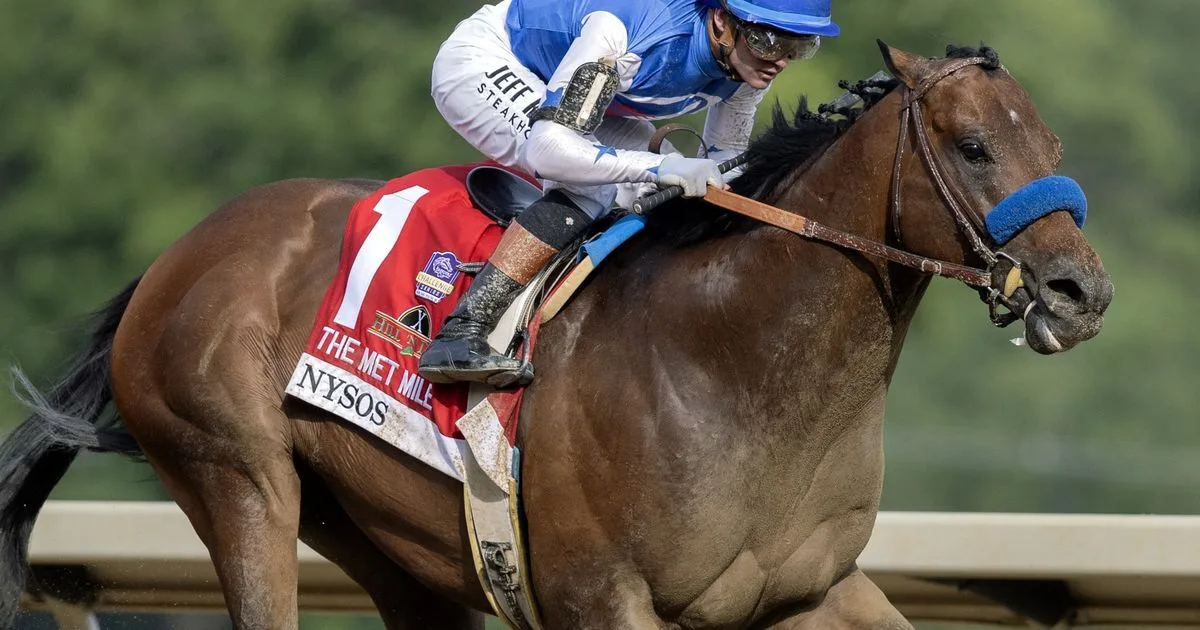
The Nysos horse retirement forces racing to confront an uncomfortable question because there was no visible catastrophe. Nysos left competition sound, fresh from the most commanding performance of his career, after routine imaging revealed subtle changes his connections were unwilling to ignore.
The decision represents prevention before breakdown, a principle central to serious horse welfare advocacy. It also moved an elite stallion prospect from a planned Breeders’ Cup campaign into the breeding shed earlier than expected, showing how welfare judgment and commercial value can point toward the same exit.
Nysos Horse Retirement Came Before a Visible Crisis
Coolmore’s official retirement announcement said a routine diagnostic evaluation revealed subtle imaging changes. It also stated that Nysos was sound and uninjured when trainer Bob Baffert, Baoma Corporation, and the Coolmore partners unanimously chose retirement.
No affected structure or diagnosis was publicly identified. That limits outside analysis, but it also prevents the story from being distorted into a claim that Nysos was actively injured. The available facts describe a precautionary decision based on information detected before an obvious clinical failure.
The five-year-old retires with eight victories and two seconds from 10 starts, more than $5 million in earnings, and Grade 1 wins in the 2025 Breeders’ Cup Dirt Mile and 2026 Metropolitan Handicap. Connections did not stop a horse whose form was fading. They stopped with another major campaign still available.
Diagnostic Imaging Changed the Meaning of Sound
Racing often uses “sound” as if it were a complete medical conclusion. A horse may move comfortably, train effectively, and show no obvious lameness while imaging identifies changes that require time, reduced workload, rehabilitation, or closer monitoring.
That distinction matters because sound is not risk-free. The value of routine imaging is not that every abnormality predicts catastrophe; it is that veterinarians and connections can make better decisions before repeated high-speed exercise adds more stress.
HISA has backed expanded diagnostic-imaging access as an injury-prevention tool. Nysos’s case shows what that principle looks like at the highest commercial level: information was found, the training timeline was reconsidered, and the horse was removed from competition.
The harder question is whether a less valuable horse would receive the same scanning, patience, and willingness to stop.
The Met Mile Made Another Campaign Tempting
Nysos’s final start gave his connections every sporting reason to continue. In the June 6 Met Mile at Saratoga, he defeated Knightsbridge by four lengths in 1:34.85, finishing 0.13 seconds outside the track record.
The final Met Mile performance showed speed, composure, and authority against major older dirt horses. It also secured a Breeders’ Cup Dirt Mile berth, although the more ambitious plan was to pursue the Breeders’ Cup Classic.
The Pacific Classic on August 22 had been identified as a possible bridge to that target. Walking away supports the welfare argument. Connections were surrendering a major-race path because the preparation required no longer fit the medical information available.
Breeding Value Changed the Risk Calculation
The economic side cannot be dismissed. Coolmore had already purchased an interest in Nysos, and Ashford Stud had been announced as his eventual destination. His Met Mile victory carried stallion-making value, while his pedigree added another commercial advantage.
Nysos is by Kentucky Derby winner Nyquist and out of Zetta Z, a broodmare purchased for $2 million. He combines elite speed, Grade 1 dirt form, and a bloodline breeders already understand.
Retirement therefore did not create the same financial uncertainty it would for a gelding or a modestly bred horse without breeding value. It transferred Nysos into another valuable career.
Economic incentives matter, even when the welfare choice is correct. Preserving substantial stallion value makes precaution easier. Racing should praise the decision without pretending every owner faces an equivalent calculation.
The real welfare standard is whether prevention remains the priority when retirement produces cost rather than revenue.
Key Takeaways From the Nysos Decision
The sporting, medical, and commercial signals need to be read together.
Key Signal
Welfare Meaning
Economic Meaning
Imaging found subtle changes
Risk was identified before visible injury
Future racing value became less certain
Nysos remained sound
Retirement was preventive
Stallion value could be preserved
Breeders’ Cup plans ended
Health outranked the calendar
Major purse opportunities were surrendered
Ashford was already secured
A long-term destination was clear
A valuable second career was available
No diagnosis was disclosed
Public interpretation must remain cautious
Veterinary information stayed private
Stud fee is unannounced
Breeding plans are still developing
Market value will be tested in 2027
The same facts can demonstrate responsible horsemanship and favorable economics without one explanation cancelling the other.
Racing Must Make Precaution Available Beyond Elite Horses
The next pressure point is access. Advanced imaging, specialist interpretation, rehabilitation time, and retirement options are unevenly distributed across racing.
A stallion prospect can be scanned routinely and removed from training without losing all future economic value. Horses in claiming races or lower-value programs may remain dependent on visible lameness, regulatory intervention, or an owner’s ability to absorb the cost of stopping.
Racing needs stronger access to preventive diagnostics, shared medical data, realistic rehabilitation funding, and credible aftercare routes for horses whose safest decision is not commercially convenient.
Transparency is the missing piece, although veterinary privacy imposes legitimate limits. The industry does not need every scan published. It does need enough explanation to show how precautionary decisions are made and how similar warning signs are handled across different levels.
The Nysos horse retirement should not be framed as proof that breeding economics defeated sport, nor as a welfare victory beyond criticism. It was a responsible decision made easier by a valuable second career. Its larger significance will depend on whether racing can extend the same early caution to horses whose retirement offers no financial upside.