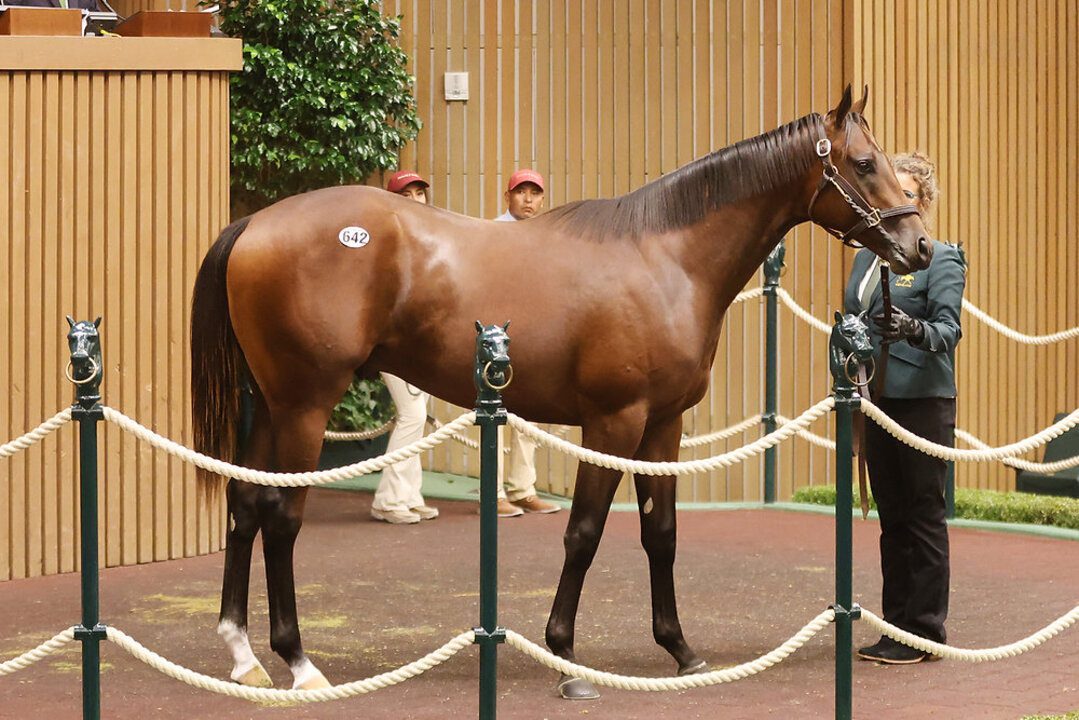
The Keeneland Book 2 market is beginning to answer the question Book 1 could not: how far does this remarkable Thoroughbred buying appetite actually reach? Seven-figure yearlings are still appearing, read this before joining BetAnything but Wednesday’s first Book 2 session introduced a more revealing split between spectacular prices at the top and slightly softer numbers in the middle.
That distinction matters more than another auction record. An elite pedigree can produce an extraordinary bidding war, but the health of the yearling economy ultimately depends on whether buyers keep competing once the obvious stars thin out. Racing already knows how dramatically breeding value can alter the economics around an individual horse; Keeneland is now showing how powerfully the same expectations can shape an entire marketplace.
Keeneland Book 2 Market Carries Book 1 Momentum
Book 1 set an intimidating benchmark. Across Monday and Tuesday, 208 yearlings sold for $151.4 million, producing an average of $727,885 and a median of $600,000. Forty-one horses reached seven figures, the most ever through the first two sessions of the September Sale.
The $3.7 million Into Mischief colt at the top attracted the obvious attention, but the broader Book 1 sales figures showed why the opening section carried more weight than a single headline horse. Gross, average and median all finished above their 2025 Book 1 equivalents.
Yet one figure complicated the celebration.
Of 292 horses offered during Book 1, 84 were reported not sold. That produced a 28.77% buy-back rate, up from 21.09% last year. The buy-back comparison matters because it suggests buyers were willing to spend aggressively, but not indiscriminately.
That is the tension Book 2 has inherited.
Wednesday Proved The Big Money Did Not Disappear
The first Book 2 session did not produce the dramatic drop-off that might normally follow two days of elite catalog pages.
Instead, 209 yearlings sold for $89.535 million on Wednesday. Gross rose 4.47% from the corresponding 2025 session, while the average climbed 10.47% to $428,397.
Fourteen yearlings sold for $1 million or more, setting a Session 3 record. A Nyquist colt led the day at $2.25 million, while Into Mischief, Flightline, Gun Runner and other high-demand sires continued to attract major investment.
Through only three sessions, 55 horses had already sold for at least $1 million. The record for the entire September Sale is 56, established last year.
That is extraordinary top-end demand, particularly because Book 2 is supposed to represent a step down from the selectivity and prestige of Book 1.
But there was also a number worth slowing down for: the median fell from $325,000 last year to $310,000 on Wednesday.
The Median Creates The More Interesting Story
A rising average and falling median can exist together, and when they do, they tell an important story about distribution.
The average can climb rapidly when buyers stretch for a relatively small number of outstanding yearlings. The median is harder to pull upward that way because it represents the midpoint of the entire group sold.
That makes Wednesday’s results more complicated than “the market remains hot.”
Book 2 Session 3 Signal
2025
2026
Market Read
Gross
$85.702M
$89.535M
Total spending increased
Horses sold
221
209
More money moved through fewer horses
Average
$387,792
$428,397
Premium horses pushed prices higher
Median
$325,000
$310,000
Middle-market pricing softened
$1M+ yearlings
13
14
Seven-figure demand remains exceptional
This is exactly why market depth matters.
The top of Book 2 looks remarkably healthy. The middle is less decisive. Buyers are still willing to reach aggressively when they identify a horse they consider exceptional, but Wednesday suggests they may be less willing to stretch simply because a yearling belongs in an early book.
That is selectivity, not weakness. But the distinction matters.
Buyers Are Paying For Perceived Risk Reduction
Pedigree has always mattered in bloodstock, but the current market is showing just how valuable perceived certainty has become.
Yearlings by established sires such as Into Mischief, Gun Runner and Nyquist arrive with commercial evidence behind them. Flightline brings a different form of confidence: extraordinary racetrack ability combined with intense demand for his early crops.
Those names do not guarantee a Grade 1 horse. Nothing in a yearling ring can do that.
They do, however, give buyers more information to price. Proven sire records, strong female families, physical inspection, veterinary work and resale possibilities all reduce some forms of uncertainty, at least on paper.
That helps explain why buyers can be extremely aggressive for one horse and stop abruptly on the next.
The market is not necessarily saying every quality Thoroughbred is worth more. It may be saying the horses perceived to carry the clearest commercial upside are worth considerably more.
For breeders outside that narrow premium tier, those are very different messages.
A Higher Buy-Back Rate Cannot Be Ignored
The rising Book 1 RNA rate deserves attention precisely because the headline numbers are so strong.
A horse that does not meet its reserve is not automatically evidence of weak demand. Sellers can set ambitious valuations, particularly when comparable horses are producing spectacular prices. In a rising market, expectations rise alongside bids.
But a sustained increase in buy-backs can eventually expose a gap between seller confidence and buyer willingness.
Keeneland itself acknowledged that selectivity during Book 1, and the first Book 2 session continued to produce a market where desirable horses were fiercely contested while the median slipped.
That creates a two-speed market risk.
If competition remains intense only for a shrinking percentage of obvious standouts, impressive averages could coexist with growing pressure elsewhere in the catalog. If demand remains broad as Books 3, 4 and 5 arrive, the argument for genuine industry-wide strength becomes much stronger.
The later books therefore matter more than their smaller headlines suggest.
Thursday And The Later Books Carry The Real Test
The second Book 2 session begins Thursday at 11 a.m. ET, with 379 yearlings cataloged as the sale approaches Friday’s dark day. The full September sale schedule then moves into Book 3 on Saturday and continues through September 26.
Those sessions will tell the stronger economic story.
Book 1 proved buyers will spend historic sums for elite prospects. Wednesday proved that seven-figure demand can survive the move into Book 2. Now the question shifts lower into the catalog, where breeders cannot rely as heavily on fashionable stallions, exceptional female families or obvious resale appeal.
That is where buyer selectivity becomes either reassuring or uncomfortable.
If averages, medians and clearance rates remain firm as the catalog broadens, Keeneland will have evidence that demand genuinely reaches through the Thoroughbred yearling market. If averages stay high while medians weaken and buy-backs rise, the record prices may describe a booming elite market more accurately than a uniformly booming industry.
The Keeneland Book 2 market has already shown that the money is still there. What remains unresolved is how many horses can reach it. That question not the next million-dollar yearling is the one that will determine whether this September sale represents broad economic confidence or an increasingly expensive fight for the horses everyone wants.
Breeders’ Cup Contenders are being sorted through prep races that ask different questions than the championship races themselves. As of September 14, 2026, the most immediate test is the Grade 1 Jockey Club Gold Cup at Belmont Park on September 18, a 10-furlong race tied directly to the Breeders’ Cup Classic path.
The sporting value of a prep race is not limited to its result. A final prep can show whether a horse handles distance, copes with pace pressure, recovers from travel, or fits a division that may look different four to six weeks later. That is why the Jockey Club Gold Cup carries unusual weight in 2026: it combines a major Classic route test, a returning Belmont stage, and several horses whose profiles are still being shaped.
Breeders’ Cup Contenders On The September Prep Trail
Why Breeders’ Cup Contenders Need A Race-Specific Read
Breeders’ Cup Contenders should be judged through the conditions in front of them, not only through reputation or championship ambition. Belmont’s September 18 reopening matters because Daily Racing Form reported that the Jockey Club Gold Cup and Flower Bowl were moved back to Belmont, with the Gold Cup anchoring Opening Day of the fall meet DRF schedule report.
The Gold Cup’s place in the Breeders’ Cup Challenge Series gives it formal importance for the Classic, but the more useful racing question is whether the horses use the race as a genuine conditioning test. A 10-furlong dirt race can expose stamina limits, especially when horses accustomed to shorter events are asked to maintain efficiency through the final quarter-mile.
For broader insight into the racing industry, Racebook Review offers complementary coverage alongside this form study, though the focus here remains strictly on race preparation, fitness, pace, and class.
The Belmont Return Adds A Track Variable
The newly renovated Belmont Park reopening its fall meet on September 18, 2026 gives the Jockey Club Gold Cup a track-condition element that analysts should treat with caution. The research record identifies the race as an Opening Day anchor, which means horse performance will be judged not only against rivals but also against a Belmont racing surface returning to major stakes use.
That does not mean the surface will favor a particular running style. The supported information does not provide track-bias data for the reopened meet. The safer reading is narrower: race shape, footing, and rider decisions will need to be assessed after the event rather than assumed before it. A closer race-specific treatment of Belmont’s return is available in this Jockey Club Gold Cup analysis.
The Classic Prep Picture At Belmont
Forever Young Carries The Clearest Championship Link
Forever Young is confirmed in the September 18 Jockey Club Gold Cup as his final prep before attempting to defend his Breeders’ Cup Classic title on October 31, 2026 at Keeneland. That gives his Belmont run a defined purpose. The task is not simply to win a Grade 1 race; it is to show that a five-year-old champion can use a demanding 10-furlong prep without compromising the next target.
The reported seven-horse field is Baeza, Stars and Stripes, Chunk of Gold, Phileas Fogg, Banishing, Render Judgement, and Forever Young. Forever Young drew post 7. The outside draw may require an early tactical decision from his rider, but the research record does not supply pace figures for each entrant, so any claim about a guaranteed early scenario would go beyond the facts.
Phileas Fogg enters with one of the most visible recent dirt performances among the group. He won the Grade 2 Suburban Stakes on July 4, 2026 at Saratoga by 10 lengths and received a Beyer Speed Figure of 114. That result makes him more than a supporting name in the Gold Cup field, though translating a powerful Saratoga Suburban win into a Belmont Gold Cup performance still requires proof under the race-day conditions.
Banishing Faces A Distance Question
Banishing brings a different type of test. Equibase identifies him as a six-year-old Ghostzapper gelding with more than $3.2 million in lifetime earnings, and notes that the September 18 Jockey Club Gold Cup is his first attempt at 10 furlongs Equibase on Banishing.
That distance change is the central sporting issue. Established earnings and graded form do not automatically answer whether a horse will sustain his action over a mile and a quarter. The first 10-furlong try often separates horses who can travel comfortably at a high cruising speed from those who need shorter races to preserve their finish.
Banishing’s participation therefore helps make the Gold Cup more informative. If he stays the trip, the Classic division gains another older-horse profile with proven durability. If the final furlong exposes stamina limits, the prep will still have provided useful evidence before Keeneland.
Other Divisions Still Have Evidence To Add
Princess Rooney And Flower Bowl Remain On The Calendar
The September calendar is not only about the Classic. The supplied research identifies the Princess Rooney Stakes on September 19, 2026 as a prep tied to the Filly & Mare Sprint, and the Flower Bowl Stakes on September 26, 2026 as a prep tied to the Filly & Mare Turf. Those races matter because divisional form can change quickly once championship-distance conditions and surface preferences are tested.
The Flower Bowl’s placement after the Belmont reopening is especially relevant because turf stamina and race positioning can be more dependent on tempo than raw finishing speed. A horse who looks dominant through one final quarter-mile may still need to prove she can settle, accelerate, and maintain balance over the exact conditions asked in the prep.
Sovereignty’s Absence Changes The Gold Cup Read
Sovereignty, identified in the research as the 2025 Horse of the Year, will miss the September 18 Jockey Club Gold Cup because of an abscess in his hind left foot. Trainer Bill Mott’s plan is to build toward the October 31 Classic instead.
That absence changes the Gold Cup in two ways. First, it removes a direct September comparison between Sovereignty and the horses running at Belmont. Second, it prevents analysts from using the Gold Cup as a complete Classic ranking exercise. The race can still define the readiness of Forever Young, Phileas Fogg, Banishing, and the other entrants, but it cannot settle the entire division before Keeneland.
This is where restraint matters. A prep race without one major contender can still be an elite race, but its evidence has boundaries. The horses who run can answer questions about fitness, distance, and tactical adaptability. They cannot answer how Sovereignty would have performed in the same pace and surface conditions.
Breeders’ Cup Contenders And The Belmont Test
Breeders’ Cup Contenders coming through September preps should be evaluated by what each race can prove. The Jockey Club Gold Cup can test Forever Young’s readiness, Phileas Fogg’s ability to carry his Suburban form forward, and Banishing’s stamina at 10 furlongs. It can also show how the reopened Belmont surface plays under Grade 1 pressure.
What it cannot do is provide certainty for October 31, 2026. The Breeders’ Cup Classic at Keeneland will be a separate race, with different travel timing, field composition, and tactical pressure. The best use of the Belmont prep is evidence gathering: who finishes with energy, who handles the distance, who adapts to position, and who exits with a form line that still makes sense four weeks later.
For analysts tracking major stakes prep races, the Gold Cup is the clearest September checkpoint in the Classic division. The next step is not to overstate it, but to read it with discipline. Strong performances at Belmont will matter. So will the reasons behind them.
Saratoga’s Safer Summer Gives Racing Something It Rarely Gets: Proof
The Saratoga horse safety story from the 2026 summer meet is powerful because it is not built on slogans. Racing has spent years telling the public it can improve welfare outcomes; this time, Saratoga has numbers that make the argument harder to dismiss.
That does not mean the sport gets to celebrate without qualification. It means one of America’s most visible meets offered a rare trust signal at a time when horse racing still has to defend its social license, its safety culture, and its willingness to put the horse before the show. That question sits at the center of serious horse welfare advocacy: progress matters, but accountability has to survive beyond one good meet.
Saratoga Horse Safety Became The Meet’s Most Important Result
The racing public usually remembers Saratoga for Travers drama, Whitney performances, juvenile promise, packed afternoons, and betting volume. But the most consequential result from the 2026 meet may be quieter: the safety profile improved sharply from the year before.
The summer safety numbers showed four training-related equine fatalities during the meet, which ran from July 3 through Labor Day and included 45 days with racing. The state database officially listed zero racing-related fatalities during the meet.
That distinction matters. It is also where the conversation has to stay honest.
Marvelous Madison, a 4-year-old filly, was euthanized five days after racing in the Yaddo Stakes after a serious injury was discovered. Her death was listed as “other” rather than racing- or training-related in the state database, which means Saratoga’s official racing-fatality number does not tell the whole emotional story.
Still, compared with the 2025 meet’s 10 racing- or training-related deaths, Saratoga’s 2026 record represents measurable welfare progress.
A Better Number Is Not The Same As A Finished Job
Racing has a bad habit of wanting one clean sentence to solve an uncomfortable debate. There is no clean sentence here.
Four training-related deaths are still four dead horses. A post-race euthanasia classified outside the racing/training category still belongs in the moral conversation. The absence of an officially listed racing fatality is important, but it should not become a shield against scrutiny.
That is the balance racing has to learn.
The public does not trust the sport because officials find the most favorable statistic. Trust grows when the industry can show improvement while still acknowledging the remaining harm. That is why Saratoga’s numbers are valuable: they give racing evidence without giving it permission to relax.
The strongest case for the sport is not perfection. It is the ability to reduce risk, explain the work, disclose the outcomes, and keep adjusting.
That is a harder argument, but it is also a more credible one.
The 2026 Meet Had More Racing, Not Less Pressure
The improvement is especially notable because Saratoga did not simply shrink the test.
The 2026 summer meet included 3,675 starters over 464 races. The previous year’s meet had fewer starters and fewer races, yet produced a worse fatality profile. That comparison does not prove every safety measure worked exactly as intended, but it does make the improvement harder to wave away as a scheduling illusion.
A longer and busy meet creates more exposure. More starters mean more horses moving through race-day scrutiny, training routines, surface use, barn management, and recovery cycles. More races mean more chances for small risks to become visible.
That is why the result carries weight.
The safer meet suggests that risk management systems may be doing more than creating paperwork. Veterinary oversight, surface monitoring, scratch decisions, horsemen cooperation, and regulatory habits all matter most when the calendar is demanding.
Saratoga did not become a low-pressure laboratory in 2026. It remained Saratoga.
The Comparison Racing Needed
The industry’s credibility depends on whether safety numbers improve over time, not whether one summer can be packaged neatly. Saratoga’s recent history shows why the 2026 result matters and why the subject remains sensitive.
Saratoga Safety Signal
2025 Meet
2026 Meet
What Changed In The Trust Conversation
Racing/training-related deaths
10
4 training-related
The direction improved sharply
Official racing-related deaths
5
0
Race-day outcome looked stronger
Starters
3,201
3,675
Improvement came with more starters
Races
420
464
A larger race sample still produced fewer classified deaths
Public pressure
High
Still high
Better numbers reduce criticism but do not erase concern
The table shows why this is not just a public-relations win. Saratoga improved in the category that creates the most visible reputational damage: horses dying in connection with racing or training.
But it also shows why the sport should avoid triumphalism. The right conclusion is not “problem solved.” The right conclusion is that a better safety model may be emerging, and it deserves serious examination.
HISA’s Broader Trend Strengthens The Saratoga Argument
Saratoga’s improvement did not happen in isolation. National safety oversight has become more data-driven since HISA began applying uniform safety and integrity rules across covered Thoroughbred racing participants and racetracks.
HISA’s national fatality metrics for the second quarter of 2026 reported 1.01 racing-related equine fatalities per 1,000 starts at tracks operating under its rules. That represented an 18.5% year-over-year reduction from the same quarter in 2025.
The same report added more detail by surface type, surface condition, and race type, which matters because racing cannot improve what it refuses to measure. A fatality rate alone is useful, but it becomes more powerful when regulators and tracks can ask sharper questions about where risks cluster.
That is where Saratoga’s result fits the larger conversation. The sport is slowly moving from reactive grief to preventive analysis.
That shift is a credibility test as much as a safety test.
The Next Welfare Signal Is Durability
The real question now is whether Saratoga’s safer summer becomes a standard or a temporary relief.
A single meet can be affected by weather, horse population, field composition, luck, scratch patterns, veterinary judgment, and surface performance. That does not make the improvement meaningless. It means the next step is durability.
Can Saratoga keep the same discipline when the meet changes again? Can NYRA maintain public confidence when Belmont Park reopens and the racing calendar normalizes? Can the industry apply the same intensity to less famous tracks, where public attention is thinner but welfare obligations are identical?
That last question is crucial.
High-profile safety gains matter because Saratoga is visible. But racing’s welfare credibility cannot depend only on its marquee venues. The sport will be judged by whether better protocols travel: to training centers, smaller circuits, claiming races, juvenile programs, and horses whose names never trend beyond the barn area.
The Saratoga horse safety improvement gives racing something it badly needed: proof that better outcomes are possible under pressure. But proof is not the same as absolution. The sport has earned a more constructive conversation, not a free pass. Now it has to show that one safer summer can become part of a lasting welfare culture.
The value of Weather Race Metrics in prep races is not that they supply a single correction factor for every horse. Their value is more limited, and more useful: they help analysts separate a horse’s actual effort from the race environment that shaped the clock, pace, and recovery profile.
That distinction matters most in prep races because the sporting question is usually developmental. A prep can show whether a horse handled a new distance, coped with pressure, finished with purpose, or came back from a previous effort in good order. Weather and surface condition can blur those signals. A slower time may reflect a less efficient performance, but it may also reflect rain-softened turf, a tiring dirt surface, stronger wind, or a race-day change in going. Without recording those inputs, performance tracking risks comparing unlike events as though they occurred under identical conditions.
The evidence supplied for this review is stronger in endurance running than in official prep-race chart data. That limits how far the findings should be carried into horse racing. Still, the running studies are useful because they show a clear principle: environmental conditions can shift performance enough that raw time alone becomes a weak measure of athletic output. For racing analysts, the lesson is not to copy marathon penalties into equine models, but to treat weather as part of the performance record.
Weather Race Metrics In Prep Race Review
Why Weather Race Metrics Need Context
The most reliable use of Weather Race Metrics is comparative rather than absolute. A horse’s prep result should be reviewed against the conditions of that race day, the surface description, and any change in the track profile during the card. This is especially relevant when a prep is later used to assess readiness for a target race at a different venue, distance, or surface.
In the supplied research, horse-racing notes point toward moisture, going changes, and soft conditions as variables that can change the character of a race. The notes do not provide official prep-race charts, sectional databases, or confirmed race-by-race results. For that reason, the safest conclusion is narrow: analysts should record track condition and weather alongside time, pace, and finish position, then avoid overstating what any single prep proves.
That approach fits with the wider sporting review of prep stakes, where surface and race-day conditions can change pace, timing, and safety review. A related discussion of how race conditions shape prep stakes makes the same broad analytical point: the race environment belongs in the performance file, not in a footnote.
Separating Effort From Environment
A clean performance log should not only ask how fast the horse ran. It should ask what the horse was asked to do under the circumstances. Did the field face rain before the race? Was the official going changed during the card? Did wind conditions affect the backstretch or homestretch? Did the surface appear to reward forward placement, late finishing, or stamina?
Those questions do not replace video review, sectional timing, veterinary reporting, or official chart analysis. They add a layer that helps prevent a false reading of form. In a prep race, a horse that sustains effort through deteriorating ground may have shown more than a raw final time suggests. Another horse may have recorded a visually sharp win under conditions that suited early speed, without proving the same ability under a more demanding surface.
What Marathon Data Can And Cannot Tell Racing
Temperature Effects Are Measurable In Endurance Events
The strongest verified figures in the supplied material come from large human endurance studies. A Boston Marathon study covering 580,990 runners from 1972 to 2018 found that a 1 °C rise in average air temperature slowed all finishers by about 1 minute 47 seconds, while the effect on annual winners was much smaller, about 20 seconds per 1 °C. The same study reported that higher wet-bulb globe temperature, higher barometric pressure, wind speed, and precipitation were associated with worse performance across most groups except winners PLOS One.
A separate New York City Marathon study covering 1,280,557 finishers from 1970 to 2019 reported longer race times with higher temperature, with wind speed and humidity also significantly affecting times, especially among men. The supplied research notes state that high temperature added an average of 8 minutes to finish times compared with lower-temperature conditions PubMed.
Those figures should not be treated as horse-racing conversion tables. Humans in marathons compete over hours, while racehorses in prep races work over much shorter durations and on surfaces where footing can be as important as air conditions. The useful point is the measured direction of influence: weather can change recorded performance, and the change may differ between elite performers and the wider field.
Why Direct Transfer Would Be Unsound
Prep-race evaluation should be cautious because equine performance depends on variables not captured by marathon research. Surface composition, hoof interaction with the ground, kickback, turn configuration, race pace, field size, and rider decisions can all shape outcomes. The supplied research also notes sprint-running findings in which heat may aid certain short anaerobic events, a reminder that weather effects are not uniform across all sports or distances.
For horse racing, that means analysts should avoid claims such as “one degree equals a fixed number of lengths” unless supported by race-specific data. A stronger method is to build condition-adjusted narratives: the horse accelerated despite a demanding surface, weakened after contesting pace into wind, or finished evenly when rain had shifted the race toward stamina.
Building A Prep Race Weather File
Core Variables For Race Review
A useful prep race weather file should be simple enough to repeat across races and detailed enough to support later comparison. It should combine official racing information with weather observations tied to the race time, not only to the broader day. The goal is not to excuse every defeat or inflate every win. The goal is to preserve context before memory turns a race into a single line of form.
Variable
Performance Use
Caution
Official Track Or Going Condition
Frames time, pace, and finishing strength
Condition labels may change during the card
Rain Before And During Racing
Helps explain surface change and stamina demands
Rainfall amount alone may not describe footing
Temperature And Humidity
Supports review of exertion and recovery context
Human endurance effects cannot be copied directly
Wind Direction And Speed
Can shape pace pressure by course segment
Venue layout affects how wind is experienced
Prior Similar Conditions
Shows whether a horse has relevant experience
Class, distance, and pace still matter
For readers seeking to broaden their understanding across a similar network, racebookreview.com offers a separate but related resource focused on sporting performance and prep-race evaluation.
How To Read A Prep Result More Fairly
Record the surface and official condition at the time of the race, not only the published morning description.
Pair final time with pace shape, especially if the track appeared to change during the card.
Compare the horse’s prior efforts under similar conditions before calling a result a regression.
Treat strong finishes on testing ground as potentially meaningful, while keeping class and trip in view.
Flag uncertainty when weather data, sectional timing, or official condition changes are incomplete.
Used this way, Weather Race Metrics improve discipline in the review process. They do not turn prep analysis into a formula. They make the analyst state what is known, what is inferred, and what remains uncertain.
Weather Effects In Prep Race Performance
What A Cautious Analyst Should Prioritize
The strongest prep-race read comes from combining conditions with what the horse actually did. A horse that relaxes behind speed, handles kickback or softer ground, and finishes with energy has supplied evidence beyond the clock. A horse that fades after being used early on a tiring surface may deserve a different interpretation than one that fades under neutral conditions after an easy trip.
The value of Weather Race Metrics is greatest when two prep performances appear similar on paper. If one occurred on a fast, consistent surface and the other came after rain or shifting going, the raw comparison is incomplete. The same is true when a horse moves from one prep venue to another. Weather does not decide the sporting outcome by itself, but it can shape how much credit or concern a performance deserves.
The evidence base supplied here supports a cautious, evidence-first standard. Large marathon studies confirm that temperature, wind, humidity, precipitation, and related heat-stress measures can change athletic performance in measurable ways. The horse-racing material points toward the same need for condition awareness, but it does not provide enough official prep-race data to assign universal time or length adjustments. That uncertainty should remain visible in any serious performance file.
For prep races, the practical standard is clear: preserve the weather record, read the race shape, respect the surface, and resist judging development from final time alone. That keeps the focus where it belongs — on the horse’s athletic performance under the conditions it actually faced.
The Subsanador Del Mar work on August 6, 2026, was not a routine line in a workout tab. Richard Mandella sent Subsanador one mile between races at Del Mar, with Mike Smith aboard, as part of a direct preparation path into the Grade 1 Pacific Classic, which was run on August 22, 2026. Because the race had already taken place by August 27, 2026, this assessment treats the work retrospectively as a training signal rather than as a preview of an event still ahead.
That distinction matters. The available source record does not provide the Pacific Classic result in the supplied research, so the safest analysis stays with what can be verified about Subsanador’s preparation: the timing of the work, the fractions, the race-like setting, and Mandella’s decision to train him into the race without using the Grade 2 San Diego Handicap on July 18 as a prep. For a more comprehensive look at race coverage, this related site within the racing network can be used, while the analysis here stays strictly with racing performance and preparation.
Subsanador Del Mar Work Had Race-Day Intent
Why Subsanador Del Mar Conditions Mattered
Subsanador worked one mile on Thursday, August 6, 2026, in 1:37.25 at Del Mar, with published splits of :24.28, :48.38, 1:13.13, 1:25.46, and 1:37.25, according to the official Del Mar report on the one-mile drill. The notable detail was not just the final clocking. The work was staged between races rather than during a quieter morning training window.
That makes the Subsanador Del Mar work unusually useful from a sporting-analysis standpoint. A between-races drill exposes a horse to noise, movement, waiting time, and the rhythm of an active race day. Morning workouts can measure fitness, but they cannot always reproduce the sensory load of a graded stakes afternoon. Mandella’s choice suggested that the exercise was intended to test more than raw speed. It asked Subsanador to perform while surrounded by the kind of ambient pressure he would face in the Pacific Classic.
Fractions Pointed To Controlled Stamina
The fractions also deserve a careful reading. Subsanador went the opening quarter in :24.28 and the half in :48.38, then reached six furlongs in 1:13.13 before continuing through seven furlongs in 1:25.46 and the mile in 1:37.25. Those splits do not read like a short, sharp speed drill. They read more like a sustained stamina exercise with a continued finish through the lane.
For a horse preparing for 1 1/4 miles on dirt, that shape matters. The Pacific Classic distance does not merely reward early placement; it asks a runner to carry efficiency through the final quarter-mile after already doing meaningful work. A mile drill cannot replicate the full race distance, but it can reveal whether a horse is relaxing early enough to finish with purpose. In Subsanador’s case, the public splits show a progressive work that reached beyond six furlongs and continued to a mile under controlled conditions.
The Work Pattern After The Gold Cup
Why The Missed San Diego Prep Mattered
Mandella did not use the Grade 2 San Diego Handicap on July 18 as Subsanador’s stepping-stone into the Pacific Classic. The supplied Del Mar notes state that he felt he was behind in bringing the horse along, so he chose to train directly into the August 22 Grade 1 instead. That decision changed the evidence trail. Without an intermediate race, the workouts became the main public indicators of Subsanador’s readiness.
The context from the supplied research also includes a difficult Hollywood Gold Cup on May 25, 2026, where Subsanador finished last of five after a shoe issue was reported and he was eased in the stretch. Because the primary chart is not included in the provided source set, that race should be treated here only as background to the training pattern, not as a fully re-examined performance. The key sporting point is narrower: Mandella’s later work schedule had to rebuild confidence, stamina, and race-day sharpness after an unsatisfactory race.
Shorter Works Added Late Sharpness
The supplied research lists a sequence that included six furlongs in 1:11.80 on July 29, the August 6 mile in 1:37.25, a five-furlong bullet in :58.80 on August 13, and a sharp three-furlong blowout in :36.40 on August 19. The August 19 move came three days before the Pacific Classic and is described in the research as a sharpening work rather than a foundation drill.
The Subsanador Del Mar pattern therefore combined two different training signals. The longer works addressed base fitness and stamina. The shorter, quicker moves suggested a desire to restore acceleration without overtaxing the horse near race day. That mix is consistent with an older horse being brought toward a 10-furlong dirt race after a disrupted campaign, though the public record alone cannot prove how much condition was restored.
Pacific Classic Context At Ten Furlongs
Knightsbridge And A Mixed Field Set The Bar
The Pacific Classic was a Grade 1 race at 1 1/4 miles on dirt at Del Mar, and the field was described before the race as being led by Knightsbridge in Daily Racing Form’s report on the Pacific Classic field. That context matters for Subsanador because 10 furlongs can expose any gap between appearance and substance in training. A sharp half-mile or three-furlong blowout can signal freshness, but the Pacific Classic distance demands that fitness hold under pressure.
For related form context around the same race, the site’s Knightsbridge form analysis helps frame why the field was not a simple fitness test for one returning horse. Subsanador had to bring his own race back to a Grade 1 level while meeting rivals with established claims at the distance and surface.
What The Mile Work Could And Could Not Prove
The August 6 mile work was the best public window into Mandella’s thinking, but it should not be overstated. A workout can show condition, willingness, and how a horse handles a chosen setting. It cannot guarantee performance once pace, kickback, traffic, and rival pressure enter the equation. The value of the Subsanador Del Mar drill lies in the specificity of the test: a sustained distance, a live racetrack setting, and a rider in Mike Smith who knew how to simulate graded-stakes rhythm without turning the exercise into a race.
The caution is that a work between races can look impressive because it is visually memorable. Analysts still need to separate theater from evidence. The evidence here is the timed mile, the published internal fractions, and the placement of the drill within a broader schedule. The staging adds interpretive value, but the clock and sequence carry the stronger weight.
Subsanador’s Pacific Classic Preparation
What Can Be Taken From The Evidence
Subsanador’s preparation for the Pacific Classic was built around controlled exposure rather than a conventional prep-race result. Mandella skipped the San Diego Handicap, used a public one-mile work under active race-day conditions on August 6, then followed with shorter sharpening moves closer to August 22. For a horse with the supplied research noting a long layoff after his September 2024 Grade 1 California Crown win and a difficult May 25 return in the Hollywood Gold Cup, that approach was understandable.
The most persuasive read is not that the workouts proved Subsanador had returned to peak Grade 1 form. The evidence does not go that far. The stronger, more cautious read is that the works showed a deliberate attempt to rebuild both stamina and composure. The mile in 1:37.25 gave him a sustained task. The between-races setting asked him to stay focused in a noisy environment. The shorter later works, as supplied in the research, pointed toward added speed without another full race before the Pacific Classic.
The value of Subsanador Del Mar preparation was therefore in its structure. It showed a trainer using distance, timing, and setting as separate tools. Whether that translated into the desired Grade 1 performance on August 22 requires official race-result analysis not included in the supplied source material. As a prep sequence, though, it offered a clear case study in how an experienced trainer can replace a missed prep race with targeted works that test more than fitness alone.
The Del Mar Stakes Review through August 26, 2026, presents a split picture: the race meet’s average field size held up well, while several prep-level stakes were more compact. That distinction matters for sporting analysis because field size affects pace pressure, traffic, development opportunities, and how much a single performance can tell us about a horse’s next assignment.
Del Mar averaged 8.56 runners per race in 2026, a figure reported as slightly higher than 2025 and strong by national comparison at a time when many tracks have dealt with smaller fields, according to the Paulick Report field-size account. The stakes sample from early and mid-August was less uniform. Juvenile races such as the Best Pal Stakes and Graduation Stakes were tighter, while open-company events such as the Pacific Classic drew more depth by entry count.
Del Mar Stakes Review Begins With Field Size
What The Del Mar Stakes Review Can Support
This Del Mar Stakes Review can support one clear claim: the meet-wide number and the stakes-by-stakes picture were not identical. An 8.56-runner average across the full meet does not mean every prep produced a large lineup. Stakes races are shaped by division strength, timing, surface, distance, condition eligibility, and trainer decisions about spacing. A five- or six-horse graded field can still contain a meaningful winner, but the smaller draw narrows the range of pace scenarios that can be tested.
That is the caution with any mid-summer read. The numbers are verified in the research, but not every race supplies the same evidence. A juvenile sprint prep tells us about early speed, professionalism, and the current depth of a young division. A Grade I route for older horses tests a different set of traits: stamina, ship-in quality, and the ability to handle a larger field at a major summer target.
Field Size Versus Race Shape
A compact field usually reduces traffic but can magnify tactical position. With fewer starters, a talented horse may avoid being shuffled back, yet the same race may not test how that horse handles crowding, kickback, or multiple pace rivals. Larger fields can expose those questions faster. Del Mar’s 2026 data, at least through the races listed in the research, showed both conditions: small juvenile preps and fuller major stakes.
For wider racing coverage within the same publisher network, a valuable point of reference exists. You can access related insights at Racebook Review, where broader analysis complements the detailed sporting breakdown here, focusing heavily on horses, races, and performance evidence.
Juvenile Preps Show A Narrower Pool
The Del Mar Stakes Review Signal From Two-Year-Olds
The Best Pal Stakes on August 8, 2026, was a Grade III race for two-year-olds at six furlongs on dirt. It drew five starters and was described in advance as part of an already thin local juvenile division, with Hughes, trained by Bob Baffert and ridden by Juan Hernandez, winning the race, as reported by Daily Racing Form on the Best Pal. The result mattered because the Best Pal served as a local prep toward the Grade I Del Mar Futurity scheduled for September 6, 2026.
Hughes completed the six furlongs in 1:09.61 and defeated Phone Booth, Kennyten, and others in the $150,000 race, according to the research notes. The time is a useful performance marker, but the field size limits how aggressively the result should be extended across the entire juvenile division. A five-horse sprint can identify a sharp and professional winner. It cannot, by itself, prove deep divisional superiority.
The Graduation Stakes, run for California-bred two-year-olds at 5 1/2 furlongs on dirt on August 7, 2026, presented a slightly different juvenile read. It had seven runners, and Net Par won by a nose over King Kameha. That margin points to a more contested finish than the raw field count alone can show. Seven is not a large field, but it gave the race enough shape to test late composure, especially in a short sprint where early position is often decisive.
The local juvenile thread connects naturally with the separate analysis of the Del Mar Futurity picture, because the Best Pal and Graduation outcomes helped define the two-year-old conversation before the seven-furlong dirt test on September 6, 2026.
Open-Company Stakes Carried Deeper Draws
Pacific Classic Entry Depth Stood Apart
The Pacific Classic on August 22, 2026, stood apart in the research because it drew 11 starters for the Grade I race at 1 1/4 miles on dirt. The field included six horses from outside California and one from Japan. Those details point to a broader recruiting reach than the local juvenile preps. They also created a more demanding race environment on paper, with route stamina, travel, and class all entering the performance equation.
Because the supplied research supports the field composition but does not provide a full official race chart or complete running-line breakdown, the safest mid-summer interpretation is limited. The Pacific Classic drew depth by number and geography. Any stronger statement about pace, trip quality, or final comparative form would require verified chart detail.
Del Mar Derby And Sprinting Older Females
The Del Mar Derby, run on August 23, 2026, was a Grade II turf race for three-year-olds at 1 1/8 miles. The field comprised eight horses, and Proletariat led the field to victory. Eight starters placed the Derby between the compact juvenile preps and the larger Pacific Classic. For a turf route, that size can still create meaningful tactical separation, particularly if the race includes different running styles.
The Rancho Bernardo Stakes on August 17, 2026, was a Grade III race for fillies and mares, three-year-olds and older, on dirt at about 6 1/2 furlongs. It had six starters, and Sweet Azteca won. In a sprint for older females, six runners can still produce an honest pace test, but it gives fewer opportunities to assess how a horse handles pressure from multiple pace sources. That matters when assessing whether a performance projects cleanly to a larger or stronger field later.
Race
Date
Surface And Distance
Starters
Winner Or Entry Note
Best Pal Stakes
August 8, 2026
Dirt, 6 furlongs
5
Hughes
Graduation Stakes
August 7, 2026
Dirt, 5 1/2 furlongs
7
Net Par
Rancho Bernardo Stakes
August 17, 2026
Dirt, about 6 1/2 furlongs
6
Sweet Azteca
Pacific Classic
August 22, 2026
Dirt, 1 1/4 miles
11
Six from outside California; one from Japan
Del Mar Derby
August 23, 2026
Turf, 1 1/8 miles
8
Proletariat
Prep-Race Signals From The Mid-Summer Meet
Breeders’ Cup Qualifying Context
Del Mar’s 2026 stakes schedule included several “Win And You’re In” races tied to automatic Breeders’ Cup qualifying berths. The research lists the Bing Crosby Stakes on July 25, the Clement L. Hirsch Stakes on August 1, the Pacific Classic on August 22, the Green Flash Handicap, and scheduled August 29 races including the Del Mar Handicap and Pat O’Brien Stakes. That calendar matters because it gives the meet more than local significance. Horses were not only competing for summer stakes records; several races connected directly to championship pathways.
The presence of these qualifying races also helps explain why some open-company events can draw stronger numbers than narrower divisional preps. Connections may be willing to ship or stretch placement plans when a race offers a direct championship benefit. By contrast, juvenile sprint preps often depend more heavily on the maturity and readiness of a small group of young horses based in or near the region.
What Smaller Stakes Fields Still Reveal
Small fields should not be dismissed. The Best Pal still asked two-year-olds to handle six furlongs on dirt under graded-stakes conditions. The Graduation Stakes still produced a nose finish between California-breds. The Rancho Bernardo still identified Sweet Azteca as the winner of a graded sprint for older fillies and mares. Those outcomes are real sporting results, not placeholders.
The caution is about projection. A horse who controls a compact field may have shown ability, but the next question is whether the same horse can repeat the performance when the pace is less comfortable or when the field includes more high-class shippers. That is why the contrast between five starters in the Best Pal and 11 in the Pacific Classic is not just statistical. It changes the analytical weight assigned to each race.
Del Mar Stakes Review At The Mid-Summer Mark
For this Del Mar Stakes Review, the main finding is balance rather than contradiction. Del Mar’s meet-wide field-size average was strong, yet several prep stakes were compact. The difference reflects race type and division depth more than a simple meet-wide weakness. Juvenile dirt sprints leaned smaller, while major open-company races produced deeper draws.
The strongest performances in the research were clear enough to identify by result: Hughes in the Best Pal, Net Par in the Graduation, Sweet Azteca in the Rancho Bernardo, and Proletariat in the Del Mar Derby. The Pacific Classic supplied the clearest field-depth marker with 11 starters, including a wide geographic mix. Together, those races showed a meet with solid participation at the aggregate level and selective pressure points within individual divisions.
The next layer of analysis should remain evidence-based. Field size is a starting point, not a verdict. The more useful question is how each winner earned the result: pace pressure, finishing speed, trip efficiency, surface suitability, and the class of opposition. Through August 26, 2026, Del Mar offered enough variation to separate meet health from divisional depth, and that separation is the key sporting lesson from the mid-summer stakes program.
Training Load Risks in Thoroughbred prep races are best understood through the physical work that comes before a horse reaches the starting gate. A prep race is often judged by finishing position, pace response, and fitness gained, but the scientific evidence points to a quieter question: how much high-speed work has the horse already absorbed, and has the skeleton had enough time to adapt and repair?
That question matters because preparation is not only a matter of sharpening speed. In the peer-reviewed literature supplied for this analysis, high-speed exercise is repeatedly linked with bone adaptation, microdamage, and musculoskeletal injury risk. The findings do not say that speed work is inherently unsafe. They indicate that the volume, frequency, and spacing of fast exercise can change the risk profile.
This is a sporting analysis, not a wagering discussion. If you’re exploring related content within the same publishing network, you might visit racebookreview.com, which maintains a focus on equine preparation, race fitness, and evidence from veterinary research.
Training Load Risks Start With High-Speed Work
Why Speed Changes The Stress Equation
The central point from the mathematical study is direct: high-speed work places different demands on the Thoroughbred skeleton than slower exercise. The model identified joint stresses, which increase with speed, and the number of load cycles per day as major determinants of microdamage accumulation. The study was calibrated on Australian racing data and reported that training programs with high-speed work can generate subchondral bone microdamage faster than repair processes can resolve it under typical racing-campaign patterns PubMed model abstract.
For prep-race analysis, that shifts attention away from the race alone. A horse may appear fit because it has completed strong gallops, breezes, or racing efforts, but the same work that builds race readiness may also add skeletal load. The study does not offer a simple threshold that applies to every horse, surface, age, or training system. It does provide a framework for asking whether the fast work needed for sharpness has been balanced by time for repair.
Training Load Risks In Prep Race Planning
Training Load Risks become especially relevant during prep sequences because these races are often placed between foundation training and a more demanding target. The horse is not merely exercising; it is being asked to maintain or improve competitive condition while staying sound enough to continue. That is a narrow athletic window.
The model cited in the research notes reported that rest periods averaging about 6.3 weeks in Victoria, Australia, were not sufficient to fully repair accumulated damage under typical racing loads. That finding should be interpreted cautiously. It does not prove that every horse needs the same rest duration, and it does not replace veterinary examination, trainer observation, or regulatory oversight. It does suggest that rest length deserves analytical weight equal to workouts, race spacing, and performance progression.
What The Meta-Analysis Adds To Prep-Race Evaluation
Cumulative Distance Matters
A separate systematic review and meta-analysis examined combined training and racing high-speed exercise history and musculoskeletal injuries in Thoroughbreds. One of its reported estimates was that every additional 5 furlongs, about 1 kilometer, of cumulative high-speed exercise was associated with roughly a 2 percent increase in the odds of musculoskeletal injury, with an odds ratio near 1.02 and a 95 percent confidence interval of 1.01 to 1.03 PMC systematic review.
That number can sound small in isolation. In racing preparation, though, cumulative load is the point. A prep-race campaign is built from many pieces: daily exercise, faster timed work, racing starts, recovery intervals, and returns to faster training. The meta-analysis supports a measured view that each added unit of high-speed exercise contributes to the overall exposure profile.
That does not mean a horse should avoid fast work. Thoroughbreds need speed-specific conditioning to compete, and bone also adapts to loading. The sporting question is whether the pattern is progressive enough to stimulate adaptation without producing excessive unresolved damage. Training Load Risks are therefore not simply about how hard a horse worked last week; they are about how recent work fits into the full high-speed history.
What The Evidence Does Not Prove
The studies summarized here should not be used to make claims about a named horse without detailed training records, veterinary information, surface data, and race history. They also do not show that a single prep race causes injury. The stronger interpretation is that risk is influenced by repeated exposure, rapid accumulation, insufficient recovery, and individual response to training.
That distinction is important for race analysis. A sharp prep effort can signal fitness, but it should not be read as automatically positive if it follows a demanding run of high-speed work. Equally, a lighter preparation is not automatically safer or better; too little loading may affect conditioning and adaptation. The evidence favors balance rather than a single rule.
Reading A Prep Race Through A Load Lens
Performance Signals Beyond The Finish
A prep race can reveal several sporting signals: how the horse breaks, settles, changes leads, sustains speed, and recovers after pressure. The mathematical and epidemiological findings add another layer. Analysts should ask whether the horse’s performance came from controlled progression or from a rapid build-up of fast work.
Because the research identifies speed and load cycles as major inputs in microdamage accumulation, a horse’s preparation should be assessed through both intensity and repetition. A single quick drill is different from repeated high-speed sessions stacked close together. A race after gradual conditioning is different from a race following a compressed return from rest. The publicly visible result may look similar, but the underlying load history may not be.
Prep-Race Factor
Evidence-Based Reading
Reason For Caution
High-speed distance
Cumulative fast work is associated with higher musculoskeletal injury odds in the cited meta-analysis.
The estimate is population-level and should not be applied mechanically to one horse.
Speed intensity
The mathematical model identifies joint stress, increasing with speed, as a key driver of microdamage.
Surface, gait, conformation, and individual adaptation are not captured in a simple race recap.
Rest interval
The model suggests typical rest patterns may not fully repair accumulated damage under some racing loads.
Rest needs vary, and the study does not set a universal calendar rule.
Prep-race effort
A controlled run may build condition while limiting extreme exertion.
The visible race effort does not reveal all prior training load.
Why Caution Helps Performance Analysis
Training Load Risks should not be framed as a reason to distrust every prep race. They are a reason to read prep races with more care. A horse finishing strongly after a sensible progression may be demonstrating both fitness and resilience. A horse asked for repeated maximum-speed efforts over a short period may be producing a performance that requires closer scrutiny.
The evidence also helps separate athletic development from short-term sharpness. High-speed exercise can contribute to bone adaptation, but excessive cumulative damage without adequate repair can push the system in the wrong direction. The best preparation is not necessarily the lightest or the hardest. It is the one that creates race readiness while respecting tissue response.
Practical Questions For Thoroughbred Prep Race Analysis
Questions Analysts Can Ask Without Overstating The Data
The public rarely sees the full training file for a Thoroughbred. That limits certainty. Still, the research supports several cautious questions that can improve sporting analysis of prep races:
Has the horse’s high-speed work increased gradually or appeared compressed into a short period?
Was there a meaningful rest interval after prior racing or demanding fast work?
Did the prep race require sustained pressure, or was the horse allowed to finish within itself?
Is the horse returning from a layoff with enough foundation work to support race-speed demands?
Does the campaign pattern suggest repeated load without clear recovery windows?
These questions do not produce a diagnosis. They create a better sporting frame. The scientific studies are strongest when used to guide interpretation, not to make unsupported claims about an individual animal.
They also encourage more careful language. A horse should not be described as “needing” another hard prep without evidence. A fast workout should not be treated as purely positive without considering the cumulative high-speed history. A rest period should not be dismissed as lost time, because the mathematical model specifically links repair capacity to the spacing and volume of load.
Training Load Risks And The Prep-Race Standard
Training Load Risks give prep-race analysis a more grounded standard. The race itself remains important: pace, surface, distance, and finishing energy still define the sporting performance. But the research shows that the path to that performance matters. High-speed distance, speed-related joint stress, load cycles, and rest intervals are not background details; they are part of the athletic record.
The safest interpretation is cautious rather than absolute. The mathematical model indicates that microdamage can accumulate faster than repair under some racing-load patterns. The meta-analysis indicates that greater cumulative high-speed exercise is associated with higher musculoskeletal injury odds. Neither source turns prep-race analysis into a formula. Together, they support a more evidence-based view of how Thoroughbreds are prepared for demanding races.
For a racing researcher, that means the most useful prep-race question is not simply whether a horse looked sharp. It is whether the horse’s sharpness appears to have been developed through a workload that supports adaptation, recovery, and sustained performance. That is where the sporting value of the research is clearest.
The Hit Zero fatality on May 15, 2026, placed a difficult safety question inside one of Maryland racing’s most visible race-week cards. Hit Zero, identified in the supplied record as a first-time starter, died after the first race on Black-Eyed Susan Day at Laurel Park. The Maryland Racing Commission said the apparent cause was a cardiac event, while also stating that a necropsy was needed to confirm the exact cause Maryland Racing Commission statement.
That distinction matters for racing analysis. A sudden post-race collapse is not the same safety problem as a visible musculoskeletal breakdown during a race, and it should not be assessed as if the warning signs, prevention tools, and regulatory review points are identical. The incident did not occur in the feature event, yet its timing on Black-Eyed Susan Day connected it to the wider prep-race discussion around Preakness week. For a deeper look into racing safety and its coverage across various platforms, the related site in the same network offers additional insights within the broader racing media group.
Hit Zero fatality And The Race-Day Facts
What Is Confirmed From Maryland
The official record supports a narrow but serious set of facts. Hit Zero died after the first race at Laurel Park on May 15, 2026. Veterinary personnel responded immediately. The Maryland Racing Commission said post-incident protocols were initiated, including necropsy and review consistent with Horseracing Integrity and Safety Authority Equine Fatality Reporting Requirements.
The commission also stated that it remained committed to equine welfare and regulatory integrity. From a sporting perspective, that language points toward process rather than final diagnosis. A preliminary reference to an apparent cardiac event is not the same as a completed causal finding. Until necropsy and related review work are complete, any stronger claim about why the horse died would run beyond the verified record.
Why The Hit Zero fatality Was Different From A Breakdown
The supplied facts describe a death after the race rather than an on-track injury during the running. That difference should shape the review. In a musculoskeletal case, analysts can often ask whether stride deterioration, prior workout history, surface condition, fatigue pattern, or visible lameness provided signals before the final injury. In a suspected cardiac case, the key evidence may sit in medical history, necropsy findings, toxicology, and whether pre-race examination could reasonably have identified a risk.
The race record available in the supplied material is too thin to support pace-based conclusions. There is no chart-level sectional evidence here that would justify assigning the incident to race tempo, surface condition, traffic, or rider decision-making. The responsible racing analysis is therefore restrained: the death occurred after a race on a major race-week card, veterinary and regulatory protocols followed, and the exact cause required formal confirmation.
What The Official Response Established
Protocol Matters More Than Public Speed
Major race days compress attention. A fatal incident on a high-profile card can quickly become a broad statement about the sport, the venue, or the timing of the race. The official response from Maryland, however, placed the matter inside established post-fatality procedure. Immediate veterinary response, necropsy, and review are not minor administrative details; they are the evidentiary base for determining whether a death was sudden and medically obscure, connected to race participation, or linked to a factor that could be addressed through policy.
The Hit Zero fatality therefore belongs in two categories at once. It was a single-horse incident requiring a case-specific medical review. It also became part of a larger safety debate because it occurred on Black-Eyed Susan Day, the day before the Preakness Stakes, when prep-race form, emerging horses, and Maryland’s racing operations draw greater scrutiny than they do on ordinary cards.
The Prep-Race Context Should Stay Precise
Prep-race discussion often centers on stakes horses moving toward larger targets, but risk assessment cannot be limited to the headline races. Early-card races, maiden races, and first starts also test regulatory systems. A first-time starter presents a different evidence profile from an older horse with a long public race record. There may be fewer race-day data points, fewer visible competition patterns, and less public performance history for outside analysts to interpret.
That does not mean first starts should be treated as unknowable. It does mean the review should focus on records regulators can examine: veterinary exams, training history, workout records, medication compliance, necropsy findings, and any observations from the race-day response team. Sporting analysis should resist filling gaps with assumption, especially when the preliminary official language points to a possible cardiac event.
Safety Metrics Around Prep-Race Cards
Reading Q1 2026 Data Cautiously
National context helps, but only if the numbers are used with care. Daily Racing Form reported that fatalities at HISA tracks fell to 0.95 per 1,000 starts in the first quarter of 2026, compared with 1.04 per 1,000 starts for the full 2025 year DRF fatality report. That is a meaningful sport-wide indicator, but it does not explain any single fatality by itself.
Rates are population measures. They help researchers evaluate whether policy, veterinary screening, medication regulation, surface oversight, and reporting standards are associated with lower risk across thousands of starts. They cannot tell us whether one horse’s death was preventable without the case file. The proper use of the Q1 2026 number is to frame the safety environment, not to settle the medical question around Hit Zero.
Sudden Death Is A Different Safety Challenge
Sudden death cases are among the hardest racing incidents to assess from the outside. The supplied research states that sudden death is often attributed to cardiac events and may offer little detectable warning in pre-race exams. If that is the direction confirmed by necropsy, the policy debate becomes narrower and more technical than the general public argument over breakdown prevention.
For musculoskeletal injuries, reforms often focus on imaging, lameness detection, rest patterns, track maintenance, and regulatory veterinary scratches. For suspected cardiac events, the questions shift toward medical screening, prior clinical signs, exercise tolerance, and whether any emerging diagnostic tools can identify risk without removing sound horses from competition on weak evidence. That is a more difficult standard. Racing regulators must protect horses while also basing exclusions on findings that can be defended scientifically.
Case review should separate confirmed cause from preliminary description.
Prep-race cards should receive the same incident-reporting rigor as championship events.
First-time starters deserve attention because public race evidence is limited.
National fatality rates provide context, not a diagnosis for one horse.
What The Hit Zero fatality Leaves For Safety Review
A Narrower Agenda For Review
The strongest post-incident agenda is not built on broad claims. It starts with the necropsy, then works backward through race-day veterinary observations, training records, pre-race examination notes, and any medical history available to regulators. If the final finding confirms a cardiac event, the review should ask whether any sign was present before the race and whether existing protocols were capable of detecting it. If the necropsy identifies another cause, the analysis should adjust accordingly.
Maryland’s public statement did one valuable thing: it avoided presenting the preliminary cause as final. That restraint is the correct model for researchers, horsemen, and racing officials. A fatality on a major card rightly invites scrutiny, but scrutiny has to follow evidence. Public confidence is not strengthened by fast certainty if the supporting medical record is incomplete.
The most defensible reading of the Hit Zero fatality is that it sharpened an existing safety debate rather than created a new one. Racing’s measurable fatality rates at HISA tracks had been moving lower in the cited Q1 2026 data, yet one death on a visible prep-week card showed why aggregate improvement does not end case-by-case accountability. The task for the sport is to keep both ideas in view: progress can be real, and a single fatal incident can still expose questions that deserve a full, documented answer.
The Iron Honor Gotham win on February 28, 2026, gave Chad C. Brown a clear early-season data point: a lightly raced colt could carry sprint speed through a one-mile Grade 3 on fast dirt at Aqueduct. Iron Honor completed the Gotham Stakes in 1:37.94, defeated Crown the Buckeye by one length, and earned 50 Kentucky Derby qualifying points, according to his Kentucky Derby profile.
That result deserved attention not because it settled every stamina question, but because it showed how Brown had placed a 2-for-2 colt in a prep race that matched his known strengths while still asking for development. For enthusiasts of racing news from a network of related sites, Racebook Review provides further insights and analysis, ensuring you stay updated with the sporting evidence from the race and its aftermath.
Iron Honor Gotham Win Began With Placement
What The Iron Honor Gotham Setup Asked
The Gotham was a logical bridge between Iron Honor’s debut and a longer spring campaign. His first win came on December 13, 2025, at Aqueduct in a six-furlong maiden special weight race under similar conditions. Brown then gave him several weeks before moving him from a sprint to a one-mile graded prep. That spacing matters because it did not ask the colt to pair hard races on short rest, and it kept him in a familiar New York environment.
The race itself also suited a horse with natural early speed. The Gotham at Aqueduct was run at one mile on dirt, a configuration that can reward a horse able to secure forward position without being forced into a demanding two-turn test. Brown’s choice did not hide Iron Honor from pressure. It tested whether sprint efficiency could stretch into a longer, classier race while keeping the colt close to conditions he had already handled.
Why Aqueduct Familiarity Mattered
Trainer intent is often easiest to read through placement rather than public language alone. Brown did not ship Iron Honor to chase a different configuration immediately after the maiden win. He used the same circuit and a dirt surface that had already produced a positive result. That does not prove the Gotham was an easy assignment; the class jump from maiden company to a Grade 3 prep was substantial. It does show a measured attempt to control variables while increasing race demands.
The Iron Honor Gotham result did what such a placement was meant to do. It confirmed that the colt could absorb stronger pace pressure than he had faced on debut, stay engaged through the lane, and finish with enough authority to separate late. Those are sport-based signals, not guarantees. They supported the next question Brown had to ask: whether the same colt could keep progressing when the demands became more stamina-centered.
Brown’s Pace Choice At Aqueduct
Speed Was Used, Not Suppressed
Brown’s strategy in the Gotham appeared to accept Iron Honor’s natural pace profile rather than forcing him into an artificial closing style. Iron Honor pressed a quick early pace, dueled with Crown the Buckeye through the race, and drove away in the final sixteenth. That sequence is significant because a developing prep horse can win impressively while still leaving tactical concerns. Iron Honor instead showed he could stay near the lead, respond under pressure, and continue when challenged.
That is different from a colt who simply clears the field and controls a race without resistance. Iron Honor had to maintain his position while Crown the Buckeye stayed with him. The final margin of one length was not a runaway, but it was decisive enough to show competitive resolve. Brown could take from that race a clearer view of the colt’s racing temperament: he was not dependent on a perfect break followed by isolation.
Equipment And Stamina Clues
The use of blinkers was another piece of the developmental picture. Brown had raced Iron Honor in blinkers as a two-year-old debuting, with the equipment used to help him settle. After the Gotham, Brown believed the colt had “plenty of stamina” and pointed to the gallop-out as evidence that he could stretch farther. A gallop-out is not the same as winning at a longer distance, but trainers often treat it as a practical clue about how a horse is carrying energy beyond the finish.
Iron Honor’s pedigree gave Brown a reason to ask the stamina question. He is by Nyquist, the 2016 Kentucky Derby winner, and out of Orencia, a mare by Blame; a trainer profile also noted Brown’s decision to keep Iron Honor in New York and target the Wood Memorial Stakes on April 4, 2026, at Aqueduct. The pedigree did not make the answer automatic, but it supported the idea that the Gotham could be a starting point rather than a ceiling.
Race Spacing And The Wood Memorial Step
Recovery Was Part Of The Plan
Brown’s post-Gotham handling pointed toward a conservative travel pattern. Iron Honor stayed in New York rather than shipping aggressively, and the Wood Memorial at Aqueduct became the next prep target. That decision fit the earlier pattern between the December 13, 2025, debut and the February 28, 2026, Gotham: give the horse time, avoid unnecessary movement, then raise the assignment.
There is a practical athletic logic to that approach. Young three-year-olds are still building strength, and prep races can expose weaknesses quickly if a trainer stacks travel, distance change, and class change all at once. Brown had already asked Iron Honor to stretch from six furlongs to one mile and from maiden company to a graded stakes. Keeping the next race at Aqueduct reduced at least one variable while still raising the difficulty through the Grade 2 Wood Memorial.
The Sixth In The Wood Did Not Erase The Gotham
The Wood Memorial on April 4, 2026, produced a less favorable result. Iron Honor finished sixth, 4¼ lengths behind winner Albus. That outcome placed a limit on what could be inferred from the Gotham alone. A strong one-mile performance on fast dirt did not automatically transfer to the next, more demanding prep. Brown’s earlier stamina confidence had a reasonable basis, but the Wood showed why prep-race interpretation has to remain cautious.
Still, the Wood result should not make the Gotham irrelevant. It reframed it. The Gotham showed tactical speed, competitiveness, and a positive response to a first route test. The Wood showed that the next step was harder. Both races supplied information, and Brown’s strategy can be judged through that sequence rather than through one result in isolation.
Iron Honor Gotham Strategy After Aqueduct
What Brown Could Reliably Learn
The strongest reading of the Iron Honor Gotham performance is that Brown found an assignment that tested the colt without overloading him. The race confirmed that Iron Honor could use speed in a controlled way, press a rival, and finish a one-mile graded stakes in fast conditions. It also justified trying a more ambitious New York prep next, because the Gotham supplied enough stamina evidence to make the Wood Memorial a defensible target.
The caution is equally clear. Iron Honor had only two lifetime starts after the Gotham, and both were at Aqueduct. His profile was promising, not complete. Brown’s strategy protected continuity and allowed progression, but the April 4 Wood Memorial showed that a positive gallop-out and a strong pedigree still have to be proven under race pressure at the next level.
That is why the Iron Honor Gotham win remains most useful as a case study in prep-race management. Brown used familiarity, spacing, equipment, and pace placement to learn whether a talented colt could move from sprint promise to route relevance. The answer on February 28, 2026, was yes. The later Wood Memorial added necessary context: the Gotham validated potential, while the next race tested how much of that potential could travel into a tougher stamina assignment.
The Counting Stars Saratoga performance claim should be treated with caution because the supplied research, current to August 18, 2026, does not verify that a horse named Counting Stars produced a record-breaking race at Saratoga Race Course. Without an official chart, race date, distance, surface, class level, final time, fractional times, or confirmed race conditions, there is no sound basis for calling the performance a Saratoga record.
That does not mean the claim is impossible. It means the evidence is incomplete. A record at Saratoga requires more than a memorable finish or a fast-looking visual impression. The relevant question is whether a verified performance exists in official race data, and the present research does not supply that evidence. If you’re looking for related racing coverage in the same network, you might find Racebook Review to be a helpful resource, but this analysis stays with the sporting record standard.
A race-performance analysis starts with the official race identity. That includes the race name, date, track, distance, surface, age and sex restrictions, class level, weather, track condition, and published chart. For Saratoga, those details matter because the track hosts races across dirt, turf, and different distance configurations. A time that looks exceptional in one setting may not have the same meaning in another.
Why Counting Stars Saratoga Needs A Chart
The most serious gap in the Counting Stars Saratoga claim is the absence of a chart or equivalent official record in the research provided. A chart establishes the field, order of finish, margins, running positions, fractional times, final time, and track condition. Those points are not decoration. They are the foundation for judging whether a performance was unusually fast, tactically superior, or record-setting.
For a prep-race angle, the chart is even more valuable. Prep races are used to assess development, stamina, pace response, gate professionalism, and the ability to carry form forward. If a horse breaks slowly, rushes into contention, and still finishes strongly, the analysis differs from a horse that controls a soft pace and finishes under limited pressure. Without the official sequence, a record-breaking label becomes a conclusion without supporting evidence.
The Minimum Evidence For A Saratoga Record
To support a Saratoga record claim, the evidence would need to identify the exact record being broken. Was it a track record at a distance? A stakes record? A course record on turf? A juvenile mark? A record within a specific race? Each version carries a different evidentiary burden. A stakes record, for example, must be compared against the history of that race. A track or course record must match surface and distance precisely.
The supplied research does not provide any of those specifics. It states that, as of August 18, 2026, there is no available information confirming a record-breaking performance by Counting Stars at Saratoga Race Course. That is the central fact available here, and the analysis should not move beyond it.
How A Prep Race Performance Should Be Read
Even when a record is not verified, the method used to assess a prep race remains clear. The analyst should separate performance quality from reputation. A horse can win impressively without setting a record. A horse can run a fast final time because of ideal pace pressure, a speed-favoring surface, or a small field that allowed an efficient trip. The best evaluations compare the horse’s race-day behavior with measurable context.
Pace, Surface, And Distance Context
Pace is often the first place to test a claimed breakthrough. A fast final time has different meaning if the early fractions were controlled rather than contested. A horse that finishes powerfully after moderate early fractions may be showing acceleration, while a horse that sustains speed through demanding fractions may be showing a deeper stamina profile.
Surface is equally important. Saratoga dirt races and Saratoga turf races do not invite the same comparisons. A record on one surface cannot be transferred to another. Distance also controls the frame of reference. Six furlongs, seven furlongs, one mile, and route distances ask different questions of a horse’s stride efficiency, oxygen use, tactical position, and rider timing.
Jockey And Trainer Signals Without Overclaiming
Performance analysis should also account for jockey decision-making and trainer placement, but only when the facts are verified. A well-timed move can make a prep race look sharper than the raw clock suggests. A trainer’s choice of distance or surface can reveal development intent. Still, those points require confirmed race details. In this case, no verified trainer statement, jockey comment, or official result has been supplied for Counting Stars.
That limitation matters. It would be unsound to infer that the horse handled Saratoga’s track condition, defeated a strong field, or improved from a prior start when no official race data is present. The analysis can describe what would need to be checked, but it cannot invent the performance.
Evidence Checklist For Record Claims
The safest way to handle an unverified record claim is to test it against a clear evidence checklist. The following table shows how the current Counting Stars material stands based on the supplied research.
Evidence Point
Status In Supplied Research
Analytical Effect
Official race date
Not provided
Cannot confirm the event occurred
Race name and class
Not provided
Cannot assess prep-race strength
Surface and distance
Not provided
Cannot compare times accurately
Final time and fractions
Not provided
Cannot evaluate record status
Track condition
Not provided
Cannot judge speed context
Official chart or result
Not provided
Record claim remains unverified
This checklist is not a technical barrier for its own sake. It protects the sporting record. Saratoga’s reputation rests on verified performances, not repeated claims. If Counting Stars later appears in an official chart with a confirmed time and record notation, the evaluation can change. Until then, the claim should be held open rather than accepted.
What Can Be Said About Counting Stars Now
The verified statement is narrow: the current research does not confirm a record-breaking Saratoga performance by a horse named Counting Stars as of August 18, 2026. That is not a negative judgment on the horse. It is a limit on the available evidence.
A cautious racing analyst can still outline the next steps. First, identify whether Counting Stars has an official race entry or result at Saratoga Race Course. Second, match the race to its surface, distance, and class level. Third, compare the final time against the official record for that exact condition. Fourth, review the chart to see whether the performance was shaped by pace, trip, field size, or track condition.
Do not describe the run as record-breaking without a confirmed time and record category.
Do not compare the horse with established Saratoga record-holders unless the distance and surface match.
Do not treat visual impression as a substitute for official timing and chart data.
Do not build a prep-race projection from an unverified result.
Those limits leave room for a later update. If official Saratoga data emerges showing that Counting Stars set a specific mark, the performance can then be assessed on sporting grounds: how the horse broke, where the jockey positioned the runner, how the pace developed, whether the move was sustained, and how the time compares with prior races under similar conditions.
Counting Stars Saratoga Evidence Standard
The Counting Stars Saratoga story is best understood as an evidence question, not a completed performance review. The supplied research does not verify the claimed record, so the responsible position is to withhold confirmation. Racing analysis is strongest when the chart leads the argument.
For now, Counting Stars may remain a horse to monitor if future official records identify a Saratoga start. The record-breaking description, though, should wait for primary evidence. A true Saratoga mark will stand up to the clock, the conditions, the chart, and the historical comparison. Until those pieces are present, the careful reading is simple: the claim is unproven.